


























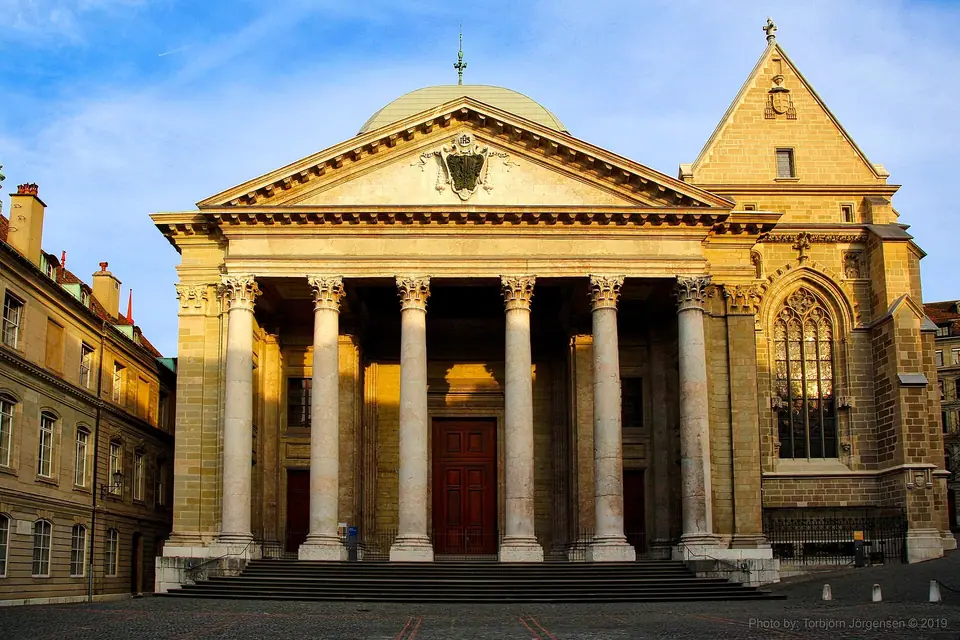
Vieille Ville, St. Pierre Cathedral & Place du Bourg-de-Four
Explore Geneva's hilltop Old Town, from the Roman and medieval layers beneath St. Pierre Cathedral to Maison Tavel and the Hôtel de Ville.
Rising on a moraine hill above the left bank of Lake Geneva and the Rhône, the Vieille Ville (Old Town) has anchored Geneva since an Allobrogian oppidum guarded river navigation here in the 1st-century BC era. Protected by fortifications until their demolition between 1850 and 1880, the upper town preserves cobbled lanes, vaulted stairways such as the Degrés de Poules, and limestone mansions that trace Geneva's transformation from prince-bishopric to Calvinist republic. Pair this walk with our Parc des Bastions and Reformation Wall guide below the southern ramparts.
Because motor traffic is tightly restricted across the hilltop core, the upper streets retain a quiet, resonant atmosphere where footsteps echo against grey molasse sandstone walls and trickling stone fountains. Narrow passages climb from the busy tram lines of the Rues Basses straight into shaded cathedral courtyards, making it easy to combine an upper-town walk with our 3-day Geneva itinerary.
Cathédrale Saint-Pierre and Its Archaeological Crypt
At the crest of the hill stands St. Pierre Cathedral (Cathédrale Saint-Pierre), the principal church of the Protestant Church of Geneva since 1535. Excavations beneath the square reveal a 1st-century BC tomb of an ancient Allobrogian chieftain, Roman sanctuary walls, and twin episcopal basilicas begun between 350 and 375 AD, when the northern cathedral measured 32 by 15 metres alongside baptisteries and fourth-century floor mosaics. Rebuilt by Burgundian King Sigismund after a fire in the year 500, the present Romanesque-Gothic cathedral was begun around 1160 under Prince-Bishop Arducius de Faucigny and completed in the 15th century, with a neoclassical portico added in the 18th century.
Walking through the underground archaeological circuit beneath the cathedral square allows you to follow subterranean walkways suspended directly over the ancient stone footings, wells, and mosaic fragments. Interpretive displays clarify how successive bishops expanded the liturgical complex over earlier Roman civic layers before the medieval mason workshops raised the limestone piers and ribbed vaults overhead.
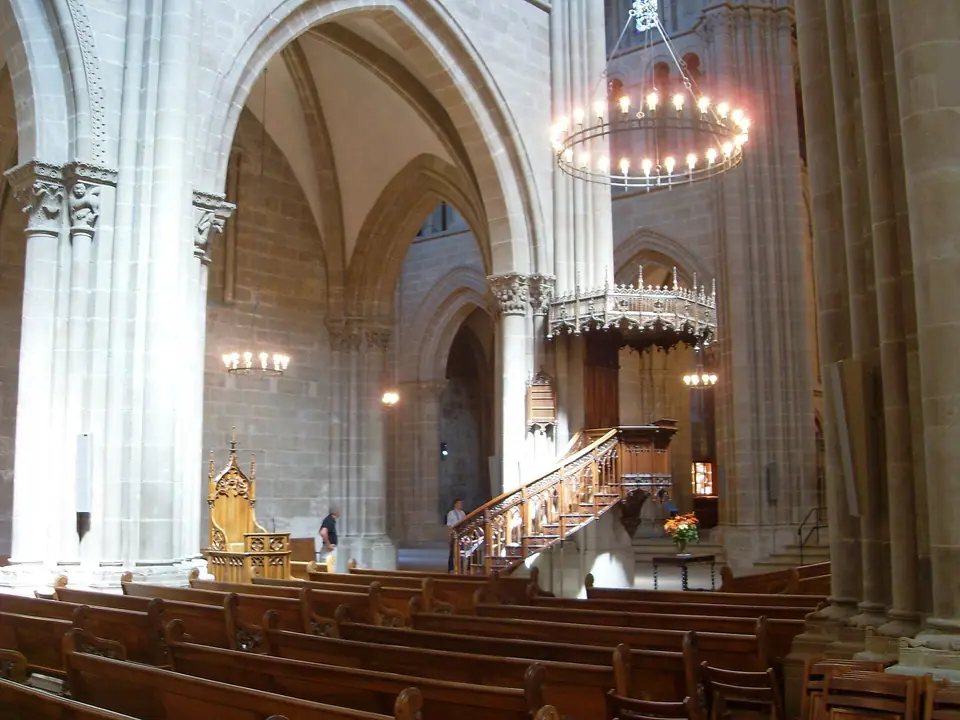
Inside the Reformed Nave, Maccabees Chapel, and Cathedral Towers
During the Reformation in 1535, citizens stripped the cruciform interior of its rood screen and side altars while sparing the medieval stained glass, leaving the austere limestone nave where John Calvin preached and where his successor Theodore Beza was buried in 1605. Carved Romanesque and Gothic capitals along the arcade columns still display intricate foliage, biblical figures, and allegorical beasts chiselled into the stone before the sixteenth-century liturgical changes.
Contrast the plain nave with the polychrome Gothic Revival Chapel of the Maccabees redecorated in the 1890s, where stencilled vaulting and richly painted woodwork restore the warmth of late medieval ecclesiastical decoration, and see the 1965 Metzler grand organ in the west gallery, designed by Poul-Gerhard Andersen with four manuals and 67 stops (95 ranks). Climb the north and south towers via the spiral stone staircases for sweeping views across the Rade, the Jet d'Eau, the Jura ridge, and Mont Blanc. Directly opposite the cathedral stands the Gothic Auditoire de Calvin, the lecture hall where John Calvin and John Knox taught Reformed theology to scholars from across Europe.
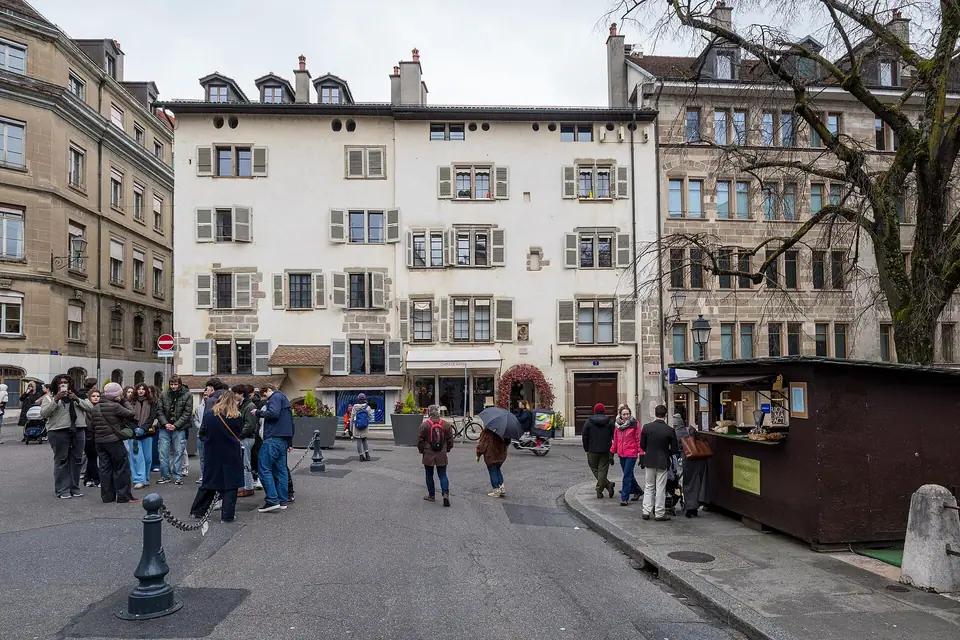
Place du Bourg-de-Four and the Refugee Rooflines
Descending east from the cathedral via the Degrés de Poules staircase brings you into Place du Bourg-de-Four, an hourglass-shaped square built over the Roman forum and medieval fairground. Bordered to the north by the former Hôpital Général (converted into the Palais de Justice after 1857) and the steepleless 1766 Lutheran church, the square was raised by 17th-century storeys added for French Protestant refugees. Around the 18th-century marble fountain stand Librairie Jullien (founded at Bourg-de-Four in 1839) and Heinz Schwartz's 1975 bronze sculpture Clémentine.
Look upward at the surrounding townhouse facades and you can still spot the architectural imprint of that refugee influx: upper floors with slightly smaller windows and timbered eaves added above older stone storeys so extra families could be housed inside the defensive perimeter. Today the square's terraced cafés and bookshops make it a welcoming spot on the hill to pause for a morning coffee or an early evening glass of local wine.
Walking the perimeter of the hilltop quarter also reveals how the old defensive ring still governs the city's elevation changes. To the north, steep cobbled passages and covered stone steps drop straight down to the commercial arcades of Rue du Marché and Rue de la Confédération; to the west and south, high retaining walls along the Promenade de la Treille and Rue de la Croix-Rouge look down over the tree canopy of Parc des Bastions; and to the east, the bourgeois townhouses of Les Tranchées stand where nineteenth-century urban planners replaced the outer ditches with elegant residential squares and museum avenues.
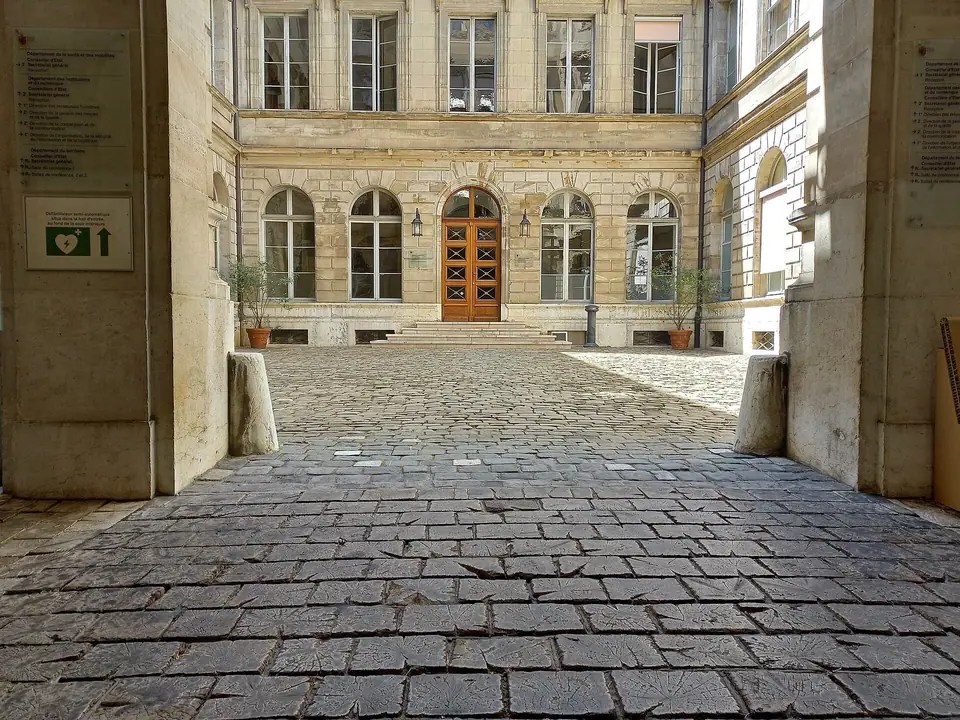
Maison Tavel and the Relief Magnin Scale Model
A few steps west of the cathedral at Rue du Puits-Saint-Pierre 6 stands Maison Tavel, Geneva's oldest surviving private residence, rebuilt with corner turrets and carved stone heads by the noble Tavel family after the great fire of 1334 ravaged half the city. Listed as a historic monument in 1923 and opened as the Museum of Urban History and Daily Life in 1986, its rooms display wrought-ironwork, carved doors, domestic furniture, wallpaper, and coins across several floors; see our Geneva museums guide.
Up under the timber roof beams of the attic sits the highlight of a visit: the Relief Magnin, a monumental copper-and-zinc scale model created by architect Auguste Magnin that reconstructs Geneva as it stood before the demolition of its bastions in 1850, complete with tiny churches, ditches, drawbridges, and lake ports. Studying the model before walking the surrounding lanes makes it easy to trace where the ancient city gates and water towers once stood.
Hôtel de Ville, the Ramp Tower, and Promenade de la Treille
- Hôtel de Ville and Tour Baudet: Seat of the cantonal government since 1405, where the archive tower known as the Tour Baudet was erected in 1455 to 1456 and where the 1864 Geneva Convention was signed in the ground-floor Alabama Room.
- The 16th-century paved ramp: Step into the arcaded Renaissance courtyard to see the paved ramp tower (1553 to 1584) built by master mason Nicolas Bogueret so councillors could reach the upper chambers on horseback or in litters without climbing steps, right beside the Old Arsenal portico displaying historic cannon.
- Promenade de la Treille and Grand-Rue: Stroll along Grand-Rue (birthplace of philosopher Jean-Jacques Rousseau) to the chestnut-shaded terrace of Promenade de la Treille overlooking Parc des Bastions, then continue toward traditional Old Town bistros for lunch.
Traveller tips
Real advice from people who have been to Vieille Ville, St. Pierre Cathedral & Place du Bourg-de-Four. Every tip is read by our team before it goes live.
No tips yet. Been here? Yours could be the first.
Thank you! Your tip will appear here after a quick review.
More in Geneva
Continue exploring Geneva with related neighbourhood, food, and planning guides
Where to Stay in Geneva: Best Areas on the Right Bank, Left Bank & Carouge
Geneva, Switzerland
Best Time to Visit Geneva: Lake Geneva Weather, Bise Wind & L'Escalade
Geneva, Switzerland
Geneva 3-Day Itinerary: Old Town, Harbour, UN Quarter, CERN & Day Trips
Geneva, Switzerland
Geneva: Essential Planning for Lake Geneva's Diplomatic Hub
Geneva, Switzerland
