


























Götaplatsen, Gothenburg Museum of Art, Röhsska Museum and Avenyn
Gothenburg's grand boulevard of Kungsportsavenyn, rising from the moat to the 1923 ceremonial square of Götaplatsen, the Gothenburg Museum of Art, and the Röhsska Museum of design.
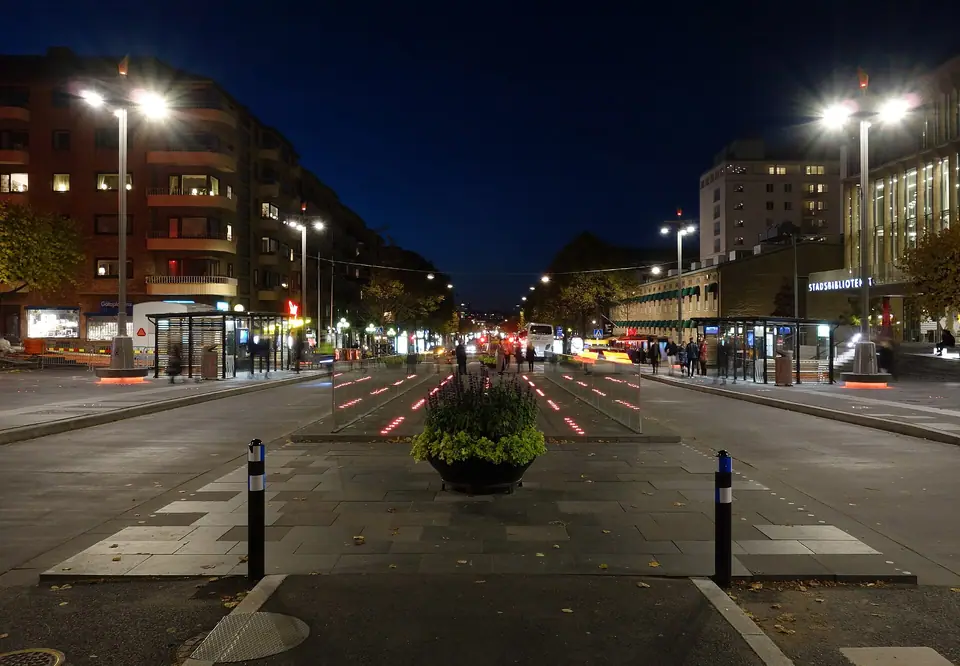
Laid out in the 1860s and 1870s outside the dismantled southern fortifications, Kungsportsavenyn (universally called Avenyn) is Gothenburg's ceremonial boulevard. Stretching roughly one kilometre south-southeast from Kungsportsplatsen bridge over the Vallgraven moat to Götaplatsen, the tree-lined avenue owes its unusually wide pavements to 10-metre deep front gardens that originally separated the 19th-century residential facades from the carriageway before being paved over for outdoor café terraces and pedestrians. About halfway along the boulevard stands Stora Teatern, the white neo-Renaissance musical and theatre house opened in 1859.
Walking uphill from the canal bridge at Kungsportsbron, you pass from the green parkland of Trädgårdsföreningen and Bältespännarparken into a symmetrical nineteenth-century streetscape inspired by Parisian and Viennese ring boulevards. Wealthy merchant families initially built stuccoed townhouses behind iron railings along the avenue; during the twentieth century, ground floors were converted into restaurants, bookshops, and galleries while the upper rising slope toward Lorensberg was reserved for a grand civic acropolis.
Götaplatsen and the 1923 Tercentennial Ensemble
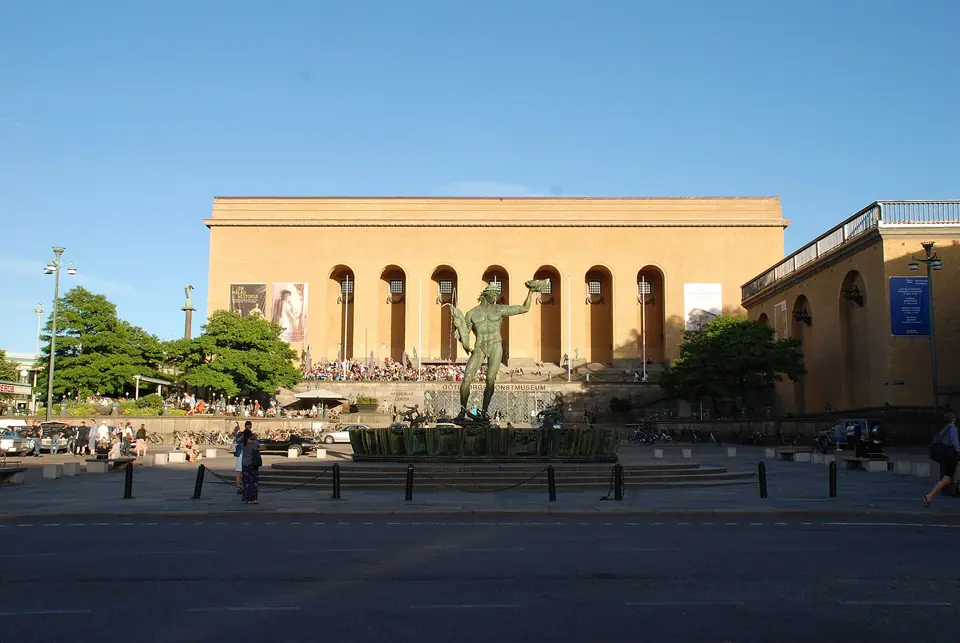
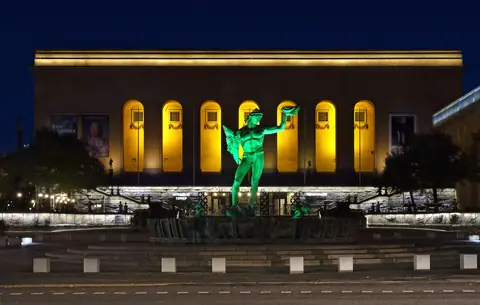
At its southern crest, Avenyn terminates at Götaplatsen, the monumental civic square created for the 1923 Gothenburg Tercentennial Jubilee Exposition (which celebrated the 300th anniversary of the city's 1621 founding two years late due to post-First World War construction delays). In the centre of the square rises sculptor Carl Milles' bronze Poseidon fountain, inaugurated in 1931 and quickly adopted as Gothenburg's civic emblem. Framing the square are the 1934 Gothenburg City Theatre (Göteborgs Stadsteater), the 1935 Gothenburg Concert Hall (Konserthuset, home of the Gothenburg Symphony Orchestra and famous for its wood-panelled auditorium acoustics), and the Gothenburg City Library.
Architectural Harmony of the Civic Square
What gives Götaplatsen its cohesive presence is how three generations of Swedish architects balanced Neo-Classical monumentality with Nordic Functionalism. While the elevated brick arches of the art museum establish a classical backdrop on the ridge, Carl Bergsten's 1934 City Theatre and Nils Einar Eriksson's 1935 Concert Hall introduce clean geometric lines, pale stonework, and warm interior maple panelling on the flanking terraces, leaving the central basin around Milles' sea god open to the sky down the length of Kungsportsavenyn.
On sunny afternoons, university students, concertgoers, and museum visitors gather along the broad granite steps rising behind the Poseidon fountain basin. From the upper landing outside the museum entrance, the entire axial vista of Kungsportsavenyn unfolds northward across the tree canopies toward the inner moat and harbour, making the terrace a natural orientation point before stepping indoors.
Gothenburg Museum of Art and the Fürstenberg Gallery
Commanding the top of the stepped terrace at the back of Götaplatsen is the Gothenburg Museum of Art (Göteborgs konstmuseum), designed by architects Sigfrid Ericson and Arvid Bjerke in Neo-Classical Nordic style using custom yellow "Gothenburg brick" with seven tall vaulted arches. Built for the 1923 exposition, officially inaugurated in 1925, and expanded with a modern rear wing by Rune Falk in 1966 to 1968, the museum houses more than 70,000 works spanning the 15th century to the present, alongside the Hasselblad Center for photography.
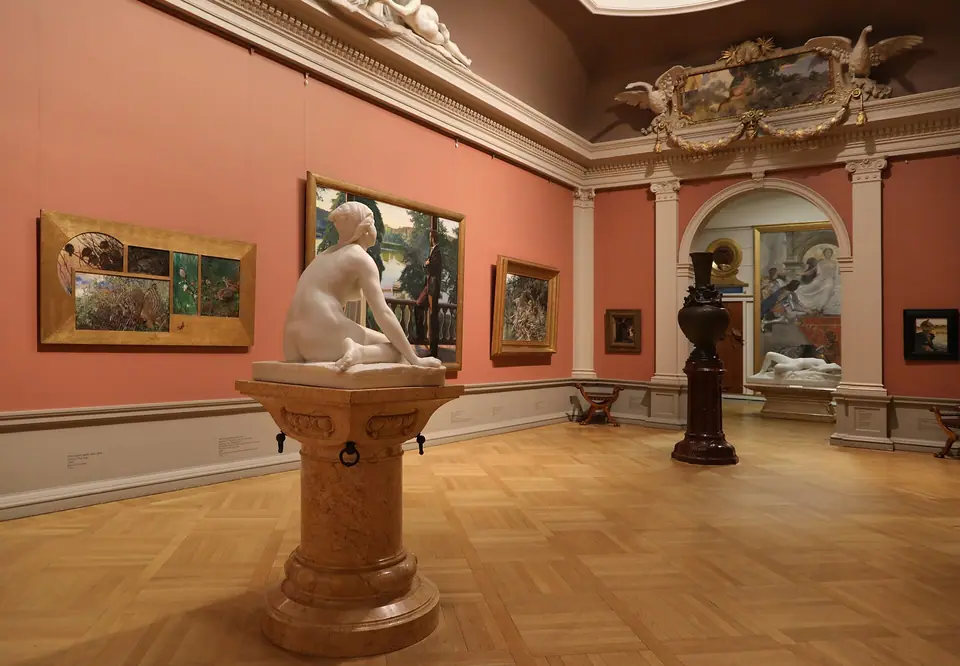
Climbing the monumental interior staircase toward the upper floors mirrors the progression from Renaissance and Baroque cabinet paintings into the luminous northern light of late-nineteenth-century Scandinavia. High barrel vaults and top-lit rooms allow large narrative canvases from Skagen, the Swedish west coast, and the Norwegian fjords to breathe without harsh artificial glare.
Nordic Masterpieces and European Collections
- The Fürstenberg Gallery: Bequeathed by Gothenburg art patrons Pontus and Göthilda Fürstenberg, these top-floor galleries hold one of the world's finest collections of late-19th- and early-20th-century Nordic art, featuring Peder Severin Krøyer's Hip, Hip, Hurrah, Carl Larsson, Bruno Liljefors, Edvard Munch, and Anders Zorn.
- Sculpture Hall and Gothenburg Colourists: Behind the seven monumental brick arches of the facade lies the vaulted Sculpture Hall displaying works by Carl Milles, Johan Tobias Sergel, and Christian Eriksson, while dedicated twentieth-century rooms highlight the expressive brushwork and saturated hues of the west-coast Gothenburg Colourists (Göteborgskoloristerna) including Ivan Ivarson, Ragnar Sandberg, Inge Schiöler, and Åke Göransson.
- European Old Masters and Modernism: Lower galleries display works by Rembrandt, Rubens, Monet, Picasso, van Gogh, and Chagall, alongside international photography exhibitions in the Hasselblad Center on the ground level.
Röhsska Museum of Design and Craft
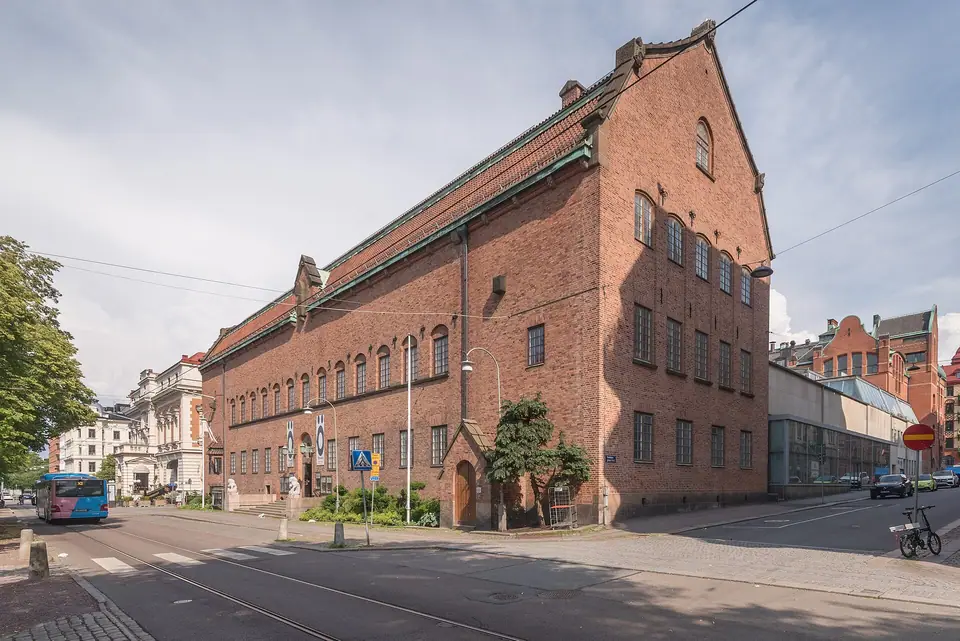
Two blocks northwest of Götaplatsen at Vasagatan 37 to 39 stands the Röhsska Museum (Röhsska museet), Sweden's specialized museum of design, fashion, and applied arts. Founded in 1904 through donations from brothers Wilhelm and August Röhss and opened to the public in 1916 inside a National Romantic red-brick building designed by architect Carl Westman, it holds more than 50,000 objects ranging from Swedish glass, ceramics, and mid-century Nordic furniture to East Asian decorative arts and couture.
Inside Westman's handcrafted brick interior, permanent design timelines trace how Scandinavian functionalism, textile printing, and industrial product design evolved from nineteenth-century guild crafts into modern household objects. Temporary exhibitions examine contemporary Nordic fashion, graphic arts, and sustainable material design, while the quiet courtyard café along Vasagatan provides a sheltered break between galleries.
Strolling the full length of Kungsportsavenyn from the canal bridge at Kungsportsplatsen up to Götaplatsen also lets you experience Gothenburg's outdoor café life across the day. Morning brings quiet bakery tables and bookshop browsers near Bältespännarparken and Stora Teatern; afternoon shifts the focus uphill to the art and design galleries; and evening fills the theatre foyers and concert hall steps around the illuminated Poseidon fountain.
Connecting Avenyn with Lorensberg, Haga, and Korsvägen
Quiet side streets in Lorensberg immediately behind Götaplatsen, including Teatergatan, Geijersgatan, and Viktor Rydbergsgatan, shelter independent bistros, wine bars, and espresso counters away from the main boulevard traffic. Behind the museum terrace, wooded paths also climb through Näckrosdammen (the Water Lily Pond park beside the University of Gothenburg humanities campus), offering a peaceful green shortcut between Götaplatsen and Korsvägen. Combine Götaplatsen with an afternoon walk east to Korsvägen, north to Kungstorget for lunch at Stora Saluhallen, or west along oak-shaded Vasagatan to Haga; check the official site for current exhibition tickets and follow Day 2 of our three-day Gothenburg itinerary.
Whether you come to Götaplatsen for a morning of nineteenth-century Nordic painting, an afternoon of Swedish furniture and glass design at the Röhsska Museum, or an evening symphony performance inside the maple-clad auditorium of Konserthuset, the boulevard and its crowning terrace remain the cultural anchor of a stay in Gothenburg.
Traveller tips
Real advice from people who have been to Götaplatsen, Gothenburg Museum of Art, Röhsska Museum and Avenyn. Every tip is read by our team before it goes live.
No tips yet. Been here? Yours could be the first.
Thank you! Your tip will appear here after a quick review.
More in Gothenburg
Continue exploring Gothenburg with related neighbourhood, food, and planning guides
Things to Do in Gothenburg: Museums, Canals, Liseberg and Islands
Gothenburg, Sweden
Haga Wooden Quarter and Skansen Kronan Redoubt in Gothenburg
Gothenburg, Sweden
Liseberg Amusement Park, Universeum and World of Volvo in Gothenburg
Gothenburg, Sweden
Southern Gothenburg Archipelago: Car-Free Styrsö, Vrångö and Brännö
Gothenburg, Sweden
