




















Daereungwon Royal Tombs, Cheomseongdae & Hwangnidan-gil Walking Guide
Complete 2026 walking guide to Gyeongju's central Tumuli Belt: stepping inside Cheonmachong Tomb, Hwangnamdaechong, Cheomseongdae Observatory, and Hwangnidan-gil.
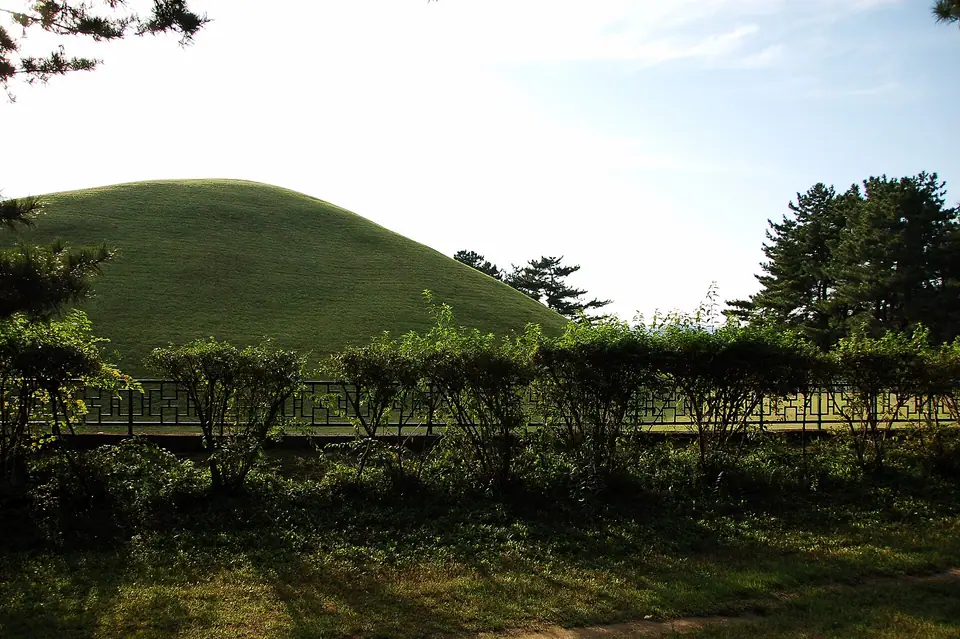
Nowhere on earth integrates ancient royal necropolises into everyday city life quite like central Gyeongju. Within the 126,500-square-metre walled park of the Daereungwon Tomb Complex (대릉원) and the adjacent open meadows of Noseo-dong and Nodong-dong. More than thirty grass-covered earthen burial mounds (neung and chong) rise up to 23 metres above the surrounding tiled rooftops. These royal mounds were built between the 4th and 6th centuries CE during the Maripgan and early Buddhist periods of Silla. These monumental tumuli hid solid gold crowns, Roman glassware, and painted birch-bark treasures untouched for 1,500 years. Below is a self-guided walking route connecting Daereungwon, the 7th-century astronomical tower of Cheomseongdae, and the lively hanok alleys of Hwangnidan-gil. Pair this walk with our Gyeongju National Museum guide and Donggung & Wolji night guide.
| Stop on the Walk | Historical Date | 2026 Entry & Hours | Don't-Miss Highlight |
|---|---|---|---|
| 1. Daereungwon Park & Michu's Tomb.. | 3rd to 6th century CE. | 3,000 KRW (09:00 to 22:00, last entry 21:30). | Magnolia photo spot between the twin mounds of Tomb No. 134. |
| 2. Cheonmachong (Tomb No, 155).. | Late 5th century CE. | Included in 3,000 KRW Daereungwon ticket (09:00 to 21:30). | Only Silla royal tomb open inside; Heavenly Horse saddle flap & gold crown replica. |
| 3. Hwangnamdaechong (Tomb No, 98).. | Mid-5th century CE. | Included in Daereungwon ticket. | Largest double-gourd royal burial mound in Korea (120 m × 80 m, 23 m tall). |
| 4. Cheomseongdae Observatory.. | Reign of Queen Seondeok (632 to 647 CE). | Free 24 hours (illuminated until 22:00). | Oldest surviving astronomical observatory in East Asia (362 granite stones). |
Why Silla Royal Tombs Were Never Looted: The Stone-Piled Wooden Chamber
Before you step through the gates of Daereungwon, understanding how Silla engineers built these mounds explains why Gyeongju yielded far more intact gold crowns than the robbed tombs of Goguryeo or Baekje. Between the 4th and early 6th centuries, Silla builders constructed a unique tomb architecture called a Dolmuji-deotneol-mudeom (Stone-Piled Wooden Chamber Tomb):
- First, workers placed a heavy timber burial chamber containing the king's wooden coffin and a wooden treasure chest at ground level or in a shallow pit.
- Second, they piled thousands of rounded river boulders several metres thick over the entire wooden house.
- Third, they sealed the boulder pile beneath layers of sticky clay and a mountain of compacted earth covered in turf.
Over the centuries, when the inner wooden beams rotted and collapsed, the thousands of loose river boulders above crashed down to seal the chamber like an impenetrable stone avalanche. Any grave robber who tried to tunnel into the mound triggered a rockslide, leaving the gold crowns, belts, and earrings completely untouched until modern archaeological excavations began in the 1920s and 1970s.
Stepping Inside Cheonmachong (Tomb of the Heavenly Horse)
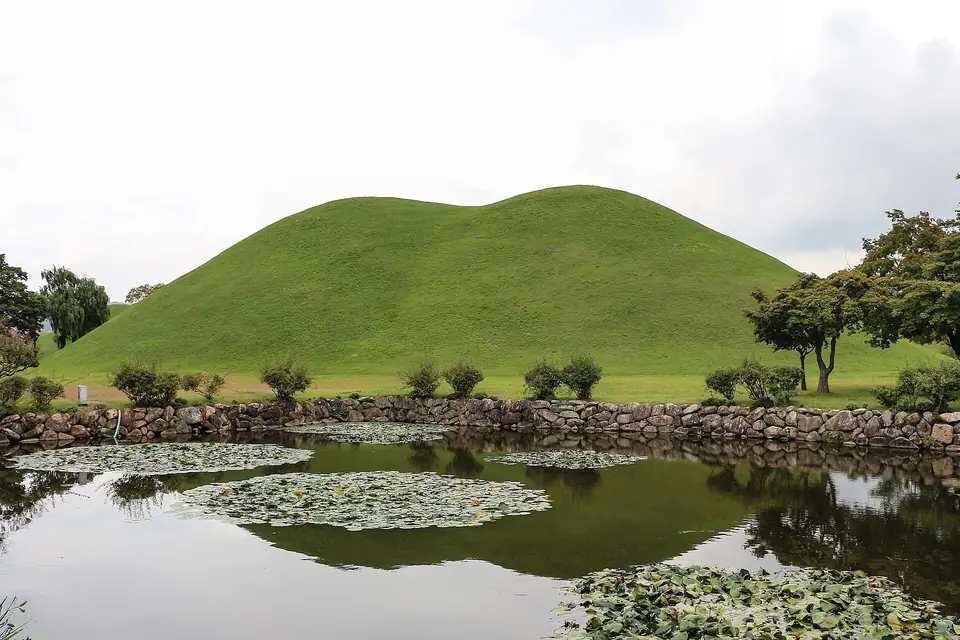
Of the 23 tombs inside Daereungwon, Cheonmachong (Tomb No. 155) measures 47 metres across and 12.7 metres high. It is the only Silla burial mound reinforced with an interior dome so visitors can walk inside. When archaeologists excavated the mound in 1973 as a trial run before tackling giant Hwangnamdaechong next door, they uncovered 11,526 royal relics dating to the late 5th or early 6th century. Because no stone epitaph naming the king was found, archaeologists named the tomb after its most extraordinary discovery. A birch-bark mudguard saddle flap (Jangni Cheonmado) painted with a white eight-legged winged horse soaring through honeysuckle clouds, the only surviving painting from the Silla Kingdom. Inside the renovated subterranean gallery, you can stand beside the cutaway boulder mound and examine precise museum-grade replicas of the Cheonmachong Gold Crown. The gold cap, the gilded bronze cauldron, and iridescent blue glass cups (the fragile originals are displayed ten minutes away at the Gyeongju National Museum).
Hwangnamdaechong and Tomb of King Michu
Just east of Cheonmachong rises the twin-peaked silhouette of Hwangnamdaechong (Tomb No, 98), the largest ancient burial mound in South Korea, spanning 120 metres from north to south, 80 metres from east to west, and 23 metres in height. Excavated between 1973 and 1975, its dual gourd-shaped mounds held a husband and wife buried consecutively in the 5th century, yielding over 58,000 artifacts. Intriguingly, the southern male tomb contained a gilt-bronze crown. In contrast, the northern female tomb held a magnificent solid gold crown and a gold belt inscribed "Belt for Madame" (Buin-dae), demonstrating the exalted ceremonial rank of Silla queens. Near the southern gate of the park, walk through the pine grove to the Tomb of King Michu (r, 262 to 284 CE), the first ruler from the royal Kim clan, and pause at the famous lone magnolia tree framed between two green tumuli near Tomb No. 134 (go at 09:00 opening to avoid the midday photo queue).
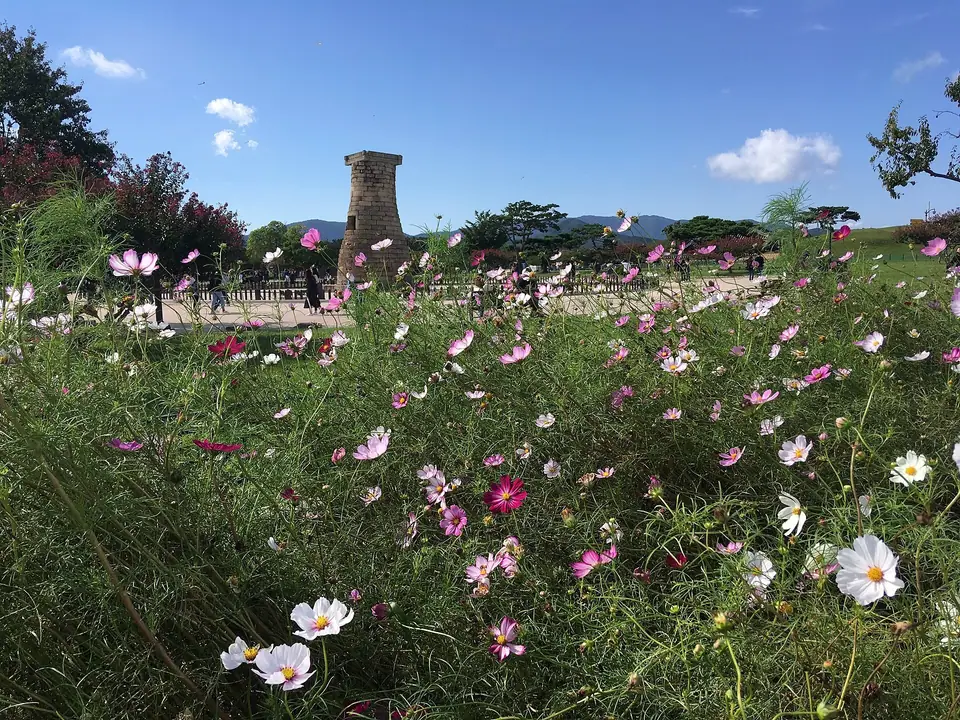
Cheomseongdae Observatory: Astronomy Encoded in Stone
Exiting the Rear (East) Gate of Daereungwon brings you directly into the open wildflower park surrounding Cheomseongdae (첨성대, National Treasure No, 31). Built during the reign of Queen Seondeok (reigned 632 to 647 CE), this 9.17-metre cylindrical granite tower is the oldest surviving astronomical observatory in East Asia. Every dimension of the tower is a mathematical calendar. It is constructed from 362 cut granite stones (matching the 362 days of the lunar year) arranged in 27 circular tiers (honouring Queen Seondeok as the 27th monarch of Silla). Including the square stone base and the two-tiered hashtag-shaped top frame (jeongja-seok), the structure comprises 29 or 30 levels (matching the days of a lunar month). Meanwhile, the 12 stone courses below and 12 courses above the central south-facing window represent the 12 months and 24 solar terms (jeolgi) of the agricultural year.
Hwangnidan-gil and the O릉 (Five Royal Tombs)
From the western stone wall of Daereungwon, cross directly onto Hwangnidan-gil (Poseok-ro). A 1-kilometre pedestrian-friendly street where low-slung 1960s houses and timber hanok buildings house specialty coffee bars. Craft beer taprooms, and street-food stalls selling hot 10-Won Cheese Bread (Sibwon-ppang) stamped with the design of Bulguksa's Dabotap pagoda (4,000 KRW as of November 2026). Climbing up to a second-floor rooftop café terrace along the eastern side of Hwangnidan-gil gives you a rare bird's-eye view straight over the black clay roof tiles onto the green mounds of Daereungwon. For a quieter tomb park away from the crowds, walk 15 minutes south of Hwangnidan-gil to Oreung (Five Royal Tombs, 2,000 KRW). This pine-shaded grove holds the mounds of Silla's founder, King Bak Hyeokgeose (57 BCE to 4 CE), and Queen Alyeong.
Where it is
- 1Daereungwon Royal Tombs, Cheomseongdae & Hwangnidan-gil Walking
- Daegu International Airport (TAE) · about 50 km from here in a straight line
- Directions in Google Maps
Traveller tips
Real advice from people who have been to Gyeongju. Every tip is read by our team before it goes live.
No tips yet. Been here? Yours could be the first.
Thank you! Your tip will appear here after a quick review.
More in Gyeongju
Continue exploring Gyeongju with related neighbourhood, food, and planning guides
Donggung Palace, Wolji Pond & Woljeonggyo Bridge Night Walking Guide
Gyeongju, South Korea
Bulguksa Temple & Seokguram Grotto Guide: Buses, Pagodas & Free Entry
Gyeongju, South Korea
Gyeongju National Museum Guide: Silla Gold Crowns, Emille Bell & Wolji Hall
Gyeongju, South Korea
Mount Namsan Hiking Guide: Samneung Trail, Rock Buddhas & Silla Pagodas
Gyeongju, South Korea
