


























Höhematte Park, Höheweg and Schloss Interlaken Guide
How an 1860 civic purchase preserved Interlaken's 35-acre Jungfrau view corridor between the Höheweg hotels and the former Augustinian monastery.
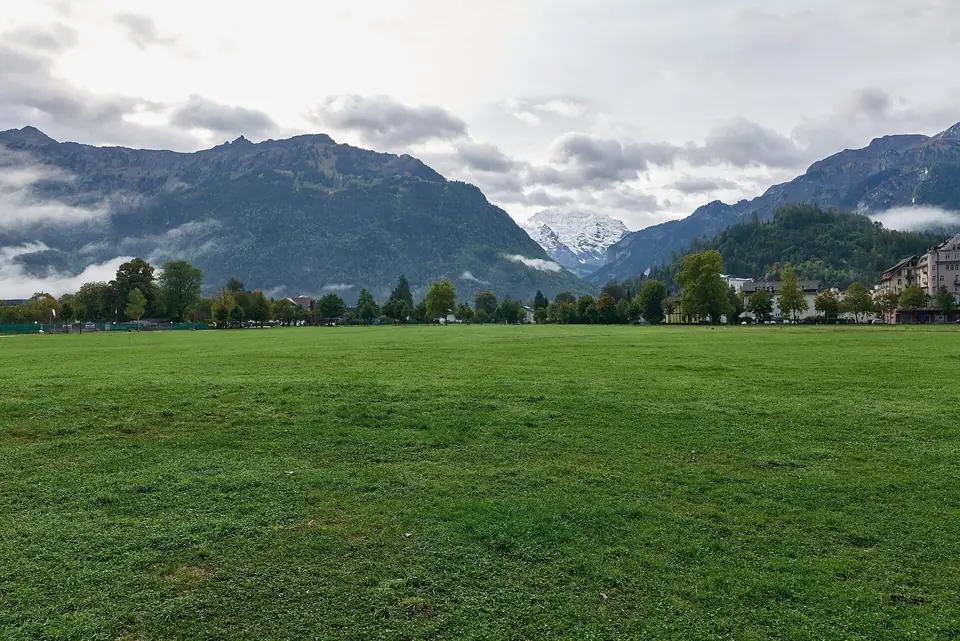
The civic heart of Interlaken is an open green rectangle that deliberately interrupts the built-up town centre. Stretching between the tree-lined Höheweg boulevard to the north and the mountain-facing promenade to the south, the Höhematte preserves the exact sightline through the steep V-shaped gap of the Lütschine valley to the white massif of the Jungfrau (4,158 metres). Along its eastern border stand the church, cloister, and administrative wings of Schloss Interlaken, where the town's medieval story began.
Unlike typical resort towns where commercial streets crowd out the natural landscape, this protected central park places an alpine meadow directly opposite grand nineteenth-century hotel terraces. Walking from west to east along the level paths allows visitors to trace the entire architectural evolution of the municipality, moving from Belle Époque hospitality and ornamental spa gardens to medieval monastic stonework and modern international friendship monuments.
How the 35-Acre Höhematte Meadow Was Saved in 1860
During the monastic era, the 35-acre field south of the walnut-shaded boulevard belonged to the Augustinian convent and later to the canton of Bern as agricultural pasture. When hotel construction accelerated along the Höheweg in the mid-19th century, speculative builders threatened to subdivide the field and block the mountain view. In 1860, a consortium of 37 private citizens, hoteliers, and local municipalities purchased the land and bound it under a perpetual servitude prohibiting construction. Today the grass remains an open park bordered by flowerbeds, the Kursaal congress centre and gardens (founded in 1859), and the landing circle for tandem paragliders descending from Beatenberg.
That farsighted civic agreement permanently defined the spatial character of the town. Because no building may rise across the southern pasture, morning and late-afternoon sunlight illuminates the snowfields of the Jungfrau directly from the sidewalk cafes and park benches along the northern boulevard. Throughout calm days, colourful paraglider canopies drift silently out of the surrounding mountain valleys and spiral down onto the central turf, giving spectators on the gravel paths a continuous aerial display against the glaciated peaks.
Strolling the Höheweg and the Japanese Garden
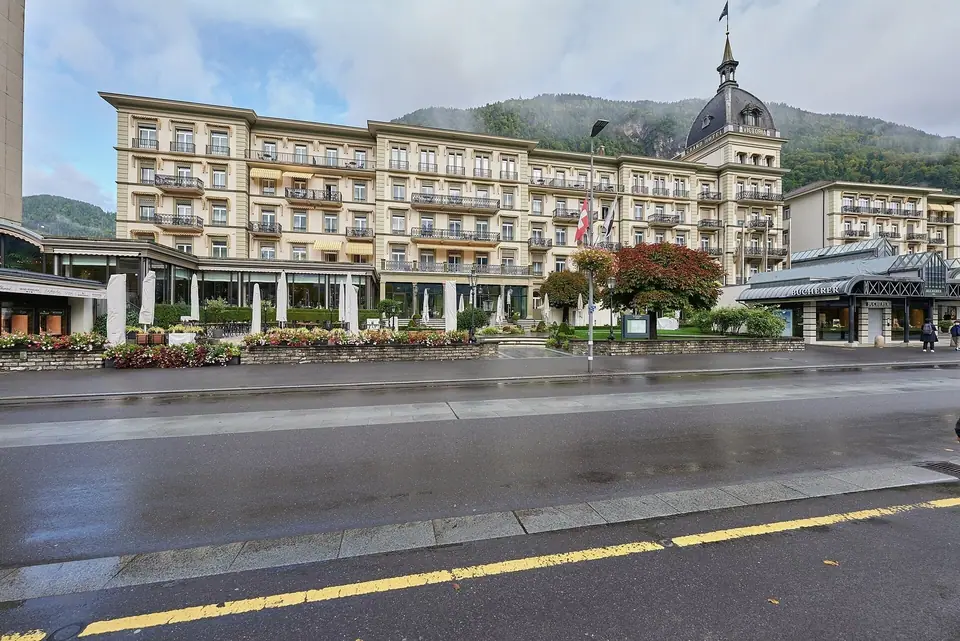
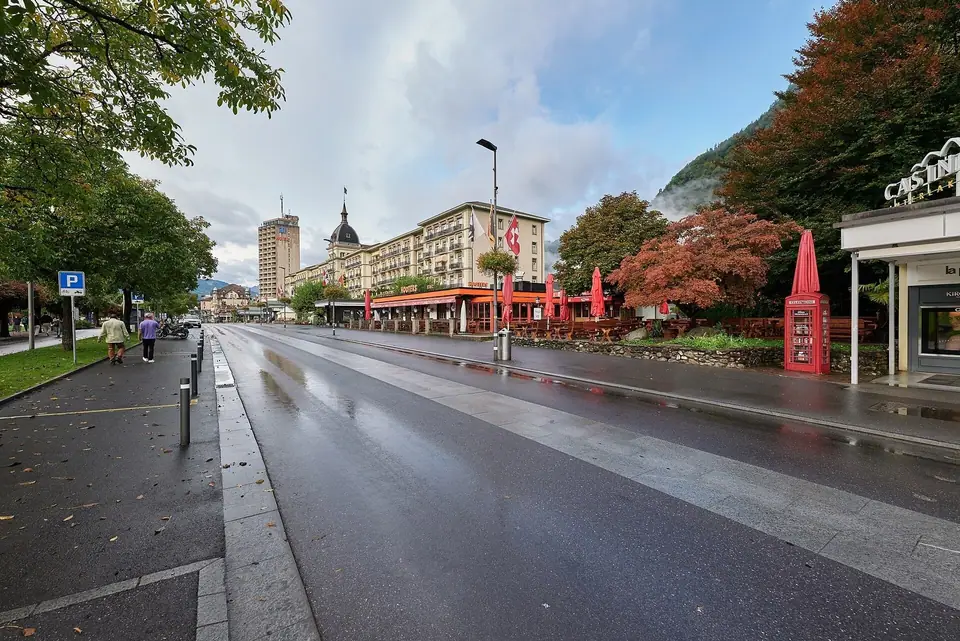
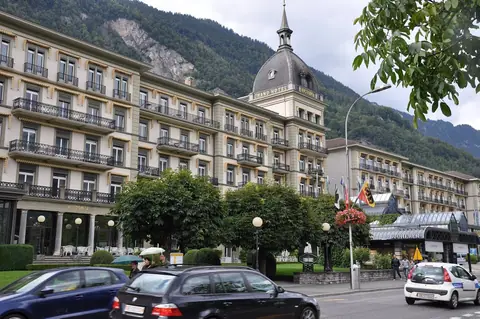
Running 1.6 kilometres from Interlaken West to Interlaken Ost, the Höheweg was laid out as a walnut-lined promenade connecting the former village of Aarmühle with the monastery precinct. Along its northern side stands the Victoria-Jungfrau Grand Hotel, formed by uniting the 1865 Hotel Victoria and 1864 Hotel Jungfrau beneath a central domed tower added in 1899. East of the hotel row, beside the Roman Catholic Church of the Holy Spirit (built 1904 to 1905), lies the Japanese Garden of Friendship, inaugurated in 1995 as a gift from Interlaken's Japanese sister city Otsu, complete with a carp pond, stone lanterns, and maple trees.
Adjacent to the hotel facades, the historic Kursaal park features manicured lawns, ornamental fountains, and a floral clock crafted from seasonal bedding plants that is replanted several times each year. Horse-drawn carriages still wait along the edge of the avenue as they did during the Victorian era, while the tranquil paths of the Japanese Garden provide a quiet enclave where water trickles over bamboo spouts and stepping stones cross a shaded pond just steps from the main promenade.
Schloss Interlaken and the 1133 Monastery Precinct
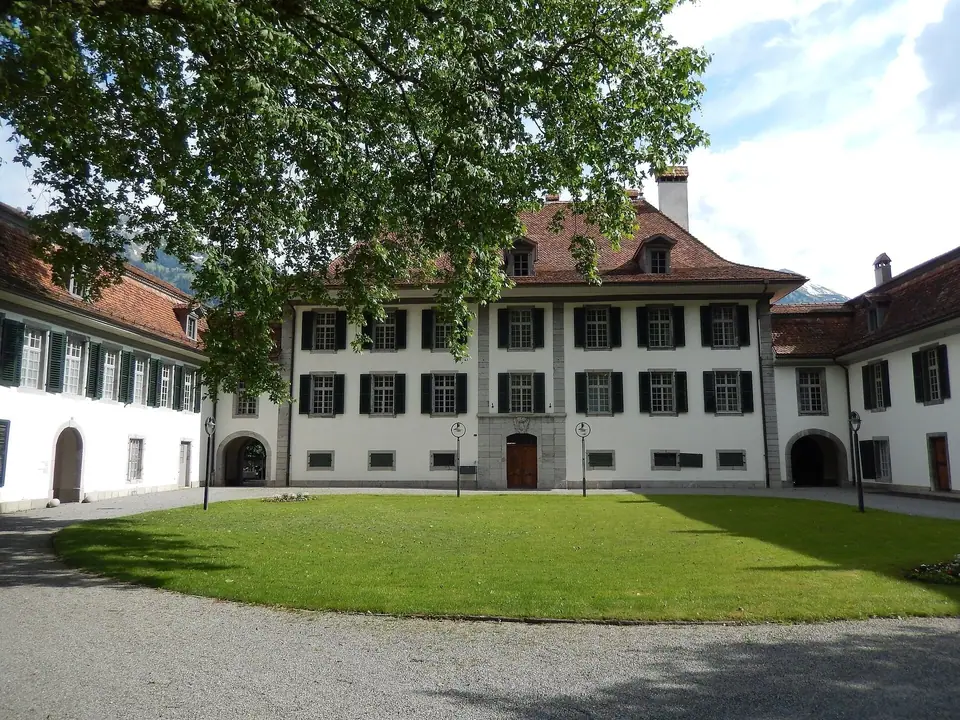
At the eastern edge of the Höhematte stands Schloss Interlaken, the complex that grew out of the Augustinian priory first documented under imperial protection by Emperor Lothair III on 8 November 1133. Following the Bernese Reformation in 1528, the monastery was secularised and administered by a Bernese bailiff (Landvogt). Samuel Tillmann built the west wing in 1684, while architect Emanuel Zehender erected the baroque New Castle (Neues Schloss) administration wing between 1746 and 1750. The surviving 14th-century convent church choir and gothic cloister bays now serve the Reformed parish and the district prefect's offices.
Stepping inside the quiet courtyard of the castle complex reveals layers of stone craftsmanship that predate the resort era by centuries. Pointed gothic arches and traceried windows in the surviving cloister walk recall the double monastery of canons and canonesses that once ruled the region, while the steep hipped roofs and plastered facades of the seventeenth- and eighteenth-century wings exemplify traditional Bernese patrician architecture. Just outside the cloister stands the historic tavern and guesthouse complex where early European travellers stayed while exploring the Oberland.
Connecting the Promenade to Surrounding Walks
Because the park and castle grounds are completely level and paved, you can easily link them with neighbouring sights across the valley floor. Combine this flat walk with Unterseen across the Aare, review our guide to staying along the Höheweg, or continue east to the river bridge for an afternoon ascent on the Harder Kulm funicular. Walking the full length of the corridor from the western station past the meadow and monastery to the eastern rail hub takes minimal effort and introduces every historical era of the town in sequence.
Photographers seeking the clearest mountain reflections and softest light on the Jungfrau massif should walk the southern footpath of the Höhematte early in the morning before wind ripples the ponds, or return near sunset when alpenglow turns the upper snowfields pink above the dark silhouettes of the foothills. Benches placed along all four sides of the grass rectangle allow you to linger and watch the changing light across the valley without ever leaving the town centre.
Because the entire promenade from Interlaken West to Interlaken Ost is flat, barrier-free, and lined with shaded benches, it serves as the natural social spine of the municipality in every season. In spring, snowmelt feeds the streams around the monastery gardens while magnolia and cherry blossoms open beside the Kursaal; in summer, open-air concerts and paraglider landings animate the central grass; in autumn, the ancient walnut and maple trees along the avenue turn deep gold against the early snows on the Jungfrau. Even in midwinter, when crisp frost covers the 35-acre meadow, the clear southern horizon makes the walkway between the grand hotels and the medieval castle cloister a rewarding stroll at any hour of the day. Stopping to read the historical plaques near the cloister courtyard and the Japanese Garden adds rich context to how a twelfth-century monastic foundation evolved into a globally celebrated mountain resort while protecting its central green space for future generations.
Traveller tips
Real advice from people who have been to Höhematte Park, Höheweg and Schloss Interlaken. Every tip is read by our team before it goes live.
No tips yet. Been here? Yours could be the first.
Thank you! Your tip will appear here after a quick review.
More in Interlaken
Continue exploring Interlaken with related neighbourhood, food, and planning guides
What to Eat in Interlaken: Fondue, Raclette, Rösti and Alpkäse
Interlaken, Switzerland
How to Get to Interlaken: Ost vs West Stations, Trains and Boats
Interlaken, Switzerland
Where to Stay in Interlaken: Höheweg, Unterseen and Ost Compared
Interlaken, Switzerland
Best Time to Visit Interlaken: Climate Normals and Seasonal Guide
Interlaken, Switzerland
