


























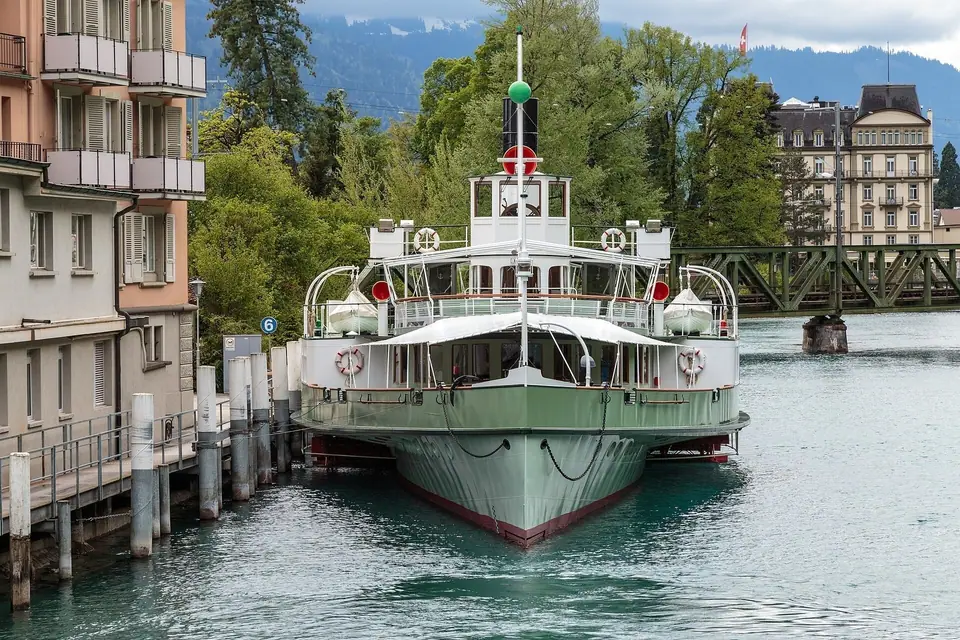
Lake Brienz (Brienzersee), Paddle Steamer Lötschberg and Giessbach Falls
Why glacial rock flour turns Lake Brienz turquoise, and how to combine a paddle steamer cruise with the 1879 Giessbach funicular and fourteen-stage waterfall.
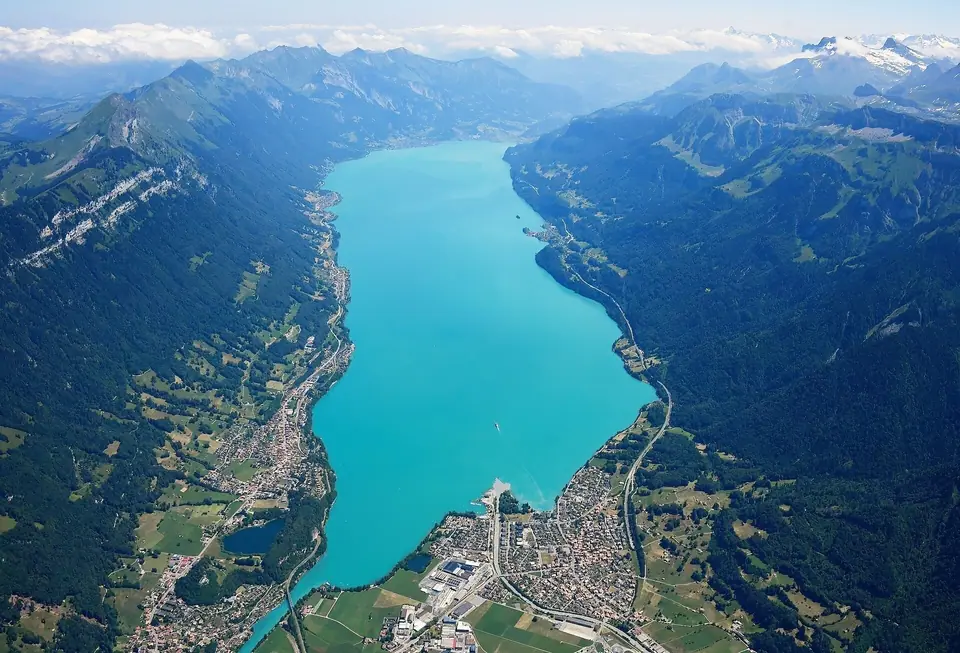
Stretching 14 kilometres east from Interlaken Ost to the woodcarving village of Brienz, Lake Brienz (Brienzersee) occupies a steep-sided glacial basin 2.8 kilometres wide, covering 29.8 square kilometres at an altitude of 564 metres. Reaching a maximum depth of 260 metres with virtually no shallow shelf along its wooded cliffs, it is fed by the upper Aare from the Grimsel region and the Lütschine from the Grindelwald and Lauterbrunnen valleys. Fine glacial silt (Gletscherschliff) suspended in the meltwater refracts sunlight into a vivid, milky turquoise colour that contrasts sharply with the darker blue of Lake Thun.
Because these mountain rivers carry cold, mineral-rich meltwater directly off high glaciers, Lake Brienz remains cool and nutrient-poor throughout the year. Steep limestone walls and dense beech and fir forests rise directly from the shoreline, giving every boat journey along the basin an enclosed, dramatic character that feels far removed from urban life.
Cruising from Interlaken Ost on the 1914 Steamer Lötschberg
Passenger ships operated by BLS Schifffahrt depart from the pier situated directly behind Interlaken Ost railway station on the Aare channel. After passing under the railway bridge and leaving the river mouth at Bönigen, boats call at Ringgenberg, Niederried, the peninsula village of Iseltwald (home to the 1907 turreted Seeburg castle on a rocky promontory), Giessbach See, Oberried, and Brienz (where the steam rack railway climbs to the Brienzer Rothorn). The flagship of the fleet is the two-deck side-wheel paddle steamer DS Lötschberg, built by Escher Wyss in Zürich in 1914 and measuring 56.5 metres in length; check the official BLS timetable for daily steamer and motor vessel sailings from spring to autumn.
On board the historic paddle steamer, polished brass fittings, wood-panelled saloons, and an open viewing gallery around the diagonal twin-cylinder steam engine allow passengers to watch the pistons drive the red paddle wheels through the turquoise water. Stepping onto the open upper deck as the ship rounds the wooded peninsula of Iseltwald offers classic views of timber chalets reflected in the sheltered bay.
The Fourteen Cascades of Giessbach Falls
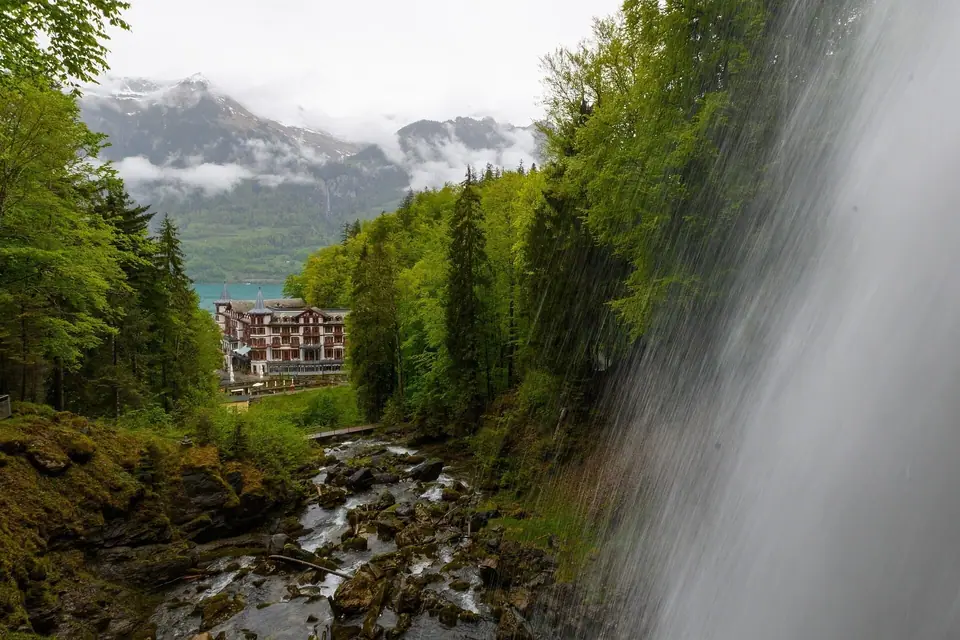
On the southern shore near the eastern end of the lake, the Giessbach stream tumbles some 500 vertical metres down the mountainside in fourteen distinct steps before plunging directly into Lake Brienz. In 1818, local schoolmaster Johannes Kehrli cut the first footpath to the falls and built a wooden bench for visitors. Today, well-maintained forest paths climb past several tiers of the waterfall, including a footbridge built directly behind one of the upper curtains of falling water so walkers can look out through the spray toward the lake.
Walking the shaded switchbacks along the rushing torrent lets you experience the full power of spring snowmelt and summer rain draining off the Faulhorn chain. Mossy boulders and tall silver firs frame each cataract, while the iron walkway behind the main upper drop provides a dramatic vantage point where the roar of the water echoes off the rock overhang.
Riding the 1879 Giessbachbahn to the Grandhotel Giessbach
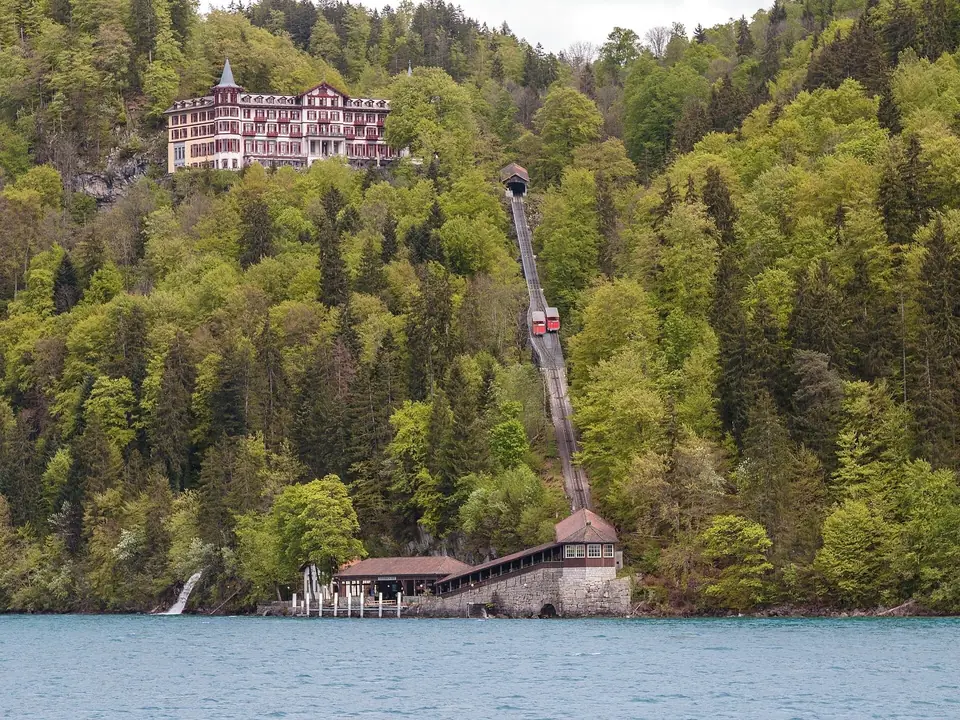
Right at the Giessbach See boat landing starts the Giessbachbahn (GbB), opened on 21 July 1879 by engineer Carl Roman Abt and builder Niklaus Riggenbach. Stretching 345 metres over a 98-metre vertical rise at gradients between 24 and 32 percent, it is Europe's oldest public funicular built with a single-track line and a central Abt passing loop (Abtsche Weiche), and sits on the Swiss inventory of historic cultural monuments. Originally operated by water ballast until 1912 and electrified in 1948, the red wooden carriages carry passengers in four minutes up a 190-metre iron trestle bridge to the Grandhotel Giessbach, a Belle-Époque palace designed by Horace Edouard Davinet between 1873 and 1875 and saved from demolition in 1983 by environmentalist Franz Weber's foundation.
From the broad terrace of the historic hotel, guests can look down across the iron trestle bridge and the green lawn to the steamer pier on the lake below, or sit inside the high-ceilinged nineteenth-century lounges after walking the forest trails around the cascades.
Combining the Steamer, Funicular and Lakeshore Path
Travellers can easily pair a cruise to Giessbach with a visit to Brienz or a lakeside walk back toward Iseltwald. A scenic shoreline trail connects the base of Giessbach Falls westward along the quiet southern bank of the lake to Iseltwald, allowing active walkers to ride the historic funicular, explore the waterfall bridges and hotel terrace, and follow the water's edge to catch an afternoon return boat to Interlaken Ost. You can also integrate this eastern lake excursion into our three-day Interlaken itinerary or compare it with high ridge views from Harder Kulm.
If you continue by ship all the way to the eastern terminus at Brienz, the boat landing sits directly beside the Zentralbahn railway station and the base of the historic steam rack railway, giving you the option to return along the northern shore by train in less than half an hour while watching the afternoon light shift across the turquoise water.
Stepping aboard a vessel on Lake Brienz offers a calm, contemplative contrast to the high mountain railways. Because the steep wooded slopes along the southern shore leave minimal room for main roads, approaching Giessbach See and Iseltwald across the water feels like entering a secluded alpine fjord. On sunny mornings, the glacial silt suspended in the lake catches the light and turns the wake behind the paddle wheels into ribbons of pale jade and turquoise, while waterfalls fed by high snowfields streak down the limestone cliffs on both sides of the ship. Whether you spend an hour riding the historic funicular up to the Grandhotel Giessbach to walk behind the thundering cascades, pause on the harbour quay at Iseltwald beneath its peninsula castle, or stay on deck for the full round-trip voyage to Brienz, the combination of Belle Époque steam navigation and untouched woodland shoreline makes this eastern lake basin an essential half-day journey from Interlaken Ost. Even on overcast afternoons when clouds veil the upper peaks, the vivid colour of the water and the forested cascades of Giessbach remain striking from both the ship deck and the iron trestle bridge, offering rewarding views in any weather.
Traveller tips
Real advice from people who have been to Lake Brienz (Brienzersee), Paddle Steamer Lötschberg and Giessbach Falls. Every tip is read by our team before it goes live.
No tips yet. Been here? Yours could be the first.
Thank you! Your tip will appear here after a quick review.
More in Interlaken
Continue exploring Interlaken with related neighbourhood, food, and planning guides
Jungfraujoch (3,454 m) and the Jungfrau Railway Guide from Interlaken
Interlaken, Switzerland
Lauterbrunnen Valley, Grindelwald and Eiger Day Trips from Interlaken
Interlaken, Switzerland

What to Eat in Interlaken: Fondue, Raclette, Rösti and Alpkäse
Interlaken, Switzerland
How to Get to Interlaken: Ost vs West Stations, Trains and Boats
Interlaken, Switzerland
