


























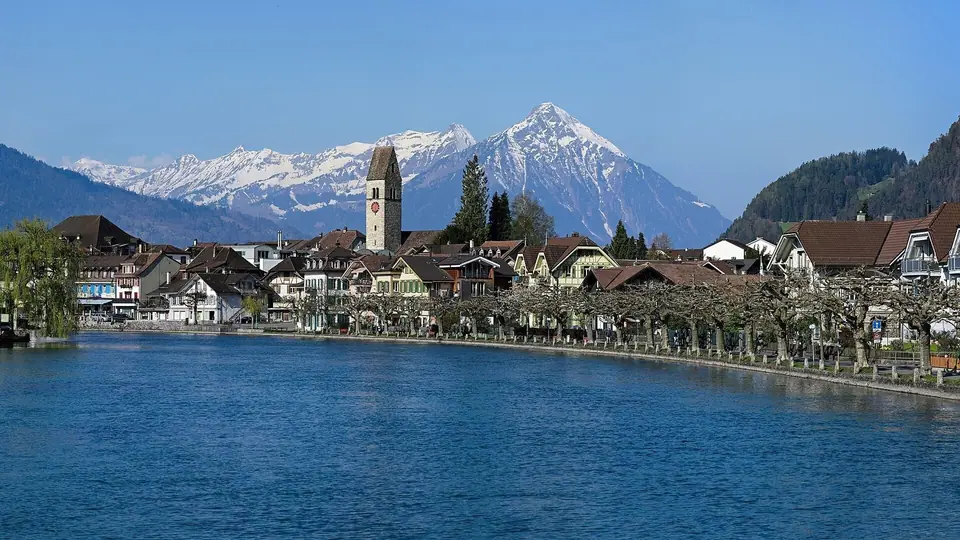
Unterseen Old Town, Aare River Bridges and Weissenau Castle
Discover the medieval town of Unterseen on the right bank of the Aare, its historic wooden and stone weirs, and the 13th-century ruins of Weissenau.
Directly across the River Aare from Interlaken West stands Unterseen, an independent municipality in the Interlaken-Oberhasli district that preserves the medieval street grid Interlaken itself never had. While Interlaken developed around an Augustinian monastery on the left bank of the river, Unterseen was founded as a fortified market town on 13 July 1279 when Habsburg King Rudolf granted Baron Berchtold III of Eschenbach-Oberhofen the right to build a stronghold between the two lakes.
Because nineteenth-century resort expansion concentrated south of the river along the Höheweg, Unterseen retained its compact historic footprint, timber-framed guild houses, and quiet parish square. Walking across the river bridges from the busy station area takes just a few minutes, yet the atmosphere shifts immediately from grand hotel boulevards to a working Bernese town backed by the steep pine forests of the Harder ridge.
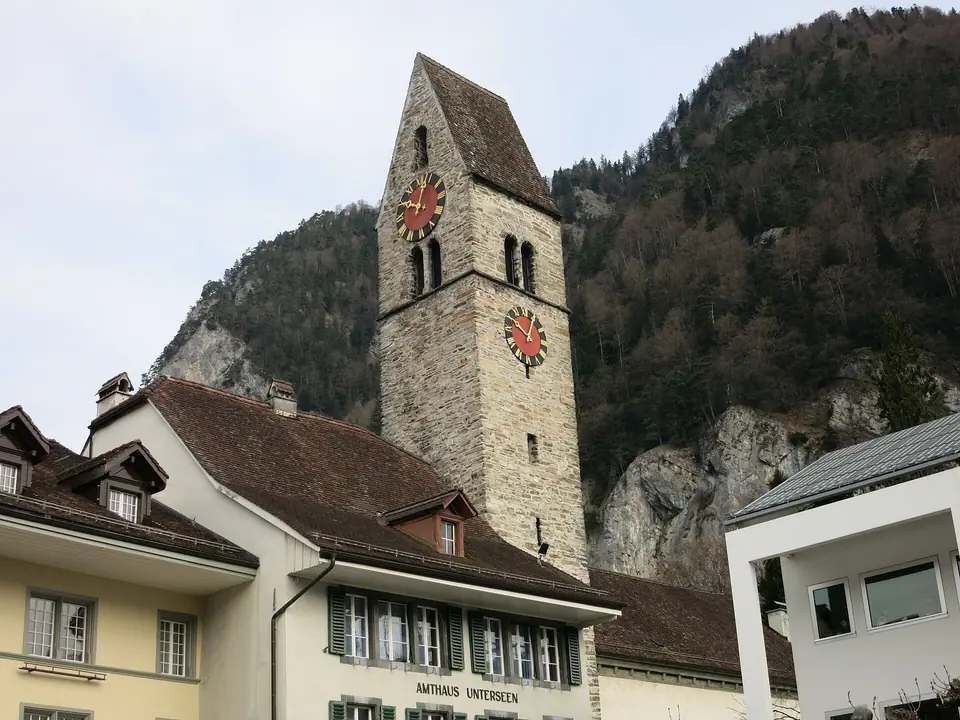
Stadthausplatz and the 1471 Late-Gothic Church Tower
Crossing the Aare bridges from Bahnhofstrasse brings you straight into Unterseen's Stadthausplatz (also called the Stedtli), a cobbled square framed by historic timber and stone houses. A town fire in 1470 destroyed much of the original settlement, prompting Bernese rebuilding that shaped the current square. At its edge rises the Reformed Church (Reformierte Kirche Unterseen), whose late-Gothic stone tower with a steep pitched roof dates from 1471, while the nave was remodelled after another fire in 1709. Next door stands the 17th-century Schloss Unterseen (built in 1656 by former bailiff Hieronymus Stettler) and the regional Touristik-Museum der Jungfrau-Region, housed in a three-storey 1687 building documenting 200 years of Alpine road, rail, and steamer history.
Inside the regional tourism museum, exhibits trace how early alpine travellers crossed mountain passes by mule and stagecoach before cogwheel railways and paddle steamers transformed the Bernese Oberland. Around the square outside, carved wooden eaves, painted shutters, and stone fountains reflect centuries of civic autonomy, making the square an inviting place to pause at a local bakery or traditional tavern away from the main tourist thoroughfare.
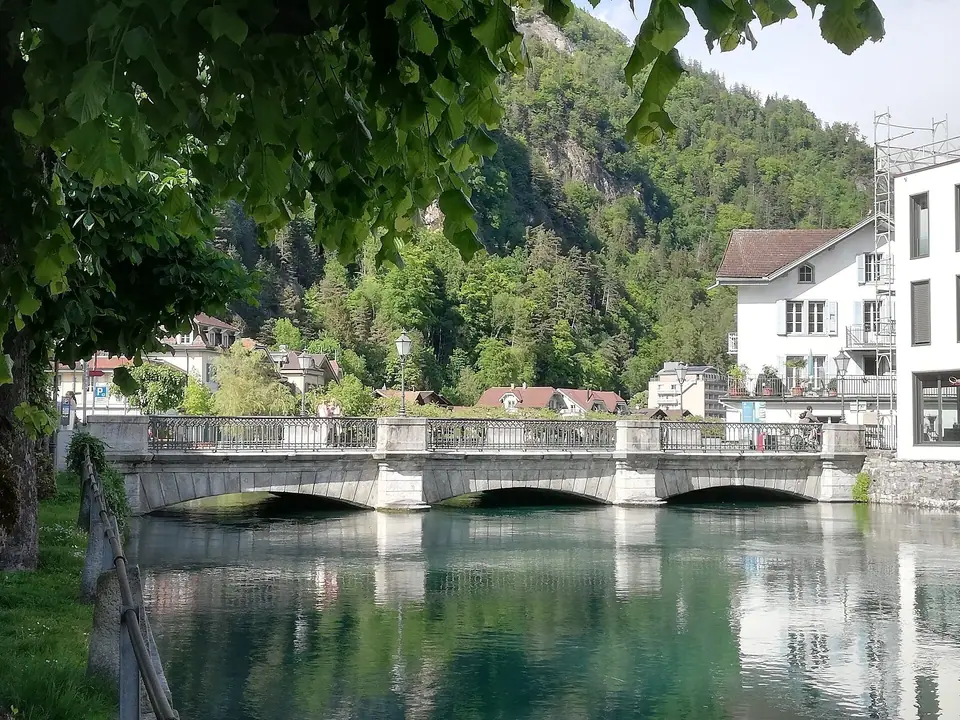
Bridges and Weirs Along the 5.5-Kilometre Aare
Between Lake Brienz (564 metres) and Lake Thun (558 metres), the Aare splits around the wooded island of Spielmatte between Interlaken and Unterseen. Since the Middle Ages, water levels were regulated by timber stone-crib weirs (Schwellen) built by the monastery to drive mills. In the 1850s, cantonal engineers replaced the old barriers with the stone Gurben and Mühlenen sluice weirs to prevent seasonal flooding on the Bödeli while maintaining enough draft for paddle steamers entering the Interlaken West shipping canal, dug in 1892.
Standing on the pedestrian bridges that cross Spielmatte island lets you watch the glacial meltwater foam through the adjustable sluice gates below. These nineteenth-century hydraulic works solved a centuries-old conflict between monastery millers, who wanted high water to turn their wheels, and lakeside farmers, whose pastures flooded whenever spring snowmelt backed up the river channel.
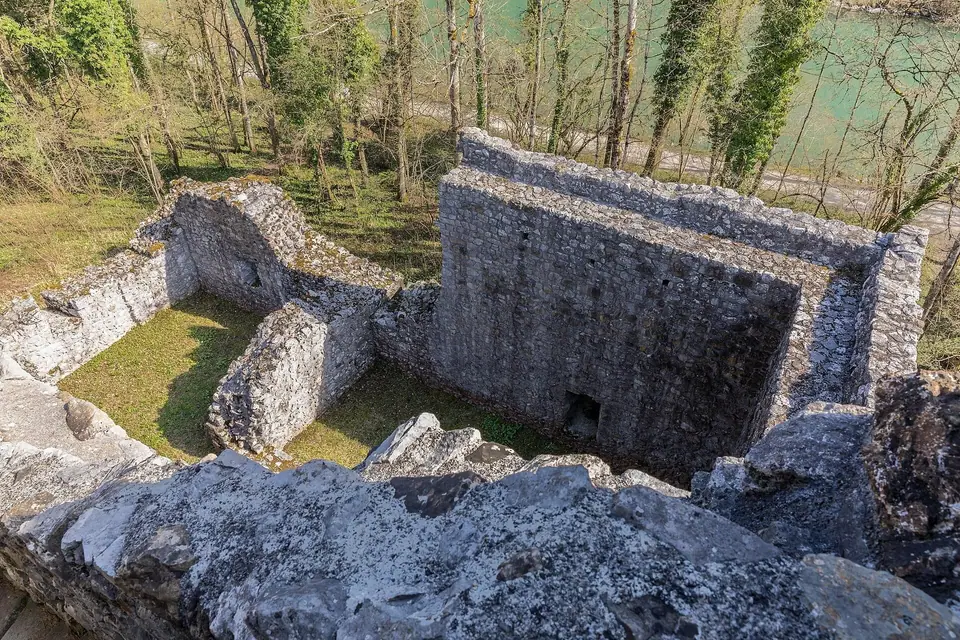
Walking to Weissenau Castle and the Nature Reserve
From Stadthausplatz, a flat 2.5-kilometre riverside path follows the right bank of the Aare westward to its mouth on Lake Thun. There, beside the old imperial shipping harbour of Widen, stand the stone keep and curtain wall of Weissenau Castle (Ruine Weissenau), recorded in 1298 as a royal fortress controlling lake traffic and acquired by Interlaken Priory in 1365. Climb the interior staircase of the surviving tower for views across the reed beds of the Weissenau Nature Reserve toward Lake Thun and the Niesen. Pair this walk with Schloss Interlaken or a steamer from nearby Neuhaus.
In the Middle Ages, goods arriving by barge across Lake Thun were unloaded at the market settlement of Widen beneath the castle walls before being carted across the alluvial plain. Although the market town declined after the monastery consolidated trade around its own river bridges, the thick rubble-stone walls and tall square keep of Weissenau remain one of the best-documented medieval fortifications on the Bödeli.
Riverside Trails and Birdlife on the Lake Thun Delta
The protected shoreline surrounding Weissenau Castle preserves a natural river delta on Lake Thun. Wooden boardwalks and gravel footpaths wind through willow groves, marsh meadows, and shallow lagoons where grebes, herons, and migrating waterfowl shelter throughout the year. On clear afternoons, the view from the river mouth stretches across the open water to the pyramidal peak of the Niesen while paddle steamers glide into the adjacent shipping canal.
Crossing Between the Two Riverbanks
Unterseen's Stadthausplatz is a five-minute walk north of Interlaken West railway station across the two Aare channels and Spielmatte island, and every footpath along the river to Weissenau is level and paved or gravelled. Travellers who return from the lakeside ruins via Neuhaus can either walk back along the quiet riverbank or hop on the local bus line directly to the station forecourt, making the loop accessible in any season and easy to combine with our Unterseen accommodation guide.
What makes this northern side of the river so rewarding for walkers is the continuity of its historic landscape from the cobbled town square all the way to the lakeshore. In less than an hour of level strolling, you pass from late-Gothic church architecture and seventeenth-century bailiff mansions to nineteenth-century hydraulic engineering at the river weirs, and finally to a thirteenth-century imperial fortress standing beside undisturbed wetland reeds. Because motor traffic is restricted along the riverside footpaths and nature reserve boardwalks, the soundscape is dominated by rushing glacial water at the sluice gates and birdsong along the delta. Whether you visit on a sunny morning before boarding a Lake Thun steamer or in the late afternoon when warm light hits the stone keep of Weissenau Castle and the timber facades of Stadthausplatz, Unterseen offers a quiet, historically grounded counterpart to the busy resort boulevard across the bridges. Every bend of the river path frames a fresh angle on the wooded wall of the Harder ridge and the snow-covered peaks rising to the south. Taking half an hour to browse the regional tourism museum on the way back rounds out the walk with rare photographs and models of early Bernese Oberland travel, showing how timber rafts, stagecoaches, and steamships connected the two lakes over the centuries.
Traveller tips
Real advice from people who have been to Unterseen Old Town, Aare River Bridges and Weissenau Castle. Every tip is read by our team before it goes live.
No tips yet. Been here? Yours could be the first.
Thank you! Your tip will appear here after a quick review.
More in Interlaken
Continue exploring Interlaken with related neighbourhood, food, and planning guides
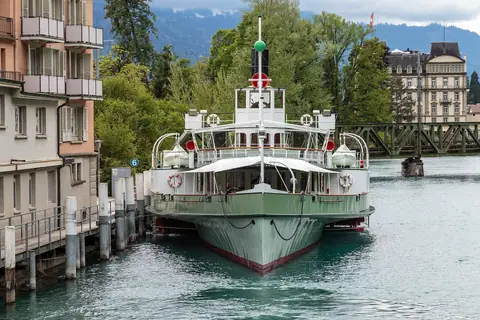
Lake Brienz (Brienzersee), Paddle Steamer Lötschberg and Giessbach Falls
Interlaken, Switzerland
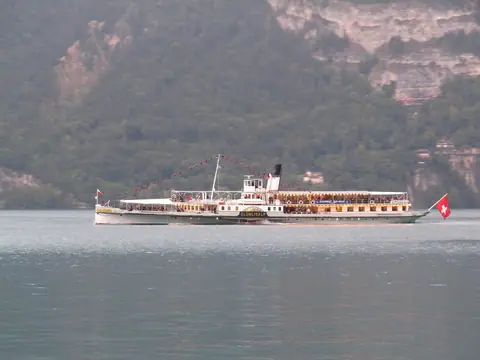
Lake Thun (Thunersee), Paddle Steamer Blümlisalp and St. Beatus Caves
Interlaken, Switzerland
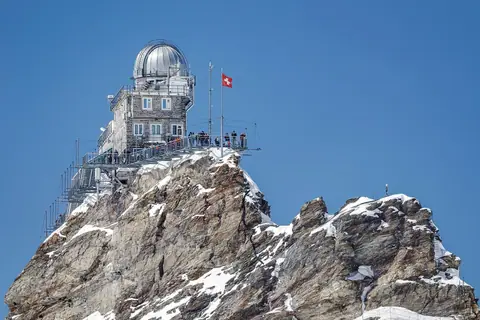
Jungfraujoch (3,454 m) and the Jungfrau Railway Guide from Interlaken
Interlaken, Switzerland
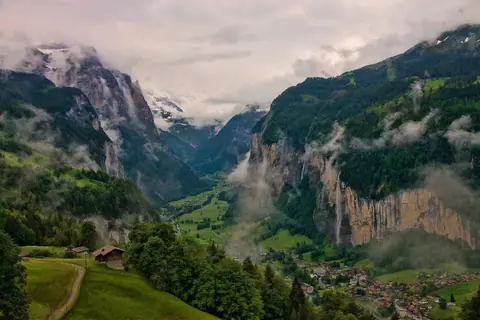
Lauterbrunnen Valley, Grindelwald and Eiger Day Trips from Interlaken
Interlaken, Switzerland
