


























Hatshepsut Temple (Deir el-Bahari) & Valley of the Queens Guide: Punt Reliefs, Tombs of the Nobles & QV66
Explore Queen Hatshepsut's three-tiered temple at Deir el-Bahari, the Punt and Birth colonnades, the Tombs of the Nobles at Sheikh Abd el-Qurna, and the Valley of the Queens.
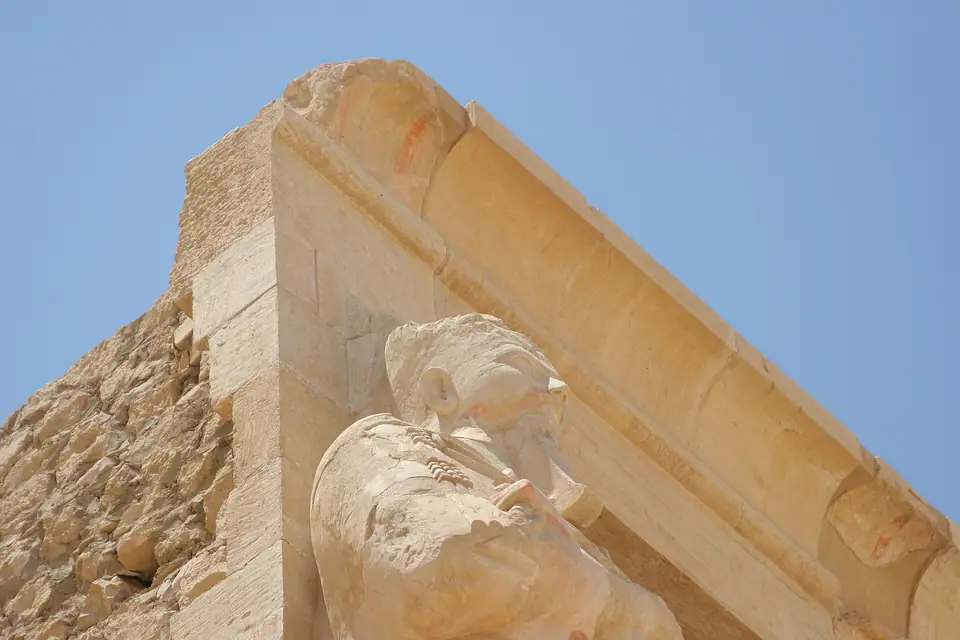
Directly across the limestone ridge from the Valley of the Kings, the eastern face of the mountain opens into a natural bay of 300-metre vertical cliffs. This dramatic rock amphitheatre is known as Deir el-Bahari ("The Northern Monastery"). At the base of this pale-gold rock amphitheatre stands the Mortuary Temple of Queen Hatshepsut (Djeser-Djeseru, "Holy of Holies"). Her royal steward and chief architect Senenmut designed the terraced sanctuary in the fifteenth century BCE. Just south along the lower slopes of the mountain belt lie the Eighteenth Dynasty Tombs of the Nobles at Sheikh Abd el-Qurna. Further south sit the royal sepulchres of the Valley of the Queens (Ta-Set-Neferu). Below is how to explore all three sites on a single morning loop.
| Monument / Site | Key Highlights | Approx. Nov 2026 Card Fee | Ticket Booth Location & Tip |
|---|---|---|---|
| 1. Temple of Hatshepsut (Deir el-Bahari) | 3 limestone terraces, Punt Colonnade, Birth Colonnade, Chapels of Anubis & Hathor | ~440 EGP + 20 EGP cash tram | On-site card terminal at Deir el-Bahari gate. Arrive before 10:00 |
| 2. Tombs of the Nobles (Ramose TT55, Userhat & Khaemhat) | Crisp 18th-Dynasty limestone reliefs of Ramose (TT55), Userhat (TT56) & Khaemhat (TT57) | ~160 EGP (3-tomb cluster) | Buy ticket first at the West Bank Ticket Office opposite Colossi of Memnon |
| 3. Tomb of Sennefer (TT96, "Vineyards") | Subterranean rock ceiling painted as a living canopy of green grapevines and clusters | ~160 EGP separate ticket | Buy ticket first at the West Bank Ticket Office opposite Colossi of Memnon |
| 4. Valley of the Queens (Biban el-Harim) | Base ticket covers QV55 (Amun-her-khepeshef), QV44 (Khaemwaset) & QV52 (Titi) | ~220 EGP base ticket | On-site card terminal at Valley of the Queens entrance. Check QV66 Nefertari status |
Architecture of Deir el-Bahari: Why Hatshepsut built a three-tiered terrace temple
When Eighteenth Dynasty female pharaoh Maatkare Hatshepsut (reigned c, 1479 to 1458 BCE) commissioned her funerary monument ("Mansion of Millions of Years"), her architect Senenmut took direct inspiration from the neighboring Eleventh Dynasty terraced mortuary temple of Middle Kingdom pharaoh Mentuhotep II (c, 2050 BCE), whose ruined foundation ramps still stand immediately to the left (south) of Hatshepsut's courts. Rather than erecting a massive stone pylon that would compete with the 300-metre cliff, Senenmut turned the mountain itself into the temple backdrop. He linked three wide colonnaded limestone terraces with central ramps originally flanked by Red Sea myrrh trees.
Buy your ticket at the Deir el-Bahari visitor centre (around 440 EGP by bank card as of November 2026, plus 20 EGP cash for the electric tram). Walk up the first ramp to the Middle Terrace, where four painted colonnades and chapels flank the central ramp.
- The Punt Colonnade (Left / Southern Side of the Middle Terrace). Do not walk up to the top terrace without spending twenty minutes along this southern portico. Carved in crisp raised relief with surviving red and yellow pigments, it records Hatshepsut's famous naval trading expedition. Five Egyptian sailing ships voyaged down the Red Sea to the Land of Punt (the Horn of Africa coast) in Year 9 of her reign. Look for the marine fish, squid, and sea turtles swimming in the Red Sea register below the ships. Above, Egyptian sailors load live Boswellia myrrh saplings in root balls while King Parahu of Punt greets the fleet with his wife, Queen Ati.
- The Chapel of Hathor (Far Left of the Middle Terrace). Immediately south of the Punt Colonnade stands the multi-aisled shrine of the motherhood goddess Hathor. Its pillars carry four-sided stone capitals carved with the cow-eared face of Hathor framed by curled wigs. Look on the side wall for the relief of the sacred Hathor cow licking Queen Hatshepsut's hand.
- The Birth Colonnade and the Chapel of Anubis (Right / Northern Side of the Middle Terrace). To legitimize her rule as female pharaoh beside young Thutmose III, Hatshepsut inscribed the Birth Colonnade with her divine origin story. The reliefs show Amun-Ra visiting her mother Queen Ahmose and the ram-headed potter god Khnum fashioning Hatshepsut on his wheel. At the far northern end of the terrace stands the Chapel of Anubis, fronted by twelve 16-sided proto-Doric fluted columns. Inside, a lapis-blue star ceiling and yellow-ochre walls of Anubis and Osiris preserve bright original pigments.
The Upper Terrace: Osiride statues and the Sanctuary of Amun-Ra
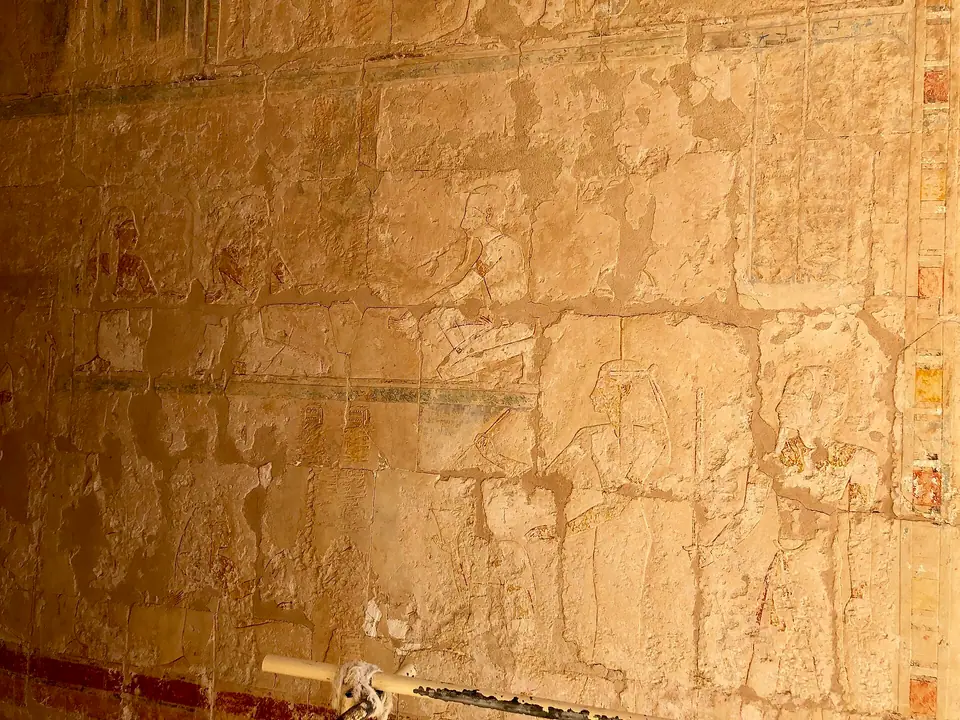
Ascending the second processional ramp, guarded at its base by a monumental granite falcon of Horus, brings you to the Upper Terrace, restored over decades by the Polish-Egyptian Archaeological Mission. Along the front portico stand twenty-six 5-metre-tall limestone Osiride statues of Hatshepsut wearing the royal false beard and double crown. Shattered twenty years after her death under Thutmose III, the statues were carefully pieced back together by modern conservators. Step through the pink granite portal at the rear of the Upper Court into the rock-cut Sanctuary of Amun-Ra. The chamber sits aligned on a winter-solstice axis with the Karnak Temple Complex across the Nile.
The Tombs of the Nobles at Sheikh Abd el-Qurna (Ramose TT55 & Sennefer TT96)
One kilometre south of Deir el-Bahari, the limestone slopes of Sheikh Abd el-Qurna and El-Khokha hold over 400 private Tombs of the Nobles. These rock-cut chapels (designated TT for Theban Tomb) belonged to viziers, governors, and royal scribes. Unlike the royal tombs in the Valley of the Kings, the nobles' tombs burst with scenes of daily life in ancient Egypt. Walls depict wheat harvests, wine-pressing, female musicians, banquets, and hunting in papyrus marshes. Remember to purchase your tickets first at the West Bank Antiquities Ticket Office opposite the Colossi of Memnon:
- The Tomb of Vizier Ramose (TT55, Combined Ticket with Userhat TT56 & Khaemhat TT57, around 160 EGP as of November 2026). Because Vizier Ramose served under both Amenhotep III and his son Amenhotep IV (who became the heretic king Akhenaten), his grand columned hall captures the exact historical moment when Egyptian art shifted styles. On the southern wall, weeping female mourners in white linen and portrait busts of Ramose's family are carved in the most exquisite classical Eighteenth Dynasty limestone relief. On the rear wall, an unfinished scene shows young Akhenaten and Queen Nefertiti standing beneath the rayed sun disc of the Aten in the revolutionary Amarna style! Next door in the same courtyard, enter TT56 (Userhat) for a thrilling painted chariot hunting scene of bounding gazelles and foxes, and TT57 (Khaemhat) for detailed agricultural harvest reliefs.
- The Tomb of Mayor Sennefer (TT96, "The Tomb of the Vineyards", around 160 EGP as of November 2026). Located higher up the hillside, the subterranean chamber of Sennefer (Mayor of Thebes under Amenhotep II) features an undulating rock ceiling. Painters transformed the rough roof into a canopy of twisting grapevines and purple grape clusters above four decorated pillars.
The Valley of the Queens (Biban el-Harim): Princes' tombs and QV66 Nefertari
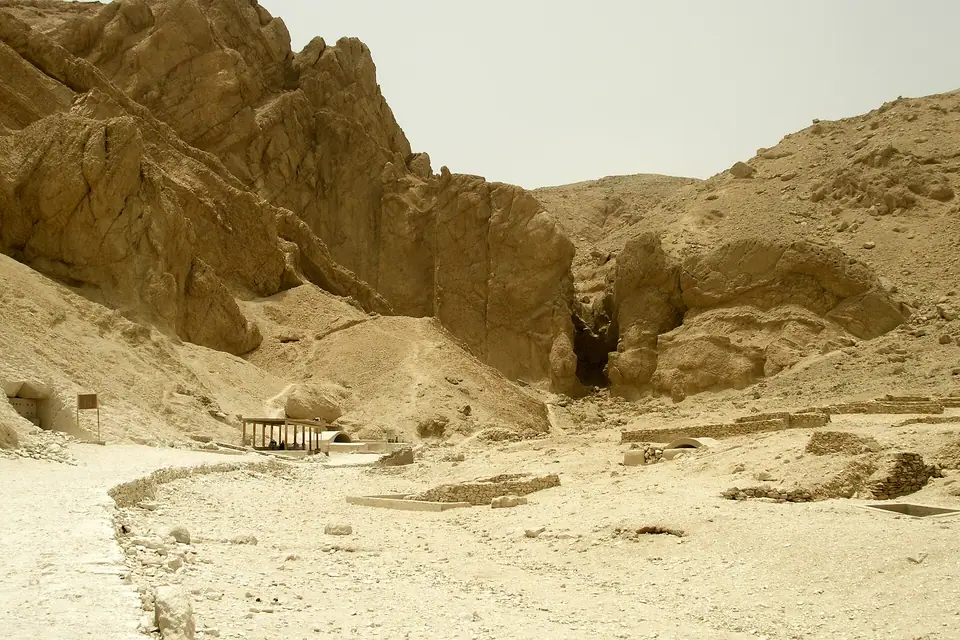
At the southern tip of the Theban hills lies the Valley of the Queens (Ta-Set-Neferu, "The Place of Beauty"). More than ninety tombs were cut here during the Nineteenth and Twentieth Dynasties for queens and young princes.
- The Standard 3-Tomb Base Ticket (around 220 EGP by card as of November 2026). Even when QV66 is closed, the Valley of the Queens base ticket is a bargain because its Twentieth Dynasty princes' tombs were painted in glowing raised relief. Enter QV55 (Prince Amun-her-khepeshef) and QV44 (Prince Khaemwaset), built for two young sons of Ramesses III. On the walls, Ramesses III leads his braided-sidelock sons by the hand to introduce them to Ptah, Thoth, and Anubis. Round out your ticket at QV52 (Queen Titi).
- The Tomb of Queen Nefertari (QV66, Check 2026 Conservation Opening Status). Built by Ramesses II for his beloved Great Royal Wife Nefertari ("For Whom the Sun Shines") and discovered by Ernesto Schiaparelli in 1904, QV66 is the "Sistine Chapel of Ancient Egypt". The Ministry of Tourism and Antiquities periodically closes QV66 for subterranean humidity and salt-crystal conservation. When open, it operates under strict daily visitor caps and a separate conservation ticket (around 2,000 EGP). Always verify QV66's current opening status at the West Bank Ticket Office before walking up to the valley.
Traveller tips
Because the cliffs of Deir el-Bahari face directly east-southeast, the three open stone terraces of Hatshepsut's Temple act like a solar reflector from 10:30 onwards. Visit the Valley of the Kings at 06:00 and arrive at Deir el-Bahari by 09:00. Wear a sun hat from our Luxor packing guide, then continue south to Medinet Habu.
Where it is
- 1Hatshepsut Temple (Deir el-Bahari) & Valley of the Queens
- Luxor International Airport (LXR) · about 12 km from here in a straight line
- Directions in Google Maps
Traveller tips
Real advice from people who have been to Luxor. Every tip is read by our team before it goes live.
No tips yet. Been here? Yours could be the first.
Thank you! Your tip will appear here after a quick review.
More in Luxor
Continue exploring Luxor with related neighbourhood, food, and planning guides
Luxor Temple & Avenue of Sphinxes Guide: First Pylon, Abu el-Haggag Mosque, Amenhotep III & Night Walk
Luxor, Egypt
Valley of the Kings Guide: Best 3 Base-Ticket Tombs, KV62 Tutankhamun, KV9 Ramesses V/VI & KV17 Seti I
Luxor, Egypt
Southern West Bank Guide: Medinet Habu, Deir el-Medina Artisans' Village, Ramesseum & Colossi of Memnon
Luxor, Egypt
Luxor Museum, Mummification Museum & Nile Felucca Guide: 1989 Statue Cachette, Royal Mummies & Banana Island
Luxor, Egypt
