






















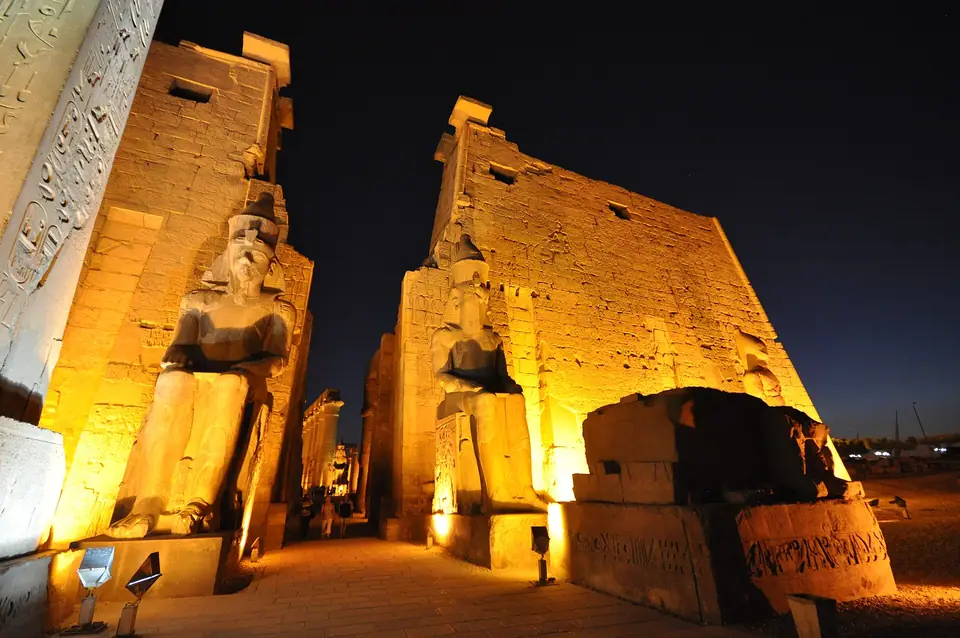
Luxor Temple & Avenue of Sphinxes Guide: First Pylon, Abu el-Haggag Mosque, Amenhotep III & Night Walk
Walk the 2.7 km Avenue of Sphinxes into Luxor Temple: explore Ramesses II's First Pylon, the living Abu el-Haggag Mosque, Amenhotep III's Colonnade, and Roman chapel frescoes.
Rising right in the centre of the East Bank Nile Corniche, Luxor Temple (ancient Egyptian: Ipet-resyt, "The Southern Sanctuary") differs from every other major temple in Thebes. Unlike mortuary sanctuaries built for deceased kings, Luxor Temple was dedicated to the annual rejuvenation of the royal ka (divine life-force of kingship). That royal renewal took place during the 11-to-27-day Opet Festival in the Nile inundation season. Two New Kingdom rulers built the core complex: Amenhotep III (Fourteenth Century BCE) in the south and Ramesses II (Thirteenth Century BCE) in the north. Over the next 3,400 years, the site remained a continuously active place of worship. It layers pharaonic bark shrines, a Sanctuary of Alexander the Great, a fourth-century Roman legionary chapel, Coptic churches, and the thirteenth-century Mosque of Sheikh Yusuf Abu el-Haggag. Below is a step-by-step route through the temple and the 2.7-kilometre Avenue of Sphinxes.
| Monument Zone | Era & Builder | What to Look For | Best Lighting Window |
|---|---|---|---|
| 1. Avenue of Sphinxes (Tariq al-Kebash) | 18th Dynasty to Nectanebo I (380 BCE) | 2.7 km paved processional road lined by 1,050+ human- and ram-headed sphinxes | 16:00 to 17:30 golden hour or floodlit evening walk |
| 2. First Pylon & Obelisk | Ramesses II (13th century BCE) | 24 m pylon with Battle of Kadesh reliefs, 25 m pink granite obelisk & 6 colossi | 16:45 sunset (western sun hits the pylon facade directly) |
| 3. Court of Ramesses II & Mosque | Ramesses II & Sheikh Abu el-Haggag (1244 CE) | 74 papyrus columns, granite colossi & 13th-century mosque perched 7 m up on walls | 17:15 dusk when mosque minarets and columns light up |
| 4. Colonnade & Solar Court | Amenhotep III & Tutankhamun (14th century BCE) | 14 open-papyrus columns (16 m high), Opet Festival reliefs & Double-row Sun Court | 17:45 to 19:30 theatrical upward floodlighting |
| 5. Inner Sanctuaries & Roman Frescoes | Amenhotep III, Alexander the Great & Diocletian | Divine Birth Room, Alexander's Granite Shrine & 300 CE Roman Tetrarchy wall paintings | Late afternoon or evening |
Walking the 2.7-kilometre Avenue of Sphinxes (Tariq al-Kebash)
Reopened in November 2021 after decades of excavation across downtown Luxor, the 2.7-kilometre Avenue of Sphinxes (Tariq al-Kebash) restores the ancient processional highway. It links the Tenth Pylon of the Karnak Temple Complex straight to the First Pylon of Luxor Temple. Sandstone pedestals along the route originally supported more than 1,050 sphinxes. Human-headed androsphinxes carved under Pharaoh Nectanebo I line the southern stretch, while ram-headed criosphinxes guard the Karnak approach. Along the verges, excavations uncovered ancient mud-brick wine presses, Nilometers, and Roman water cisterns.
You have two ways to experience the Avenue of Sphinxes. You can view the finest southern stretch inside your standard Luxor Temple ticket (around 500 EGP by bank card as of November 2026), or walk the full 2.7-kilometre length from Karnak in 45 minutes. Carry water and wear a sun hat from our packing guide, as the sunken sandstone road has zero shade before sunset.
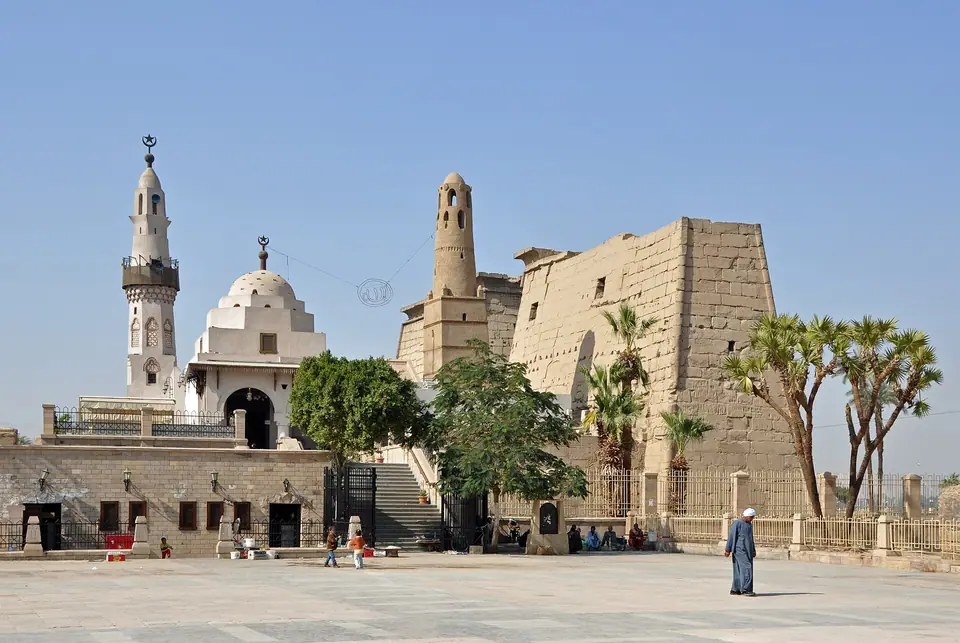
The First Pylon of Ramesses II and the Twin Obelisk Story
Approaching the northern entrance of Luxor Temple from the Avenue of Sphinxes, you stand before the 24-metre-high, 65-metre-wide First Pylon of Ramesses II. Look closely at three details on the facade before stepping through the central portal.
- The Lone 25-Metre Pink Granite Obelisk (and Its Sister in Paris). Originally, two red granite obelisks stood asymmetrically in front of the pylon. The eastern obelisk (25 metres tall, weighing 254 tonnes, with four baboons carved in high relief at its base adoring the rising sun) still stands here. Its slightly shorter 23-metre western twin was gifted by Ottoman Viceroy Muhammad Ali Pasha to France in 1830 and has stood at the centre of the Place de la Concorde in Paris since October 1836.
- Colossal Statues and the Battle of Kadesh. Guarding the gateway sit two colossal enthroned statues of Ramesses II carved from dark grey-black granodiorite (15.6 metres high including their pedestals), flanked once by four standing colossi. Across the face of the pylon wings, sunk reliefs depict Ramesses II charging in his war chariot during the Battle of Kadesh (1274 BCE) against the Hittites. Four deep vertical slots in the masonry once anchored 40-metre cedar flagstaffs tipped with electrum.
The Court of Ramesses II and the Living Mosque of Abu el-Haggag
Passing through the First Pylon, you notice that the northern court twists slightly eastward compared to Amenhotep III's southern half. Ramesses II's architects engineered that axis shift so the First Pylon would align squarely with the Avenue of Sphinxes coming from Karnak. Inside the Peristyle Court of Ramesses II (57 by 51 metres), 74 closed-bud papyrus columns surround the open plaza. Between the columns stand polished red-granite colossi of Ramesses II with delicate figures of Queen Nefertari beside his calves.
Look up at the northeastern corner of the court for a remarkable architectural layer. The whitewashed walls and minarets of the Mosque of Sheikh Yusuf Abu el-Haggag sit suspended 7 metres in the air directly atop the pharaonic columns. When the Sufi patron saint of Luxor died in 1244 CE (642 AH), centuries of Nile flood silt and village debris had buried Luxor Temple up to its column capitals. Residents built the mosque on what was then ground level. French archaeologist Gaston Maspero excavated the temple down to its pharaonic pavement in the 1880s. The living mosque remained untouched atop its stone perch, leaving its old medieval doorway hanging high above the courtyard.
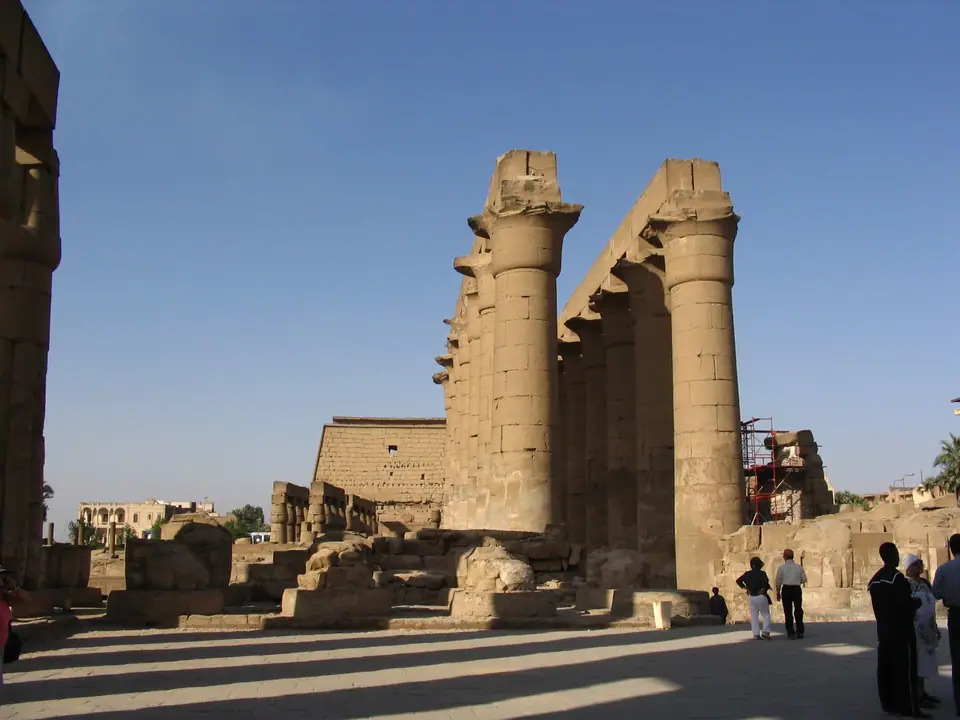
The Colonnade of Amenhotep III, Solar Court, and Roman Imperial Chapel
Walking south from Ramesses II's court, you enter the eighteenth-dynasty temple of Amenhotep III:
- The Processional Colonnade (Carved by Tutankhamun and Horemheb). Fourteen giant sandstone columns with open-bell papyrus capitals soar 16 metres overhead along a 52-metre corridor. The side walls preserve the finest surviving reliefs of the Opet Festival, carved under the boy king Tutankhamun and later usurped by Horemheb. Priests carry the sacred barques from Karnak to the Nile and tow the barges upstream while Nubian dancers, acrobats, and drummers celebrate along the bank.
- The Solar Court of Amenhotep III and the 1989 Cachette. Beyond the colonnade opens the sunlit Peristyle Court of Amenhotep III (45 by 56 metres), ringed by double rows of clustered papyrus-bud columns. In January 1989, workers testing soil dampness beneath this court uncovered a deep cachette pit. Roman-era priests had buried 26 pristine royal and divine statues there around 300 CE, now displayed in the Luxor Museum.
- The Roman Tetrarchy Frescoes, Birth Room, and Alexander the Great's Sanctuary. At the southern end of the Solar Court, Roman masons walled in four columns around 300 CE under Emperor Diocletian. The pharaonic vestibule became the imperial cult chapel (sacellum) of a Roman legionary fortress. Look closely at the curved apse and flanking walls where sheets of lime plaster have flaked away. Fourth-century CE Roman frescoes of toga-clad courtiers sit directly on top of fourteenth-century BCE carved hieroglyphs of Amenhotep III. Behind the apse lies the Divine Birth Room, showing the god Amun visiting Queen Mutemwiya to conceive Amenhotep III. Next door stands the inner Barque Shrine rebuilt by Alexander the Great around 330 BCE, where Alexander wears a pharaonic kilt and double crown before Amun-Ra.
Traveller tips
Time your entry to Luxor Temple for 16:15 to 16:30 (open daily from 06:00 until 20:00 in winter and 21:00 in summer). You can photograph the First Pylon, the Mosque of Abu el-Haggag, and the Roman frescoes in warm afternoon sunlight during your first 45 minutes. As dusk falls, upward amber floodlights transform the 14 columns of Amenhotep III's Colonnade on the same admission ticket. Pair this walk with our 3-day Luxor itinerary and Corniche dining guide. Before leaving the western side of the enclosure, pause along the outer Roman fortification wall facing the Nile Corniche. There you can spot reused sandstone blocks carved with upside-down pharaonic cartouches and early Christian crosses. If you walk the full 2.7-kilometre Avenue of Sphinxes from Karnak to Luxor Temple in the late afternoon, start at Karnak around 15:15. Walking south puts the lowering sun behind your right shoulder rather than glaring in your eyes. Keep your admission ticket in your pocket until you exit the final turnstile on the Corniche promenade.
Where it is
- 1Luxor Temple & Avenue of Sphinxes
- Luxor International Airport (LXR) · about 7 km from here in a straight line
- Directions in Google Maps
Traveller tips
Real advice from people who have been to Luxor. Every tip is read by our team before it goes live.
No tips yet. Been here? Yours could be the first.
Thank you! Your tip will appear here after a quick review.
More in Luxor
Continue exploring Luxor with related neighbourhood, food, and planning guides

How to Get to Luxor & Around: Airport (LXR), Cairo Sleeper Trains, Nile Ferries & West Bank Taxis
Luxor, Egypt

Best Time to Visit Luxor: Upper Egypt Desert Climate Normals, Winter Sun & Summer Heat Strategy
Luxor, Egypt
What to Wear in Luxor: Subterranean Tomb Heat, Sun Protection, Footwear & Upper Egypt Modest Dress
Luxor, Egypt
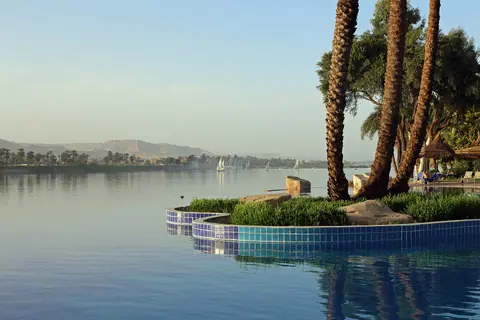
Where to Stay in Luxor: East Bank Corniche Resorts vs West Bank Al-Gezira Garden Guesthouses
Luxor, Egypt
