



















Karnak Temple Guide: Great Hypostyle Hall, Sacred Lake, Obelisks, Open-Air Museum & Precinct of Amun-Ra
Explore the 100-hectare Karnak Temple Complex in Luxor: the 134-column Great Hypostyle Hall, Hatshepsut's Obelisk, Sacred Lake, Open-Air Museum chapels, and dawn route.
Known to the ancient Egyptians as Ipet-isut ("The Most Select of Places"), the Karnak Temple Complex on the northern East Bank of Luxor is the largest religious sanctuary ever built in antiquity. The complex spans more than 100 hectares (247 acres), with the brick-enclosed Precinct of Amun-Ra alone covering 30 hectares. More than thirty pharaohs expanded Karnak across 2,000 years, from Senusret I around 1971 BCE down to the Roman emperors. Unlike temples built to a single blueprint, Karnak grew along two intersecting processional axes. An East-West solar axis links Pylons I through VI, while a North-South ceremonial axis (Pylons VII through X) leads toward Luxor Temple. Below is how to navigate its ten pylons, obelisks, and hidden chapels without getting overwhelmed.
| Karnak Sector | Key Monuments & Dimensions | Ticket Rule (As of Nov 2026) | Recommended Time & Order |
|---|---|---|---|
| 1. First Pylon & Great Forecourt | 40 Criosphinxes, 43 m high First Pylon, Barque Shrine of Seti II, Ramesses III Temple | Included in main Karnak ticket (~600 EGP by card) | 25 mins (enter at 06:00 opening) |
| 2. Great Hypostyle Hall | 134 columns (12 central columns 21 m high, 3.5 m wide); Seti I & Ramesses II battle reliefs | Included in main Karnak ticket | 45 mins (06:25 to 07:10 before tour groups) |
| 3. Obelisks, Sanctuary & Akhmenu | 29.5 m Obelisk of Hatshepsut (323 tonnes), Philip Arrhidaeus Shrine, Botanical Room | Included in main Karnak ticket | 45 mins (follow East-West axis to rear) |
| 4. Sacred Lake & Southern Axis | 120 x 77 m Sacred Lake, Scarab of Amenhotep III, Cachette Court (Pylons VII-X), Khonsu Temple | Included in main Karnak ticket | 40 mins (loop south around Sacred Lake) |
| 5. Open-Air Museum | White Chapel of Senusret I, Red Chapel of Hatshepsut, Calcite Shrine of Amenhotep I | Included in main Karnak ticket (north of First Court) | 35 mins (08:30 to 09:05 as crowds fill main hall) |
Approaching Karnak: The Criosphinxes, First Pylon, and Great Forecourt
Located 3 kilometres north of downtown Luxor (a 10-minute, 100-to-150 EGP taxi ride), the Karnak Visitor Centre opens at 06:00. Buy your all-inclusive entry ticket (around 600 EGP by Visa or Mastercard as of November 2026, or use your Luxor Pass). After clearing the turnstiles, walk past the ancient Tribune Quay, where royal barges once moored along a Nile canal. From the quay, proceed down the Western Avenue of Ram-Headed Sphinxes (Criosphinxes). Each of the forty sandstone lions carries the curved-horn head of a ram sacred to Amun-Ra, sheltering a miniature effigy of Pharaoh Ramesses II between its front paws.
You enter the temple proper through the unfinished First Pylon, built during the Thirtieth Dynasty under Pharaoh Nectanebo I (around 380 BCE). Towering 43 metres high and 113 metres wide with walls 15 metres thick, its inner face still preserves a section of the original ancient mud-brick construction ramp used to haul sandstone blocks into place. Inside the vast Great Forecourt (103 by 84 metres), inspect the triple Barque Shrine of Seti II on your left. In the centre stands the lone 21-metre Column of Taharqa, while the Temple of Ramesses III rises on your right.
Inside the 134-column Great Hypostyle Hall of Seti I and Ramesses II
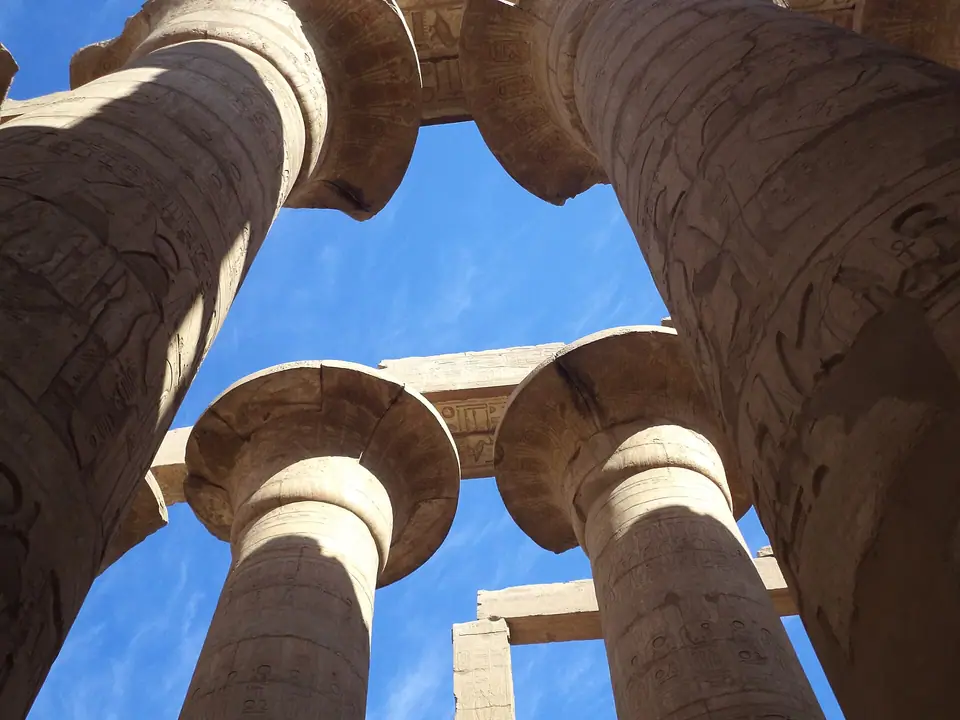
Pass between the colossal pink granite statue of Ramesses II and the ruined Second Pylon. You immediately step into the Great Hypostyle Hall, initiated by Pharaoh Seti I and completed by Ramesses II in the thirteenth century BCE. Measuring 102 metres wide by 53 metres deep (5,400 square metres), this stone forest represents the primordial papyrus marsh of Egyptian creation mythology:
- The 12 Central Open-Papyrus Columns vs the 122 Closed-Bud Columns. The central nave is supported by 12 colossal sandstone columns with flared, open-umbrella papyrus capitals. Each column soars 21 metres (69 feet) high and 3.57 metres in diameter, wide enough to hold fifty adults. Above them survive the stone clerestory window grilles that once channelled the only shafts of daylight into the roofed hall. Flanking the central aisle in seven rows on either side stand 122 slightly shorter columns (15 metres high) carved with closed papyrus-bud capitals. Look straight up at the architraves and column undersides to spot vivid turquoise, ochre, and lapis-blue pigments restored by conservation teams.
- Comparing Seti I's Delicate Raised Relief with Ramesses II's Deep Sunk Relief. Step outside the northern and southern exterior walls of the Hypostyle Hall to see a textbook lesson in New Kingdom art history. The northern half of the hall (built by Seti I) is carved in refined, low-profile raised relief (bas-relief) depicting Seti I's military campaigns in Canaan and Syria. When Ramesses II took the throne, he instructed his sculptors to carve the southern half in deep sunk relief (relief en creux). Cutting deep into the sandstone prevented successors from chiselling away his cartouches. It also cast sharp shadows across his Battle of Kadesh reliefs and the Egyptian-Hittite Peace Treaty on the southern wall.
The Obelisk of Hatshepsut, Bark Sanctuary, and Akhmenu of Thutmose III
Continuing east beyond the Third and Fourth Pylons brings you to the oldest core of the temple:
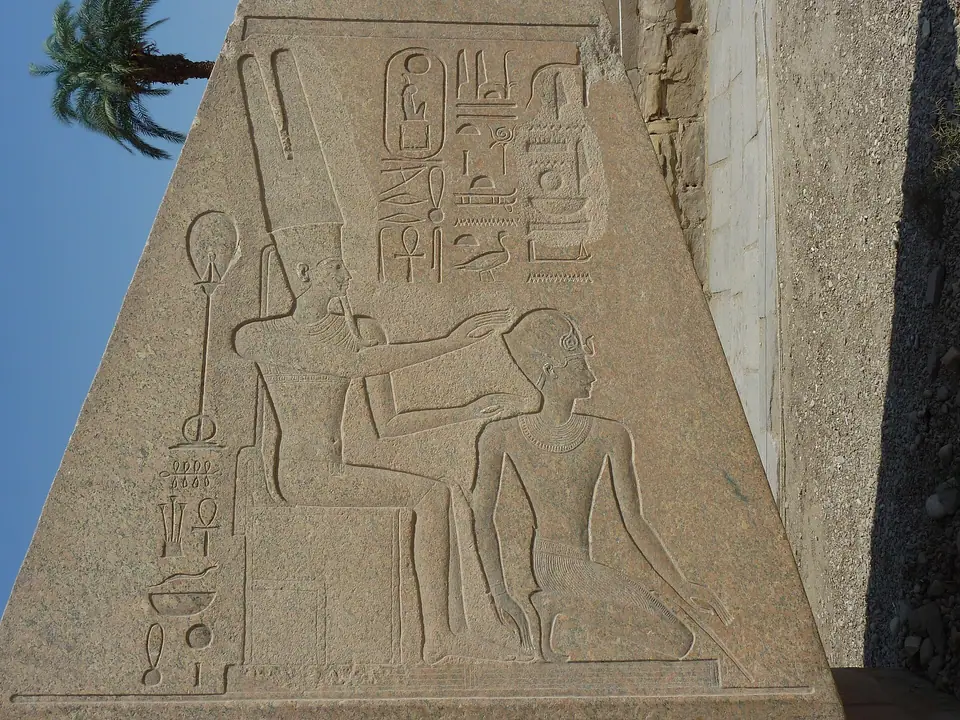
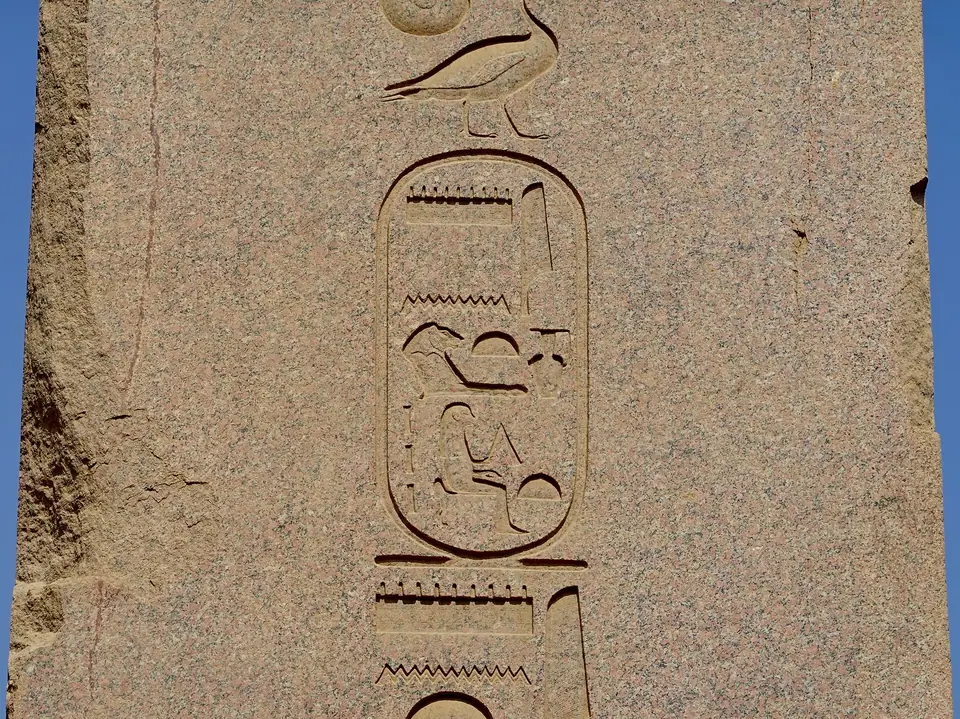
- The Standing Obelisk of Queen Hatshepsut (29.56 Metres High). Quarried from a single block of red Aswan granite weighing roughly 323 tonnes, Hatshepsut's northern obelisk went up around 1457 BCE. Standing 29.56 metres high, it is the tallest ancient obelisk still standing on Egyptian soil. Its fallen sister obelisk lies by the Sacred Lake, where you can examine the exquisite carved apex (pyramidion) showing Amun crowning Hatshepsut face-to-face.
- The Pink Granite Sanctuary of Philip Arrhidaeus and the Middle Kingdom Court. Directly ahead stands the polished pink granite bark shrine built around 320 BCE for Alexander the Great's half-brother and successor, Philip Arrhidaeus, on the footprint of Thutmose III's shrine. Beyond an open courtyard, where the earliest Middle Kingdom temple of Senusret I stood before stone blocks were stripped, rises the Festival Hall (Akhmenu) of Thutmose III. Look for its unique tent-pole columns, carved wider at the top than at the base to mimic wooden military tent poles. Next door sits the Botanical Chamber, carved with exotic birds and plants brought back from Thutmose III's Syrian campaigns in 1450 BCE.
The Sacred Lake, Open-Air Museum, and Temple of Khonsu
Before leaving Karnak, explore three sectors that hasty tour groups routinely bypass:
- The Sacred Lake and Giant Granite Scarab. Measuring 120 by 77 metres and lined with cut stone steps and underground geese pens, the Sacred Lake supplied water for the priests' four daily purification rituals. At its northwest corner stands a colossal red granite Scarab Beetle of Amenhotep III dedicated to Khepri, god of the rising sun (around which local visitors walk anticlockwise for good fortune).
- The Open-Air Museum (Included in Main Ticket). Tucked into the northwestern corner of the complex off the Great Forecourt, the Open-Air Museum displays three reconstructed barque shrines. Later pharaohs had dismantled these monuments and used their blocks as rubble fill inside the Third Pylon. Highlights include the limestone White Chapel of Senusret I (1950 BCE), the quartzite Red Chapel of Queen Hatshepsut, and the Alabaster Chapel of Amenhotep I.
- The Southern Axis (Pylons VII to X) and the Temple of Khonsu. Extending south from Pylons III and IV, four monumental pylons built by Thutmose III, Hatshepsut, Amenhotep III, and Horemheb form the southern axis. In the Cachette Court before the Seventh Pylon, archaeologist Georges Legrain unearthed over 17,000 statues between 1903 and 1907. In the southwestern corner of the enclosure stands the intact Twentieth Dynasty Temple of Khonsu, dedicated to the moon god. Its Ptolemaic gateway (Bab el-Amara, built by Ptolemy III Euergetes) opens directly onto the Avenue of Sphinxes.
Traveller tips
North of the Hypostyle Hall stands the compact Temple of Ptah, where a statue of the lioness goddess Sekhmet gleams under a shaft of roof light. Attendants there and near the Temple of Khonsu sometimes wave visitors behind ropes for baksheesh. Keep your official ticket handy and politely decline unofficial tours. Pair your morning at Karnak with our 3-day Luxor itinerary and Luxor Museum guide. Restrooms and a shaded café sit right beside the Sacred Lake, making it the best spot inside the enclosure for a mid-morning water break.
Where it is
- 1Karnak Temple
- Luxor International Airport (LXR) · about 7 km from here in a straight line
- Directions in Google Maps
Traveller tips
Real advice from people who have been to Luxor. Every tip is read by our team before it goes live.
No tips yet. Been here? Yours could be the first.
Thank you! Your tip will appear here after a quick review.
More in Luxor
Continue exploring Luxor with related neighbourhood, food, and planning guides
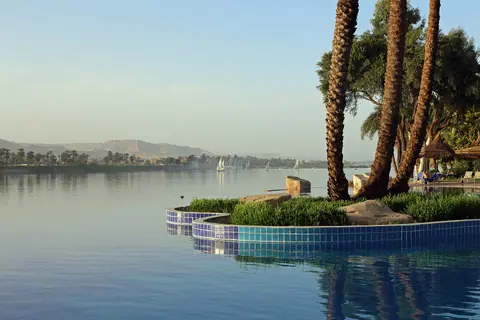
Where to Stay in Luxor: East Bank Corniche Resorts vs West Bank Al-Gezira Garden Guesthouses
Luxor, Egypt
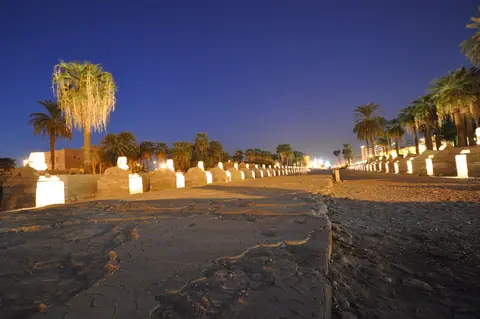
Luxor 3-Day Itinerary: East Bank Temples, Northern Royal Wadis & Southern Mortuary Loop
Luxor, Egypt
Luxor Temple & Avenue of Sphinxes Guide: First Pylon, Abu el-Haggag Mosque, Amenhotep III & Night Walk
Luxor, Egypt
Valley of the Kings Guide: Best 3 Base-Ticket Tombs, KV62 Tutankhamun, KV9 Ramesses V/VI & KV17 Seti I
Luxor, Egypt
