





















Dendera & Abydos Day Trip from Luxor: Temple of Hathor's Turquoise Ceiling, Temple of Seti I & Osireion
Plan a day trip north from Luxor to the Temple of Hathor at Dendera and the Temple of Seti I at Abydos: travel times, 2026 tickets, astronomical ceilings, and the Abydos King List.
Travellers with a fourth day in Luxor should head north along the Nile Valley into Qena and Sohag governorates. The Temple of Hathor at Dendera (65 kilometres north) and the Temple of Seti I at Abydos (165 kilometres north) preserve two of the finest interiors in Egypt. Unlike the roofless courts of central Luxor, Dendera's massive sandstone roof slabs remain intact above a cleaned cosmos of glowing turquoise zodiacs. Further north, Abydos preserves the finest painted limestone raised reliefs of the Nineteenth Dynasty. Below is how to organize a half-day trip to Dendera or a full-day combined loop to Abydos and Dendera.
| Day-Trip Option | Distance & Drive Time from Luxor | Approx. Nov 2026 Site Ticket | Approx. Private Car Cost & Total Duration |
|---|---|---|---|
| 1. Dendera Only (Half-Day) | 65 km north (near Qena); 1 hour each way | ~300 EGP by card (plus optional crypt/roof add-ons) | ~1,800 to 2,400 EGP per car (4.5 to 5 hours total round-trip) |
| 2. Combined Abydos + Dendera (Full-Day) | 165 km north to Abydos, then 100 km south to Dendera, then 65 km to Luxor | ~260 EGP (Abydos) + ~300 EGP (Dendera) by card | ~3,200 to 4,200 EGP per car (8 to 9 hours total, Depart 07:00) |
| 3. Luxor-to-Hurghada Transfer via Dendera | Stop at Dendera (65 km north) en route to Highway 26 to Red Sea (220 km east) | ~300 EGP by card at Dendera gate | ~3,000 to 4,000 EGP one-way car with luggage and 2-hour Dendera stop |
The Temple of Hathor at Dendera: Turquoise astronomical ceilings and Cleopatra VII
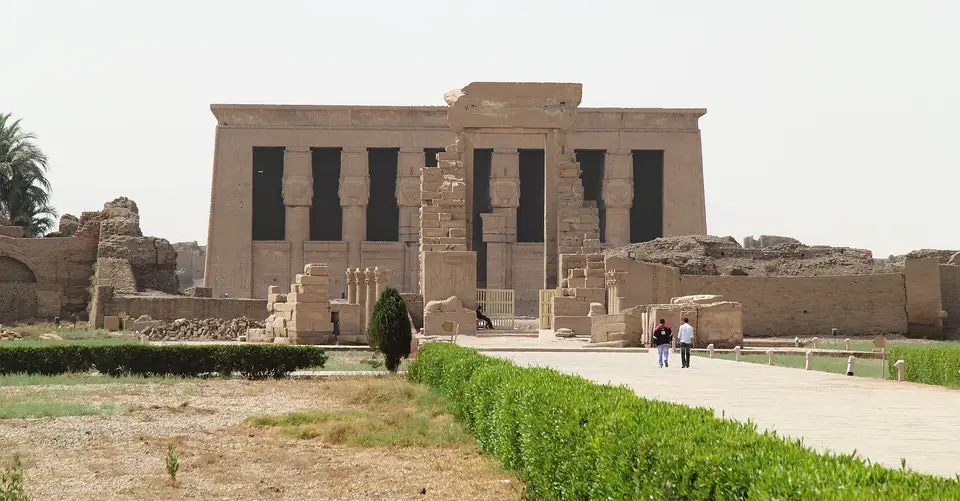
Located on the west bank of the Nile outside Qena (a 60-minute drive north of Luxor), the Dendera Temple Complex (Iunet) stands at the edge of the desert. In antiquity, it was the primary cult centre of Hathor, goddess of music, motherhood, and the sky. Although earlier shrines stood here from the Old Kingdom onwards, the sandstone temple standing today dates between 54 BCE and 60 CE. Late Ptolemaic rulers (including Ptolemy XII and Cleopatra VII) and early Roman emperors built and decorated its halls. Over the past fifteen years, conservators used gentle laser and poultice cleaning to strip away two millennia of cooking-fire soot from the ceiling. Stepping through the northern portal today delivers an unforgettable shock of turquoise colour.
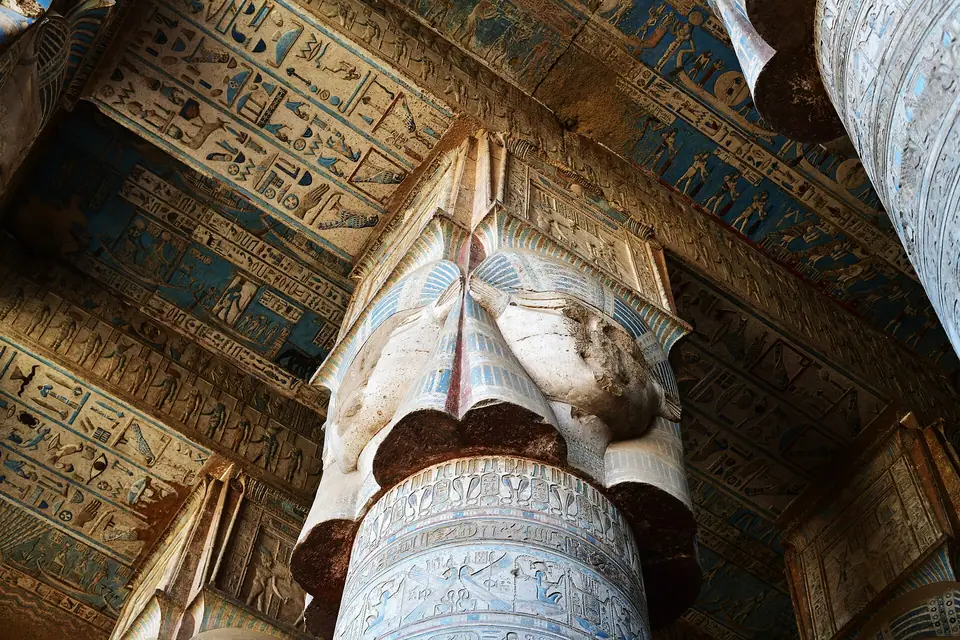
- The 24 Hathor-Headed Columns and Astronomical Ceiling of the Great Hypostyle Hall (Pronaos). Twenty-four towering columns support the outer hall, each topped with a four-sided sistrum capital bearing the cow-eared face of Hathor. Overhead, the massive sandstone ceiling is divided into seven astronomical bands. Look straight up to see the elongated body of the sky goddess Nut overarching the heavens beside winged solar discs. Across the bands sail the 36 decan star constellations, the twelve signs of the Greco-Egyptian zodiac, and the phases of the moon. Every register glows in original 2,000-year-old Egyptian blue and turquoise pigment.
- The Subterranean Crypts, Staircases, and the Dendera Zodiac. Behind the inner Hypostyle Hall (Hall of Appearances) and the central Barque Sanctuary, descend into the narrow subterranean wall crypts built inside the thickness of the foundation masonry. Here crisp, unweathered reliefs depict gilded cult statues and ritual Menat necklaces (including the famous relief of giant lotus buds holding coiled primordial snakes inside womb-like bubbles, which internet folklore amusingly nicknames the "Dendera lightbulbs"). Next, climb the straight Western Staircase, whose walls show priests of the New Year's Festival (Wepet-Renpet) carrying Hathor's shrine up to the roof. On the terrace, enter the Rooftop Chapel of Osiris, where a cast marks the ceiling spot of the circular Dendera Zodiac (now in the Louvre in Paris).
- Cleopatra VII and Caesarion on the Exterior Rear Wall. Before leaving the enclosure (which also contains a Roman Mammisi birth house, Sacred Lake, and mud-brick sanatorium), walk around to the exterior southern (rear) wall of the main temple. There, carved at monumental scale, stands the only surviving full-size temple relief in Egypt of Queen Cleopatra VII Philopator. She stands directly behind her young son Ptolemy XV Caesarion (fathered by Julius Caesar) as they offer incense to Hathor.
The Temple of Seti I at Abydos: The holiest pilgrimage site of Osiris
Continuing another 100 kilometres (90 minutes) north of Dendera into Sohag Governorate brings you to Abydos (ancient Egyptian: Abdju). Abydos was the supreme pilgrimage centre of ancient Egypt, where First and Second Dynasty kings were buried at Umm el-Qa'ab around 3100 BCE. Religious tradition held that the head of Osiris, lord of the underworld and resurrection, was buried here. Every pious Egyptian hoped either to make a pilgrimage to Abydos in life or to erect a memorial cenotaph stela near Osiris's processional route.
Built by Nineteenth Dynasty Pharaoh Seti I (c, 1290 to 1279 BCE) and completed by his son Ramesses II, the Temple of Seti I at Abydos costs around 260 EGP by card as of November 2026. Its unique L-shaped floor plan houses the finest painted limestone bas-reliefs of the New Kingdom.
- The Seven Vaulted Sanctuaries. Instead of terminating in a single sanctuary, the second hypostyle hall opens onto seven parallel vaulted chapels. From left to right, they honour the Deified King Seti I, Ptah, Ra-Horakhty, Amun-Ra, Osiris, Isis, and Horus. Because Seti I sourced fine white crystalline limestone rather than coarse sandstone, his sculptors achieved extraordinary detail. The walls preserve hair-thin facial profiles, pleated linen robes, and soft pastel blues, yellows, and reds.
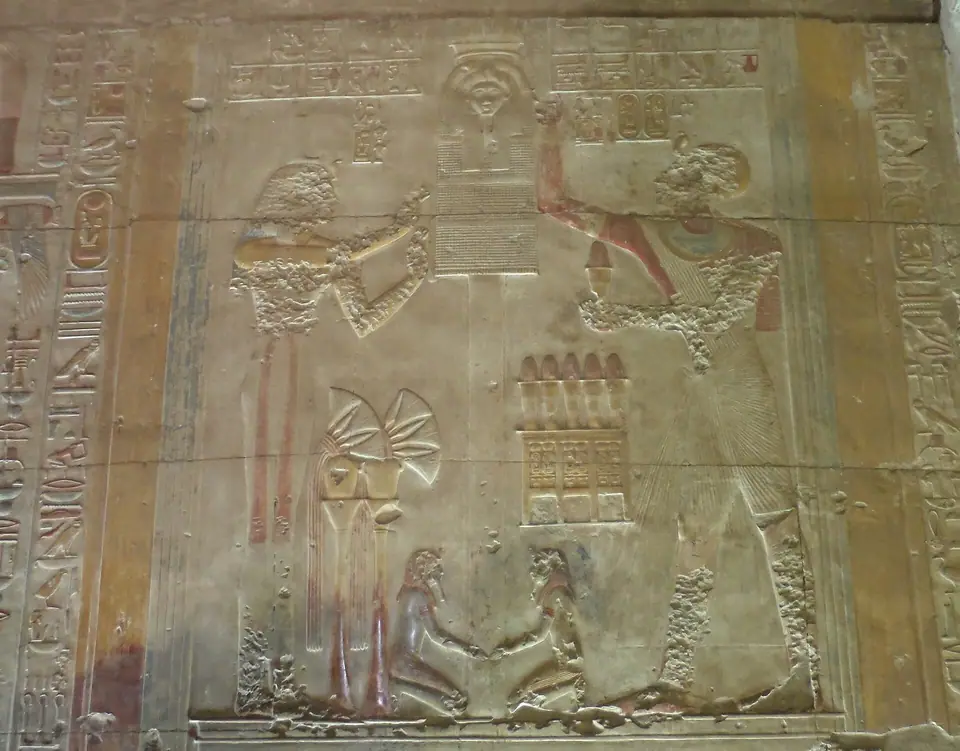
- The Abydos King List (Gallery of the Lists). Turning left into the southern wing of the L-shaped temple brings you into the Gallery of the Ancestors. On the right wall, Seti I holds a censer while young Prince Ramesses reads from a scroll before 76 chronological royal cartouches. The list runs from Egypt's first unifier, Menes (Narmer), down to Seti I, while omitting Hatshepsut, Akhenaten, and Tutankhamun. Look on the opposite wall for the charming scene of Seti I and young Ramesses lassoing a wild bull by its horns and tail.
- The Subterranean Osireion and the Temple of Ramesses II. Walk out the rear door of Seti's temple to view the sunken Osireion, built 15 metres below floor level from monolithic blocks of Aswan granite. Resting in natural groundwater, it served as a symbolic island cenotaph of Osiris. Five minutes' walk northwest stands the smaller, roofless Temple of Ramesses II, where open sunlight illuminates vivid turquoise-and-crimson limestone reliefs of butchered cattle offerings, captive soldiers, and fragments of the Battle of Kadesh.
Road logistics, checkpoints, and booking your driver
In the past, tourist police required foreign vehicles travelling to Abydos and Dendera to drive in slow early-morning armed convoys. As of 2026, the fixed convoy system has been replaced by standard roadside checkpoints along the modern Desert Highway and Agricultural Road, allowing private tourist cars to travel flexibly during daylight hours:
- Always Visit Abydos First, Then Dendera on the Way Back. If doing the full-day combined excursion, depart your Luxor hotel at 06:30 or 07:00 and drive straight 2.5 hours north to the furthest point, Abydos (arriving around 09:30 when the temple is quiet and cool). Spend 90 minutes at Seti I's and Ramesses II's temples, then drive 90 minutes south to reach Dendera around 12:30, returning to Luxor by 15:30 or 16:00.
- Passport Photocopies and Cashless Cards. Your hotel or driver registers a routine tourism police road permit the afternoon before a trip into Qena and Sohag governorates. Provide a photo of your passport bio page and Egyptian visa stamp at least 24 hours in advance. Carry your physical Visa or Mastercard for the cashless ticket terminals at Abydos (~260 EGP) and Dendera (~300 EGP).
Traveller tips
Pack a boxed breakfast and 2 litres of water per person from Luxor, as dining options along the Qena-Balyana highway are basic. Back in town, celebrate with a clay-pot dinner from our Luxor food guide. At Dendera, check at the main ticket window whether the optional extra tickets for the Rooftop Chapel of Osiris and the subterranean wall crypts are available on your morning. Purchasing those add-on tickets at the main gate saves walking back from the temple pronaos. Wear grippy closed-toe shoes for the narrow stone steps inside the Dendera crypts and staircase, and carry a small phone light to examine the finely incised wall reliefs without touching the stone.
Where it is
- 1Luxor
- Luxor International Airport (LXR) · about 52 km from Luxor in a straight line
- Directions in Google Maps
Traveller tips
Real advice from people who have been to Luxor. Every tip is read by our team before it goes live.
No tips yet. Been here? Yours could be the first.
Thank you! Your tip will appear here after a quick review.
More in Luxor
Continue exploring Luxor with related neighbourhood, food, and planning guides

What to Eat in Luxor: Upper Egyptian (Sa'idi) Clay-Pot Tagines, Sun-Risen Bread, Stuffed Pigeon & Karkadeh
Luxor, Egypt
Luxor Orientation: East Bank vs West Bank Geography, Cashless Ticket Rules, Luxor Pass & Avoiding Scams
Luxor, Egypt
Best Things to Do in Luxor: Karnak, Valley of the Kings, Hatshepsut, Medinet Habu & Nile Sails
Luxor, Egypt
How to Get to Luxor & Around: Airport (LXR), Cairo Sleeper Trains, Nile Ferries & West Bank Taxis
Luxor, Egypt
