Art Gallery of Ontario (AGO) Guide
Toronto's main art museum, a short walk from Chinatown and Kensington Market.
The Art Gallery of Ontario stands on Dundas Street West at McCaul Street, on the edge of the university district and a few minutes from Chinatown. Visitors usually call it the AGO. It is Toronto's serious art museum, and its position on the west side makes it easy to build into a full day of walking and eating.
The building and the collection
Frank Gehry, who grew up in Toronto, redesigned the gallery in a project completed in 2008. From Dundas you see a long glass front with a ribbed blue-grey titanium section above it, and inside, a timber and glass stair spirals up through the atrium. It is as much a reason to come as any painting, and we would walk through it even with no interest in art.
The strongest part of the collection is Canadian. Expect landscapes by the Group of Seven and their circle, a deep body of Inuit art, and a large holding of sculpture by Henry Moore, whose rounded bronzes sit in their own gallery. A European floor and contemporary rooms fill out the rest. The Grange, a Georgian house from the early nineteenth century attached to the museum, gives a quiet glimpse of how the district looked before the city grew around it.
The galleries are arranged so that you can dip in and out. If you are visiting with a companion who tires quickly, agree a meeting point near the atrium and split up for an hour; the building is easy to navigate and the stair makes a natural landmark. Look also for the changing contemporary and photography rooms, which often surprise visitors who came expecting only landscapes.
How to use your time
Allow two to three hours at a steady pace. The AGO rewards selection: go first to the Canadian rooms, then the Moore gallery, then the spiral stair and whatever special exhibition suits you. Exhibitions and admission arrangements change, so check the official site rather than trusting a printed guidebook.
Outside, the OCAD University building, a black and white box held up on coloured stilts, is easy to spot a block west and rewards a photograph. Grange Park, immediately behind the gallery, has benches, a playground and an easy place to sit with a coffee when you have had enough of galleries.
A west-side route
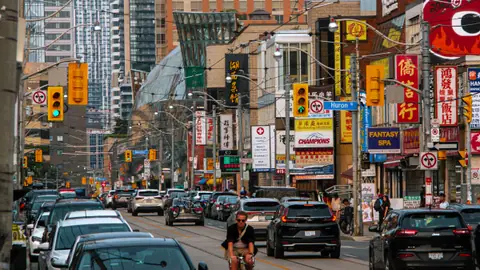
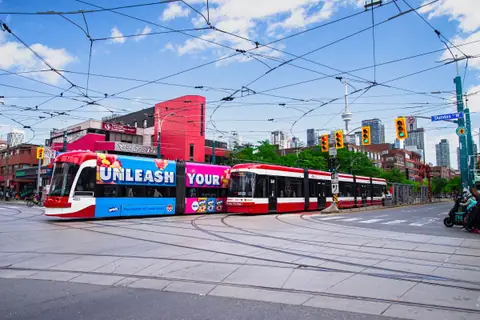
The AGO works best as the starting point. Walk south and west to Spadina Avenue and the Dundas crossing, where Chinatown begins with bakeries, herbalists and noodle shops. Continue north-west into Kensington Market for a late lunch, then finish on Queen Street West for the independent shops and galleries. The loop is walkable, and the Dundas streetcar or the St. Patrick subway station can carry you home if your legs give out.
What to skip, and who it suits
The AGO is for people who like looking at pictures, and who enjoy a building that is part of the show. If you want dinosaurs, mummies or something that entertains children without effort, the Royal Ontario Museum is the safer choice. It is also a poor fit for a rushed visit squeezed between two timed attractions, because the building invites you to wander and the collection loses its effect at speed.
We would skip trying to read every label in the European rooms unless that is your specialism; the Canadian and Inuit halls give you something you cannot see elsewhere. For a wet or very cold day, the AGO pairs well with lunch in Chinatown and a stroll under cover wherever you can find it. Photographers will find the glass front at its best in low afternoon light, when the timber of the stair glows against the windows. In warmer weather, give yourself time on the pavement afterwards, because the streets around it are as much a part of the visit as the collection. If you are working through the city by area, our things to do guide shows where this fits among the other big names.
Traveller tips
Real advice from people who have been to Art Gallery of Ontario (AGO). Every tip is read by our team before it goes live.
No tips yet. Been here? Yours could be the first.
Thank you! Your tip will appear here after a quick review.
More in Toronto
Continue exploring Toronto with related neighbourhood, food, and planning guides