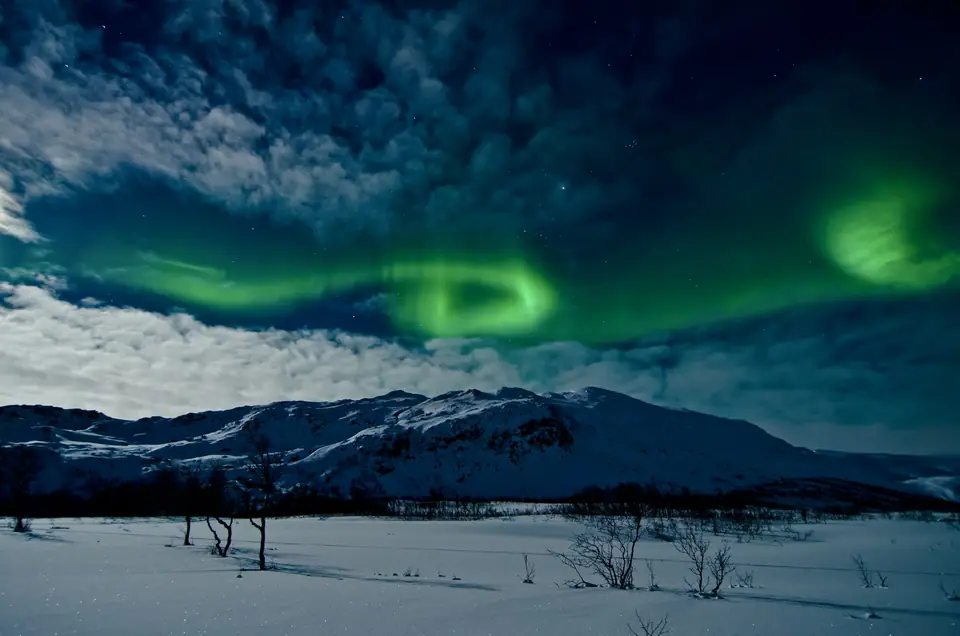
Northern Lights (Aurora Borealis) and Midnight Sun in Tromsø
Positioned directly beneath the auroral oval at nearly 70 degrees north, Tromsø experiences both the winter aurora borealis season from September to April and 69 days of continuous midnight sun from 18 May to 25 July.
Because Tromsø sits at 69 degrees 40 minutes north latitude, directly beneath the geomagnetic auroral oval yet warmed by the North Atlantic Current, it offers the mildest winter coastal temperatures of any major city in the global northern lights belt. Tromsø's 1991 to 2020 winter temperatures average -3.0 °C in January and -3.3 °C in February, letting visitors watch the aurora borealis without extreme polar cold. Conversely, Earth's 23.4-degree axial tilt brings two months of continuous summer daylight when the sun never dips below the northern horizon. Pair these seasonal cycles with month-by-month weather statistics in the best time to visit Tromsø guide.
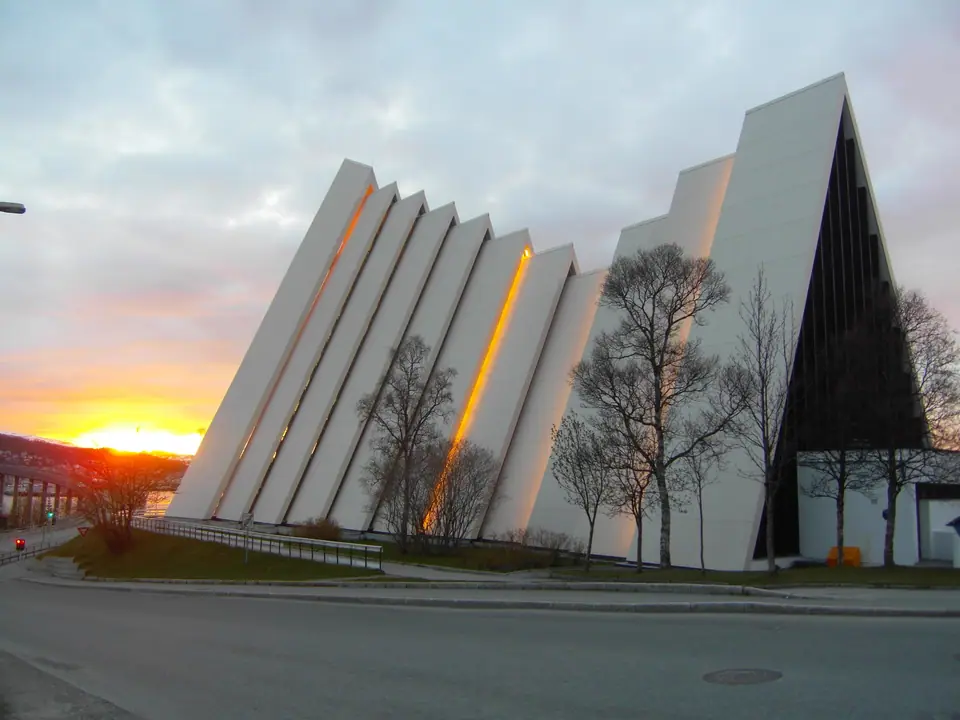
Aurora Borealis Physics and Tromsø's 1928 Auroral Observatory
The aurora borealis occurs when charged electrons and protons carried by the solar wind are channelled along Earth's magnetosphere into the upper atmosphere at altitudes between roughly 80 and 600 kilometres, colliding with oxygen atoms to emit green light (around 557.7 nanometres) at 100 to 200 kilometres altitude and rarer crimson-red light higher up, while nitrogen molecules produce violet and blue fringes. Following Kristian Birkeland's northern lights research, the Rockefeller Foundation funded the Auroral Observatory (Nordlysobservatoriet) beside Lake Prestvannet in 1927. Opened in 1928 under its first director Leiv Harang, the observatory was absorbed into the University of Tromsø when the university opened in 1972.
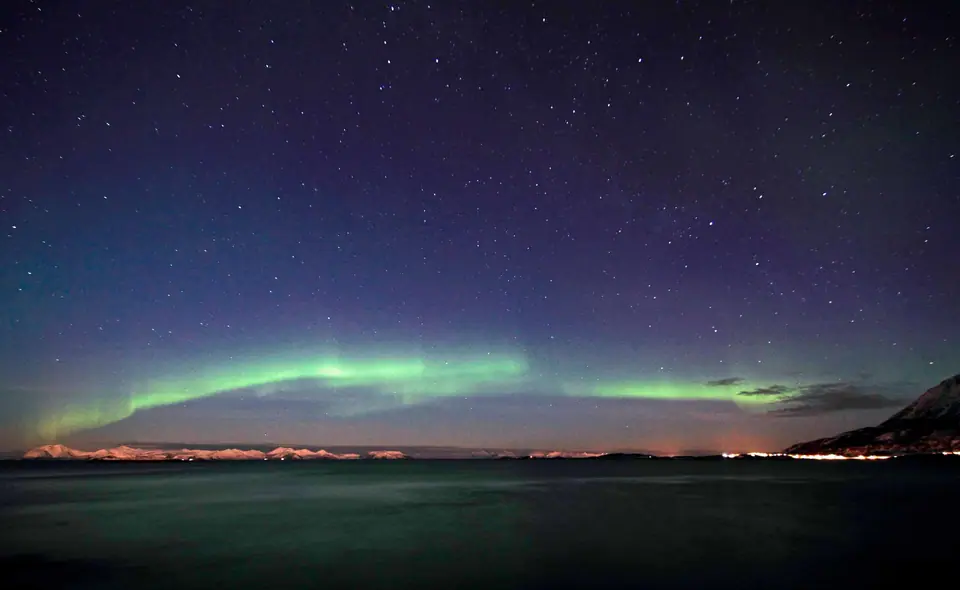
When and Where to Watch the Northern Lights Around Tromsø
Auroral activity occurs year-round in the upper atmosphere, but dark night skies are required to see it: in Tromsø, the viewing season runs from early September through early April, peaking from mid-evening through the hours past midnight when Tromsø rotates beneath the midnight sector of the auroral oval. On Tromsøya island, two dark-sky parks are reachable on foot or by city bus: the shoreline of Telegrafbukta at the southwestern tip of the island and the birch-ringed perimeter path of Lake Prestvannet at 96 metres elevation, as well as the upper deck of Fjellheisen on Storsteinen. When coastal clouds cover the ocean side, aurora chasers drive west to Ersfjordbotn on Kvaløya or east into the rain shadow of the Lyngen Alps and Skibotn.
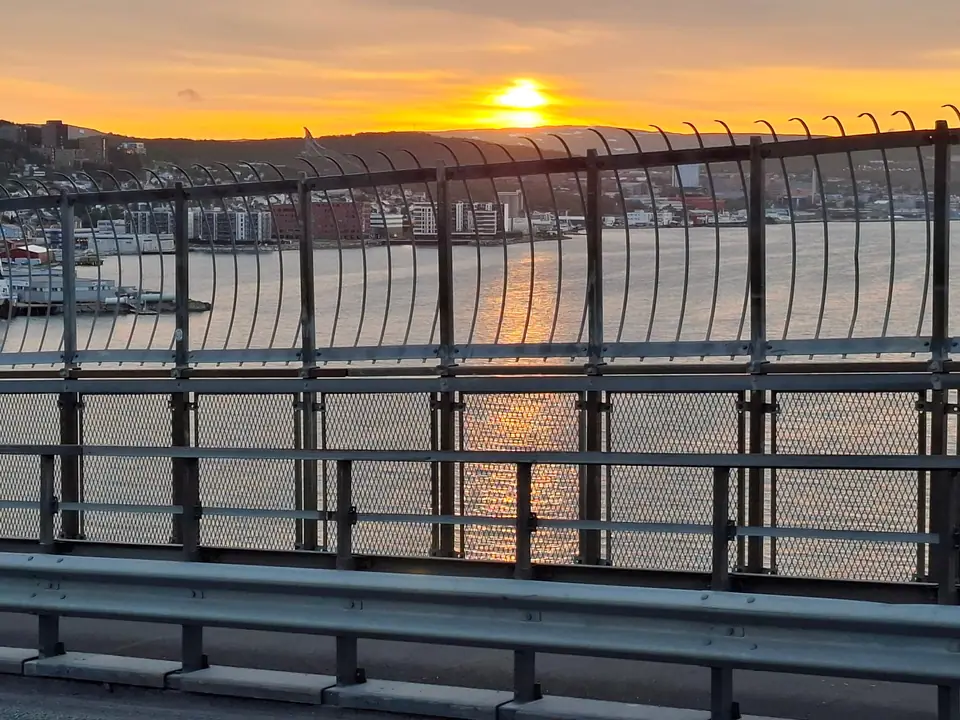
Midnight Sun (18 May to 25 July) and Polar Night (26 November to 15 January)
During summer, the sun stays continuously above the geometric horizon in Tromsø from 18 May to 25 July (69 days, or from 15 May to 27 July when accounting for atmospheric refraction from elevated viewpoints). Every June since 1990, the Midnight Sun Marathon starts and finishes on Storgata and crosses the Tromsø Bridge under nocturnal sunlight. In winter, the sun remains below the horizon during the polar night (mørketid) from 26 November to 15 January (or 21 November to 17 January behind the surrounding mountain ridges), yet Tromsø's latitude (within 67°24' to 72°34' north) still receives several hours of blue civil polar twilight around solar noon before the sun returns on Soldagen (21 January).
Birkeland's Terella Experiments and Polar Sky Science
Long before modern satellites monitored solar flares and coronal mass ejections, Norwegian physicist Kristian Birkeland organised high-latitude expeditions across northern Norway at the turn of the twentieth century to prove that electric currents flowing along magnetic field lines from the sun cause the polar lights. By recreating glowing auroral rings inside an evacuated glass chamber around a magnetised metal sphere called a terella, Birkeland laid the foundation for space weather physics, a scientific tradition still demonstrated today for visitors inside the Arctic University Museum on southern Tromsøya.
When the permanent observatory opened near the shores of Lake Prestvannet in the late 1920s, researchers used sensitive magnetometers, spectrographs, and parallactic cameras to measure the exact height and wavelength of auroral curtains above the island. Because the city sits directly beneath the quiet-time auroral oval, even gentle geomagnetic activity produces visible green arcs overhead whenever the sky is dark and free of low cloud cover, whereas stronger solar storms unleash fast-moving coronal draperies rippled with pink and violet lower borders.
Microclimates, Rain Shadows and Camera Settings
Watching the northern lights around Tromsø is as much a game of local meteorology as of solar activity. When westerly winds push moist maritime clouds off the Norwegian Sea against the outer islands, the sky above the harbour and central Tromsø hotels may be overcast while inland valleys further east enjoy crisp, star-filled conditions. On clear, calm evenings, staying on the island at Telegrafbukta, Lake Prestvannet, or the upper viewing platform at Storsteinen lets you see the lights without leaving town; on cloudy nights, mobile chasers follow real-time satellite imagery either west toward the open coast of Kvaløya or east into the dry rain shadow behind the Lyngen Alps toward the Finnish border.
To photograph the aurora cleanly, mount a camera or modern smartphone on a sturdy tripod to prevent wind vibration, switch the lens to manual focus set to infinity on a bright star or distant harbour light, and use a wide aperture with an exposure lasting several seconds so the sensor captures the subtle colour gradients of the moving curtains. Because cold night breezes drain lithium batteries rapidly, keep spare power banks and camera batteries tucked inside an inner fleece pocket close to body heat, and wear insulated boots with wool socks while standing still on snow or frozen ground.
From mid-May through late July, the midnight sun transforms the rhythm of outdoor life across the archipelago. With the sun skimming low along the northern horizon above the sea and mountain peaks rather than setting, late-evening hours bathe the fjords and wooden streets in warm golden light ideal for quiet hikes, sea kayaking, and late-night photography without crowds. Travellers visiting during these bright summer weeks should pack a comfortable sleep mask and draw hotel blackout curtains tightly to keep circadian rhythms steady.
Conversely, during the winter polar night from late November to mid-January, the sun stays just below the southern horizon, yet the sky is far from pitch-black at midday. For several hours around noon, refracted sunlight scatters across the upper atmosphere over snow-blanketed mountains and water, filling the city with a soft pastel glow ranging from pearl pink to deep indigo blue before twilight fades into the long auroral evening.
Traveller tips
Real advice from people who have been to Northern Lights (Aurora Borealis) and Midnight Sun in Tromsø. Every tip is read by our team before it goes live.
No tips yet. Been here? Yours could be the first.
Thank you! Your tip will appear here after a quick review.
More in Tromsø
Continue exploring Tromsø with related neighbourhood, food, and planning guides