


























Polar Museum (Polarmuseet), Skansen and Roald Amundsen Guide
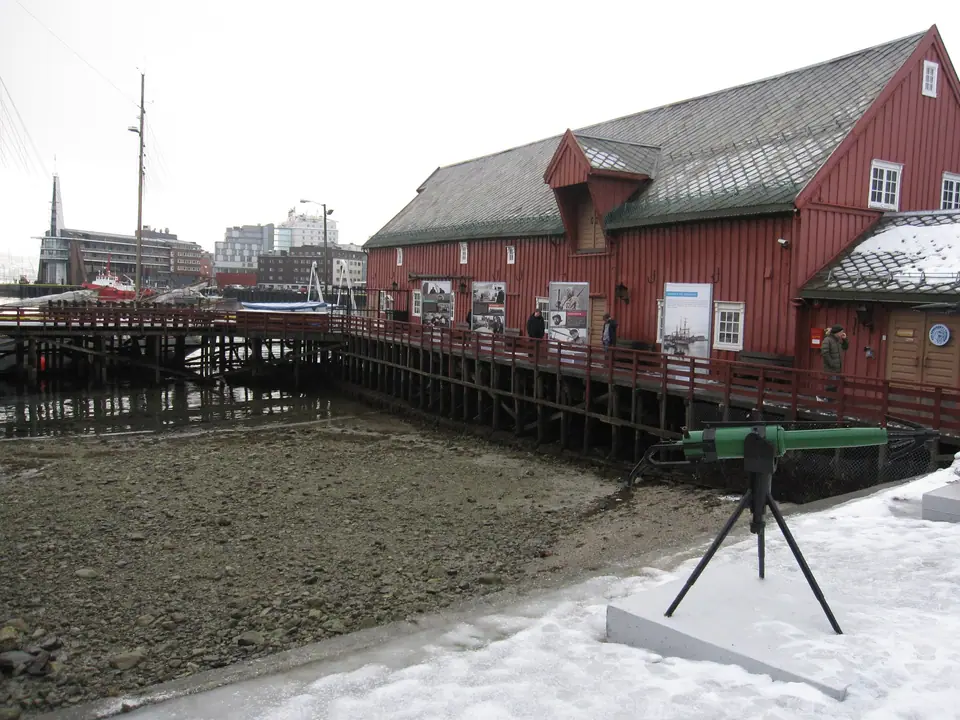
Clustered around the historic Skansen fortification on the northeastern shore of Tromsøya, the 1830s red customs warehouses of the Polar Museum chronicle Arctic winter trappers and Roald Amundsen's expeditions.
At the northeastern point of central Tromsø, just steps south of the western abutment of the Tromsø Bridge, the turf ramparts of Skansen and the timber pier of Tollbodbrygga form the oldest surviving built ensemble in the city. Here, where Tromsø's medieval church stood around 1252 and where customs officers inspected Russian Pomor grain vessels after Tromsø gained its 1794 town charter, an 1830s red wooden customs warehouse houses the Polar Museum (Polarmuseet). Together with the Roald Amundsen statues at Prostneset and the preserved sealing cutter MS Polstjerna further south, this quarter explains why Tromsø became known as the Gateway to the Arctic.
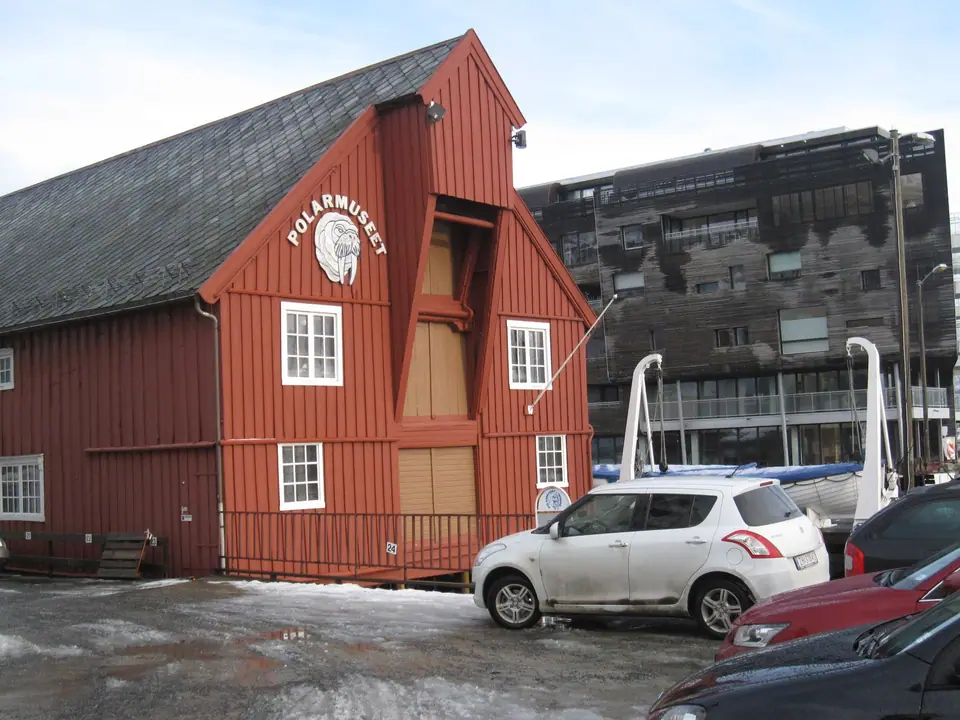
The Polar Museum (Polarmuseet): 1978 Opening in an 1830s Warehouse
The Polar Museum occupies the protected Wharf Customs Warehouse and Customs Packing House (Tollpakkhuset) at Søndre Tollbodgate 11B, built along the water's edge between 1833 and the late 1830s. Opened on 18 June 1978, 50 years after Roald Amundsen's final flight from Tromsø, its timber rooms trace two centuries of Arctic survival.
Svalbard Winter Trappers: Henry Rudi and Wanny Woldstad
Permanent rooms reconstruct overwintering trappers' cabins from Svalbard, showcasing the hunting careers of Wanny Woldstad (the first female winter trapper on Svalbard in the 1930s) and Henry Rudi (known as the "Polar Bear King", who spent 27 winters in the Arctic and hunted 713 polar bears), alongside Willem Barentsz's 1596 discovery of Spitsbergen and seventeenth-century whaling stations.
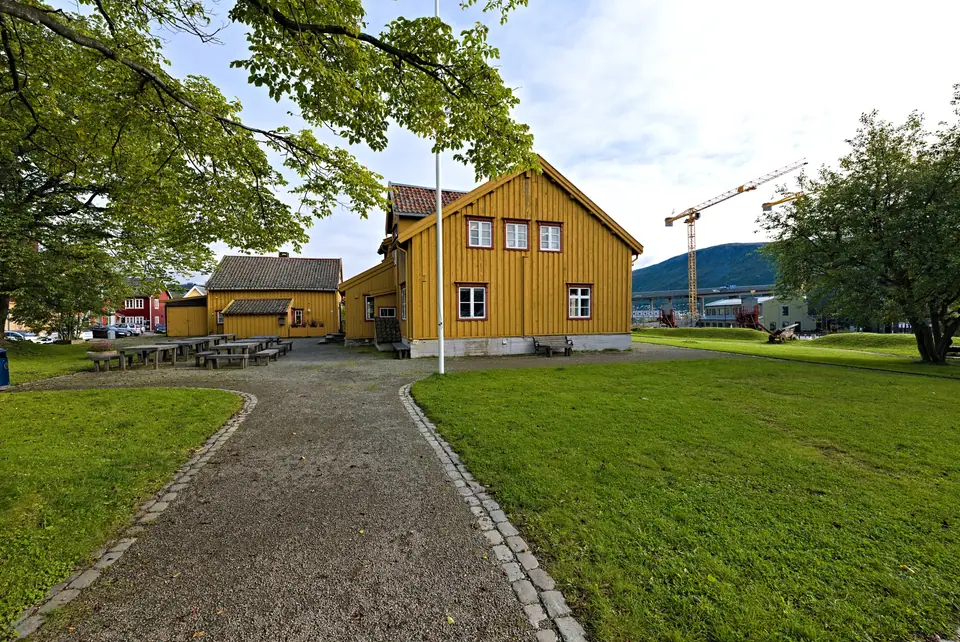
Skansen: Thirteenth-Century Earthworks and the 1789 Timber Tollhouse
Immediately west of the Polar Museum pier lies Skansen (monument ID 87577 in the Norwegian Directorate for Cultural Heritage), a semicircular turf-and-stone fortification surrounded by traces of a water-filled moat dating to the High Middle Ages (thirteenth to fourteenth centuries), built to defend the church and anchorage against Karelian and Russian raids. Inside the earthwork stands Tromsø's oldest surviving building, the yellow Empire-style Main Customs House (Tollboden på Skansen), erected in 1789 after King Christian VII established trade freedom and a customs station in Northern Norway in 1787. Used by Reichskommissar Josef Terboven during the Second World War, the house later held the Tromsø City Museum.
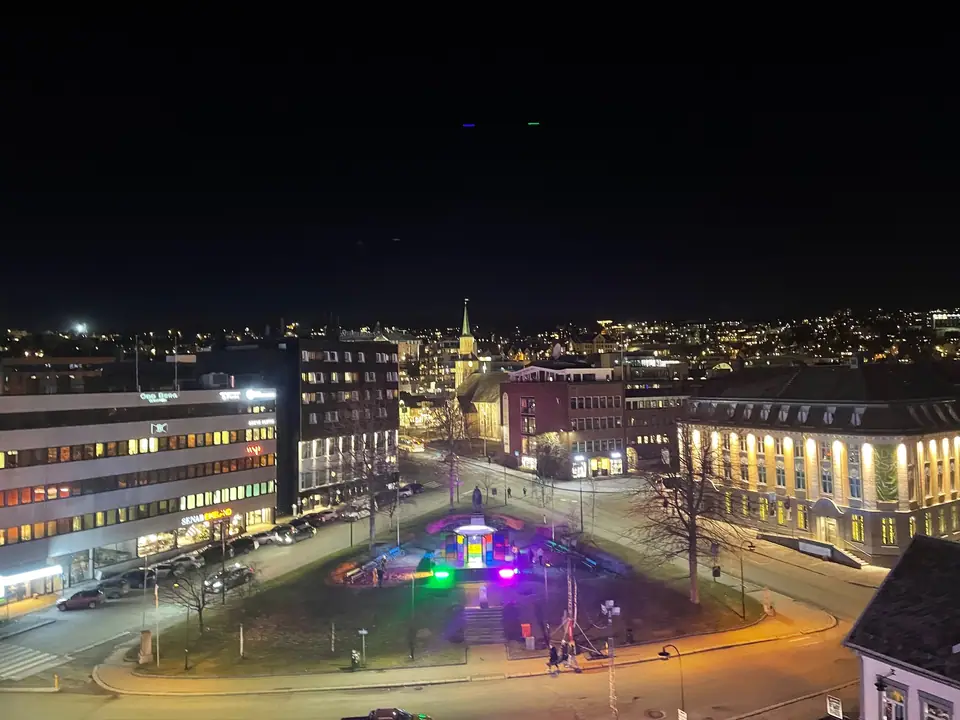
Nansen, Amundsen and Polar Outfitting on Storgata
From the late nineteenth century, nearly every major Arctic expedition recruited ice pilots, dog handlers, and ships in Tromsø and outfitted equipment through pharmacist Fritz G. Zapffe at Storgata 42. Fridtjof Nansen called at Tromsø with Fram in 1893, and Roald Amundsen used the port for his Gjøa, Maud, and 1925 to 1926 Dornier Wal and Norge flights.
Amundsen's Final Flight Aboard the Latham 47 (18 June 1928)
When Italian general Umberto Nobile's airship Italia crashed on the pack ice north of Spitsbergen in May 1928, Amundsen boarded the French twin-engine flying boat Latham 47 (registration F-FRJX, piloted by René Guilbaud) in Tromsø harbour on 18 June 1928; the aircraft vanished over the Barents Sea three hours later. Visitors can see Amundsen's monument on Roald Amundsens plass and his bronze bust outside Polaria.
Walking across the cobblestones of Søndre Tollbodgate to the water's edge at Tollbodbrygga takes you directly into the working maritime fabric of nineteenth-century Tromsø. Unlike purpose-built modern galleries, the Polar Museum's home inside the low-ceilinged 1830s customs packing house retains its heavy hand-hewn pine beams, creaking plank floors, and small multi-paned windows looking out over the narrow sound where wooden sealing sloops and expedition ships once dropped anchor to load coal, dried fish, sled dogs, and winter provisions.
Because the museum is organised room by room across two connected warehouse wings, visitors follow a chronological path from early European voyages into the Barents Sea to the golden age of solitary winter trapping and twentieth-century polar aviation. Detailed English exhibition booklets borrowed at the ticket desk translate every display case label, allowing you to read original diary entries, trapping ledgers, and telegrams sent back to Tromsø from the high Arctic pack ice without missing historical nuances.
Life Inside an Overwintering Svalbard Trapper's Cabin
Among the most evocative spaces inside the warehouse are the life-size reconstructions of tiny driftwood and tar-paper trappers' huts from Svalbard. Isolated for months at a time through the freezing darkness of the high-Arctic winter without radio contact or medical aid, trappers like Henry Rudi and Wanny Woldstad survived on fresh seal and ptarmigan meat while tending long lines of wooden deadfall fox traps and automatic spring-gun polar bear boxes set along frozen fjord shores.
Display cases alongside the cabins hold homemade fur mittens, whale-oil lamps, reloading presses, and hand-carved tools that show the extreme self-reliance required to avoid scurvy, frostbite, and carbon monoxide poisoning inside snow-buried shelters. Separate maritime rooms trace how Dutch navigator Willem Barentsz mapped Bear Island and Spitsbergen during his 1596 search for a Northeast Passage, followed by centuries of Dutch, English, Russian Pomor, and Norwegian walrus and bowhead whale hunting across the northern archipelagos.
Roald Amundsen's Footsteps Around Tromsø Harbour
Beyond the walls of the museum, Roald Amundsen's deep connection to the city remains visible at several waterfront landmarks within a brief walk along the harbour. Outside the red warehouse entrance on the pier stands a bronze bust of the explorer looking out across the water toward Tromsdalen, while further south at Roald Amundsens plass near Prostneset rises a full-length statue commemorating his polar voyages through the Northwest Passage, to the South Pole, and across the Arctic Ocean aboard the airship Norge.
After touring the indoor galleries at Søndre Tollbodgate, step next door onto the grass-covered medieval ramparts of Skansen to admire the yellow 1789 Empire timber customs house and look straight across the harbour basin toward the Tromsø Bridge. From Skansen, you can walk south down Storgata past Fritz G. Zapffe's historic polar pharmacy at number 42 and finish at the southern quayside to inspect the 1949 sealing vessel MS Polstjerna inside its glass preservation pavilion, completing a full-day circuit of Tromsø's polar exploration heritage on foot. Along the harbour quay between Skansen and Prostneset, interpretive plaques and preserved timber wharf buildings further illustrate how captains, ice pilots, and scientists prepared their ships before sailing north toward the pack ice of Spitsbergen, Franz Josef Land, and the Greenland Sea.
Traveller tips
Real advice from people who have been to Polar Museum (Polarmuseet), Skansen and Roald Amundsen. Every tip is read by our team before it goes live.
No tips yet. Been here? Yours could be the first.
Thank you! Your tip will appear here after a quick review.
More in Tromsø
Continue exploring Tromsø with related neighbourhood, food, and planning guides
Kvaløya Island, Ersfjordbotn, Sommarøy and Lyngen Alps Day Trips
Tromsø, Norway
What to Eat in Tromsø: Arctic Cod, Reindeer, Biđus and Mack Beer
Tromsø, Norway
How to Get to Tromsø: Langnes Airport, Hurtigruten and Buses
Tromsø, Norway
Where to Stay in Tromsø: Best Areas from Storgata to Sommarøy
Tromsø, Norway
