


























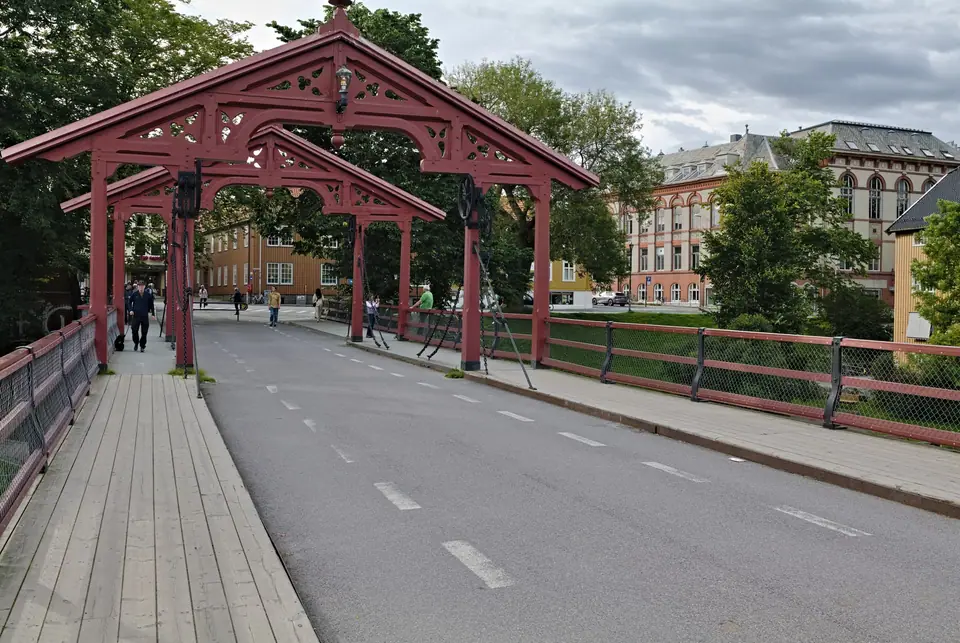
Bakklandet, Gamle Bybro and the Trampe Bicycle Lift
Cross the 82-metre Gamle Bybro through Lykkens Portal into cobbled Bakklandet and see the 130-metre Sykkelheisen Trampe bicycle lift on Brubakken.
Directly across the Nidelva river from Nidaros Cathedral and the Kjøpmannsgata wharves, Bakklandet is Trondheim's oldest suburb (forstad), stretching between the river and the hillside below Kristiansten Fortress. Divided into Nedre Bakklandet along the riverfront and Øvre Bakklandet higher up the slope, the area grew during the first half of the 17th century as artisans, fishermen, and merchants settled across the river.
Siege Fires and the 17th-Century Suburb
Because Bakklandet lay immediately beneath the defensive guns of Kristiansten Fortress, military commanders repeatedly burned the wooden suburb to clear fields of fire: Swedish forces torched it during the siege of 1658, and Norwegian defenders burned it again in November 1718 when General Carl Gustaf Armfeldt's Swedish army marched on Trondheim. Rebuilt with small two-storey timber residences alongside riverside warehouses (brygger), Bakklandet later absorbed 19th-century brickyards, the Trondhjems Mekaniske Værksted shipyard, and in 1882 the railway approach to Bakke bru.
The 1970s Motorway Protest and Preservation
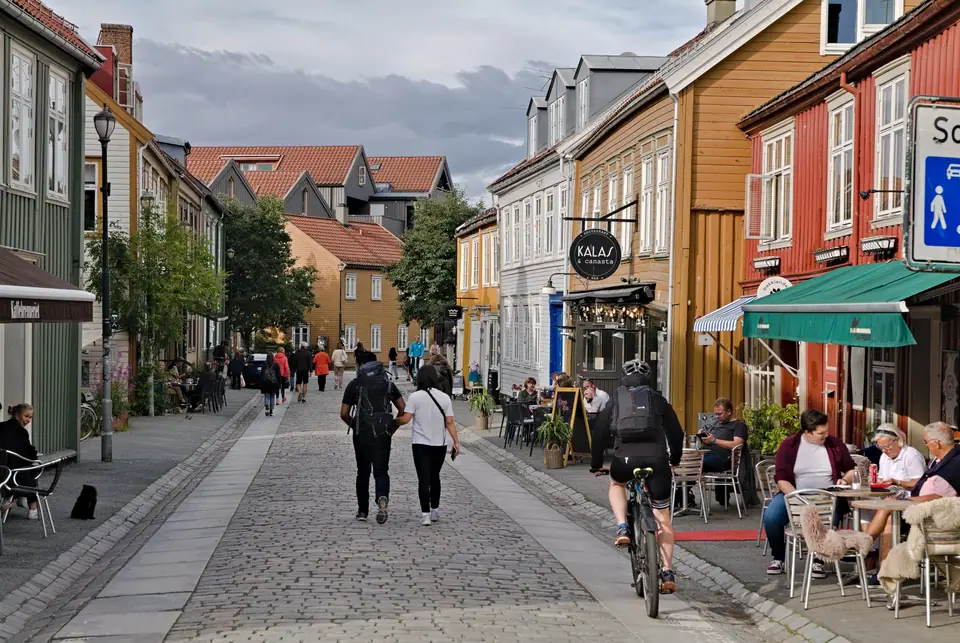
In the 1960s and 1970s, municipal planners proposed demolishing large parts of Bakklandet to build a relief highway (Bakklandstangenten). Local activism and student protests halted the project, leading to preservation in the 1980s that saved the cobbled streets of Nedre Bakklandet for pedestrians, cyclists, and cafés.
Gamle Bybro and Cicignon's 1681 Crossing
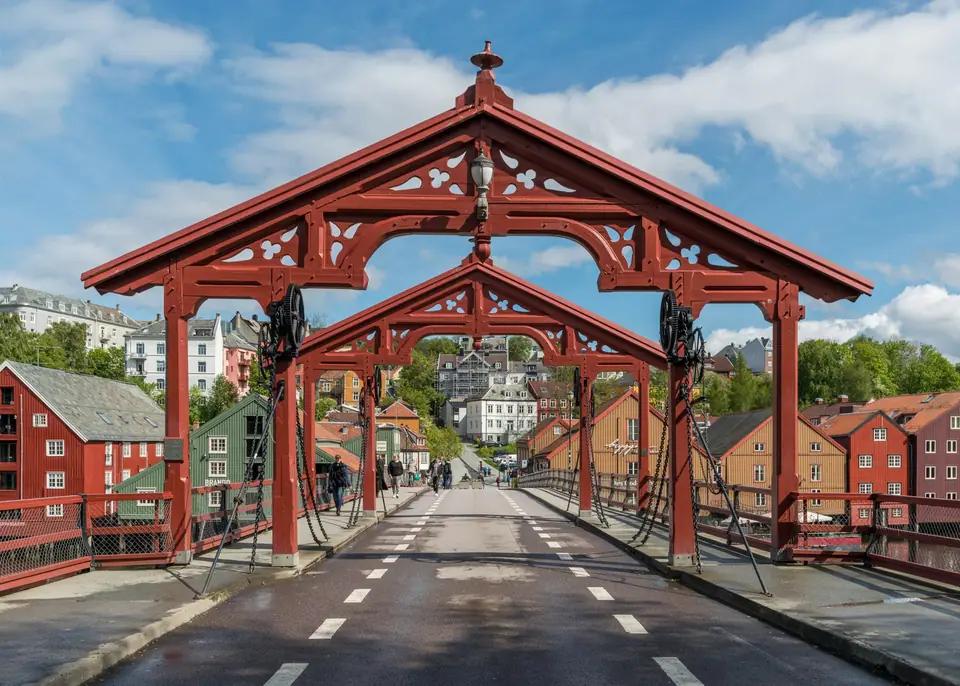
The link between Midtbyen and Bakklandet is Gamle Bybro (the Old Town Bridge), measuring 82 metres in length across the Nidelva river. Prior to 1681, river traffic used the medieval Elgeseter Bridge further upstream. As part of the 1681 city plan after the Horneman Fire, Major General Johan Caspar de Cicignon constructed a wooden bridge on three stone piers here so troops could move between the town and Kristiansten Fortress; King Christian V funded the work and opened the crossing in 1685.
Carl Adolf Dahl's 1861 Bridge and Lykkens Portal
Until 1816 a guarded excise gatehouse stood at the west end, and bridge tolls continued until Bakke bru opened in 1887. Rebuilt in its present form by city engineer Carl Adolf Dahl in 1861 with carved wooden portals at either end, the bridge was nicknamed Lykkens portal (Portal of Happiness) after resistance fighter and composer Oskar Hoddø wrote his famous waltz about the Nidelva river there in April 1940.
Brubakken and the Trampe Bicycle Lift
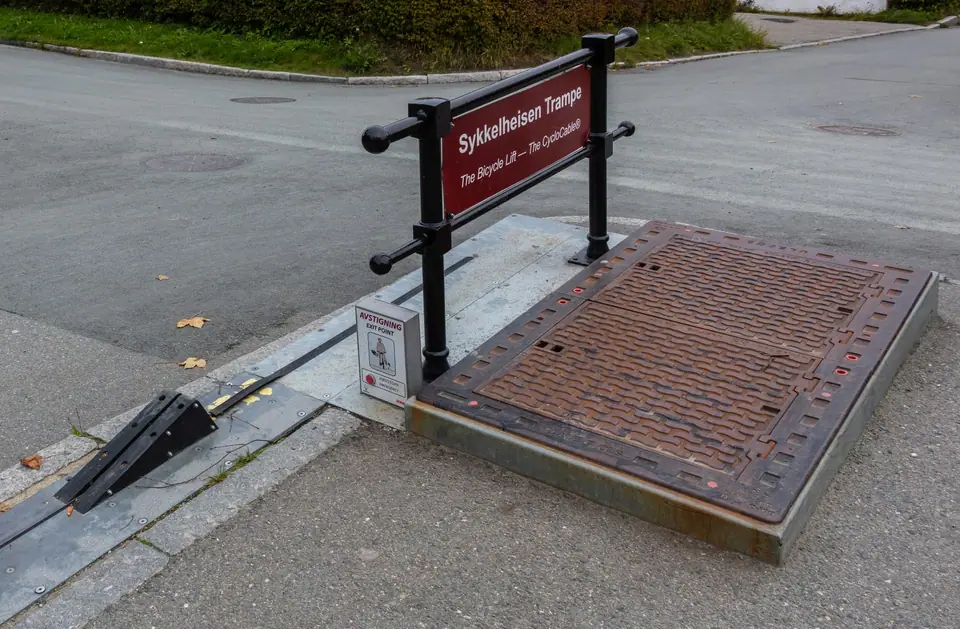
At the eastern end of Gamle Bybro, Brubakken climbs sharply toward Kristiansten Fortress. Built into the right-hand kerb of Brubakken is the Trampe bicycle lift (Sykkelheisen Trampe), the world's first cable-driven footplate lift for cyclists. Designed in 1992 by civil engineering student Jarle Wanvik and opened on 18 August 1993 the 130-metre wire-rope track climbs an 18% gradient (roughly 1:5) at up to two metres per second, carrying up to five cyclists spaced 20 metres apart. After transporting over 200,000 riders, the lift was upgraded in 2013 to the CycloCable system and operates free of charge.
How the CycloCable Footplate Works on Brubakken
Watching or trying the bicycle lift on Brubakken is one of Bakklandet's everyday street scenes. Unlike a ski lift where riders dismount from their equipment, cyclists remain seated on their own bicycles along the right-hand side of the paved lane. At the bottom starting station beside Gamle Bybro, the rider places the right foot onto a small metal footplate that emerges from a narrow slot in the kerb while keeping the left foot on the bicycle pedal. When the cable mechanism engages, the footplate glides smoothly uphill along the 130-metre track, pushing the rider and bicycle up the steep 18% incline toward the top of the ridge near Kristiansten Fortress and onward routes toward the university campuses at Gløshaugen.
Because Brubakken is paved and open to pedestrians, visitors without bicycles can walk up the pavement alongside the track, stopping halfway to look back over the red-tiled and corrugated roofs of Bakklandet toward the green copper spire of Nidaros Cathedral on the opposite bank. The view down the hill frames the wooden arches of Gamle Bybro and the reflections of the riverside wharves in the slow current below.
Walking Nedre and Øvre Bakklandet
To appreciate the architectural texture and social preservation of the suburb, walk a loop that takes in both the lower riverside street (Nedre Bakklandet) and the upper parallel lane (Øvre Bakklandet):
- Nedre Bakklandet: Lined with low timber cottages painted ochre, white, dark red, and soft green, where former artisan workshops and ground-floor parlours now house independent coffee bars, bakeries, small design studios, ceramic workshops, and neighbourhood bistros with outdoor tables on the cobbles.
- The Riverside Wharves (Bakklandsbryggene): Narrow passages between the houses open onto viewing spots where wooden warehouses stand on timber pilings directly in the current of the Nidelva river, facing the matching Kjøpmannsgata wharves across the water.
- Øvre Bakklandet: A quieter residential lane higher on the slope, home to historic timber buildings such as Baklandet Skydsstation at Øvre Bakklandet 33, which dates from the late eighteenth century and serves traditional Norwegian lunches and regional cakes and warm drinks.
- Nygata and Lillegårdsbakken: Side streets that preserve the tight parcel layout established when wooden cottages were rebuilt following the seventeenth- and eighteenth-century military fires.
From the northern end of Nedre Bakklandet near Bakke bru, you can continue straight along the east bank into the converted brick shipyard district of Nedre Elvehavn (Solsiden) and cross the Verftsbrua footbridge to Brattøra, or recross the Nidelva into Midtbyen. Travellers considering an overnight base in these quiet timber lanes can compare Bakklandet with central Munkegata in our Trondheim accommodation guide and three-day itinerary.
Photographers visiting Gamle Bybro find different light conditions depending on the hour and season. In the morning, sunlight strikes the western facades of the Bakklandet warehouses along the east bank, whereas late afternoon and long summer evenings illuminate the ochre and red gables of Kjøpmannsgata on the west bank while casting warm reflections beneath the timber spans of the bridge. Because motor traffic is restricted on Gamle Bybro and along Nedre Bakklandet, the crossing remains calm and pedestrian-friendly throughout the day. In winter, when frost and fresh snow settle on the red wooden portals of Lykkens Portal and warm lamplight glows from the small multi-pane windows of Nedre Bakklandet, the walk from the cathedral riverbank over to the foot of Brubakken feels especially atmospheric and unhurried.
Traveller tips
Real advice from people who have been to Bakklandet, Gamle Bybro and the Trampe Bicycle Lift. Every tip is read by our team before it goes live.
No tips yet. Been here? Yours could be the first.
Thank you! Your tip will appear here after a quick review.
More in Trondheim
Continue exploring Trondheim with related neighbourhood, food, and planning guides
Ringve Music Museum, NTNU Gløshaugen and Bymarka Trails
Trondheim, Norway
What to Eat in Trondheim: Sodd, Skjenning, Seafood and Dahls
Trondheim, Norway
How to Get to Trondheim: Værnes Airport, Rail Lines and Port
Trondheim, Norway
Where to Stay: Midtbyen, Bakklandet, Solsiden and Brattøra
Trondheim, Norway
