


























Stiftsgården Royal Residence, Torvet Square and Vår Frue Kirke
Explore Stiftsgården, the 140-room wooden royal palace built in 1774 to 1778 on Munkegata, alongside Torvet's sundial and medieval Vår Frue kirke.
At the heart of Johan Caspar de Cicignon's 1681 Baroque street grid, where the wide avenues of Munkegata and Kongens gate intersect, Midtbyen brings together Trondheim's grandest 18th-century wooden architecture, its central civic square, and its second surviving medieval stone church.
Stiftsgården: Northern Europe's Largest Wooden Palace
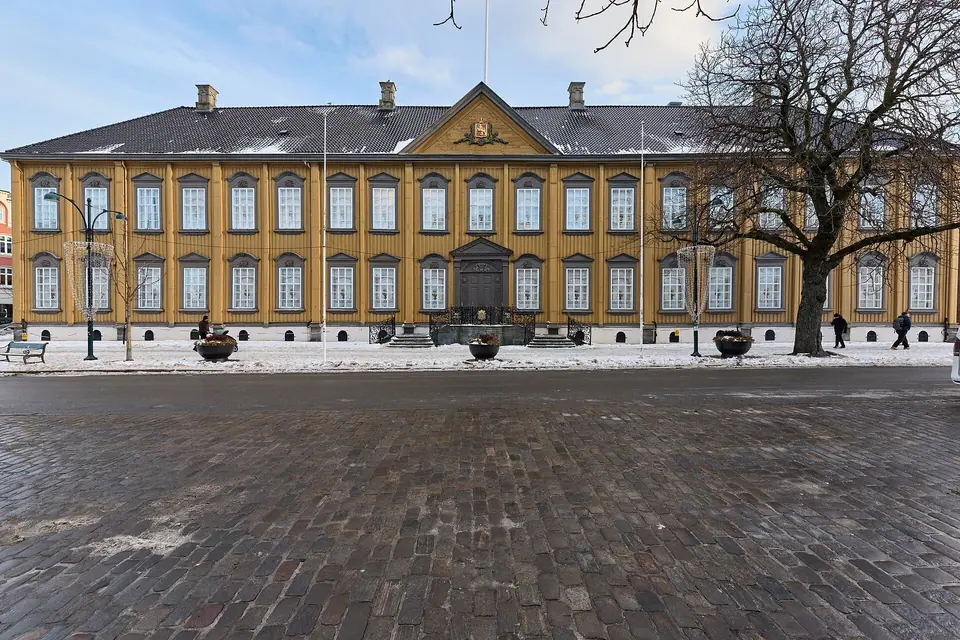
Standing at the corner of Munkegata and Dronningens gate, Stiftsgården is the official royal residence in Trondheim and one of the largest wooden buildings in Northern Europe, comprising roughly 140 rooms across 4,000 square metres (43,000 square feet). The three-winged U-shaped townhouse, featuring a 58-metre main facade along Munkegata and two courtyard wings built of notched log timber clad in smooth panelling, was erected between 1774 and 1778 for Privy Councillor (geheimerådinne) Cecilie Christine von Schøller (1720 to 1786), daughter of General Johan Friderich Frølich and wealthy widow of chamberlain and merchant Stie Tønsberg Schøller. Blending late Rococo ornament with Neoclassical symmetry (likely designed with her cousin Admiral Christian Lerche), the palace received the city's highest fire-insurance valuation in 1777.
From Private Townhouse to Coronation Residence
Cecilie Christine Schøller spent most of her final years in Copenhagen, where she died in 1786; her son-in-law General Georg Frederik von Krogh lived in the palace and hosted Crown Prince Frederik of Denmark-Norway here in 1788 before Schøller's grandson sold the estate to the state in 1800. Serving first as the residence of the regional governor (stiftsamtmann) and royal family, and housing the Bank of Norway's vault in its basement from 1816 to 1819, Stiftsgården became exclusively the royal residence in 1906, when part of its Baroque garden opened as Stiftsgårdsparken. It hosted festivities for the coronations of Carl III Johan (1818), Carl IV (1860), Oscar II (1873), and Haakon VII (1906), the benedictions of Olav V (1958) and Harald V (1991) at Nidaros Cathedral, and Princess Märtha Louise's wedding in 2002. Check the official site for summer guided tour schedules.
Torvet Square, the Olav Tryggvason Sundial, and Vår Frue Kirke
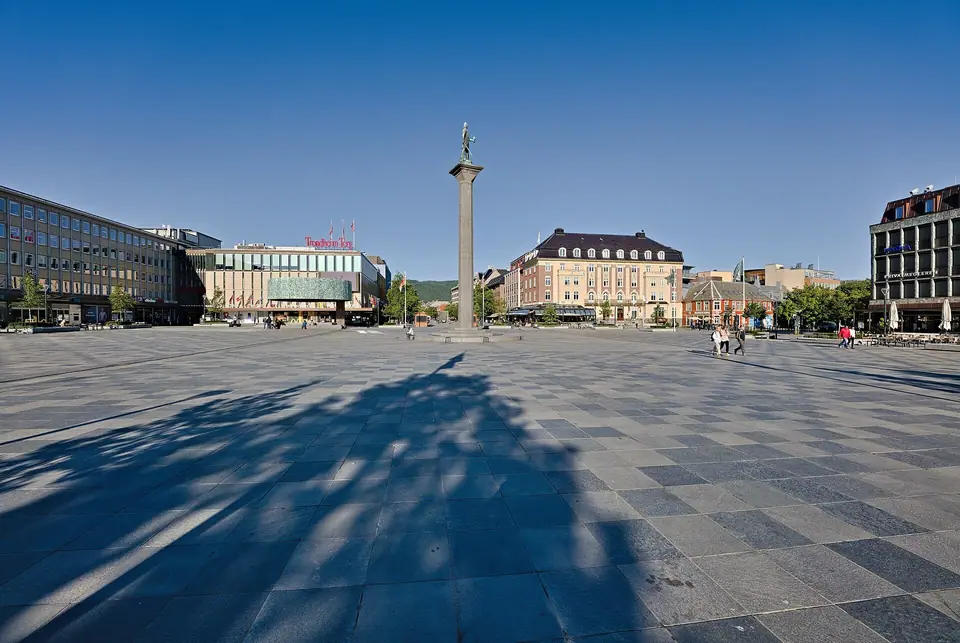
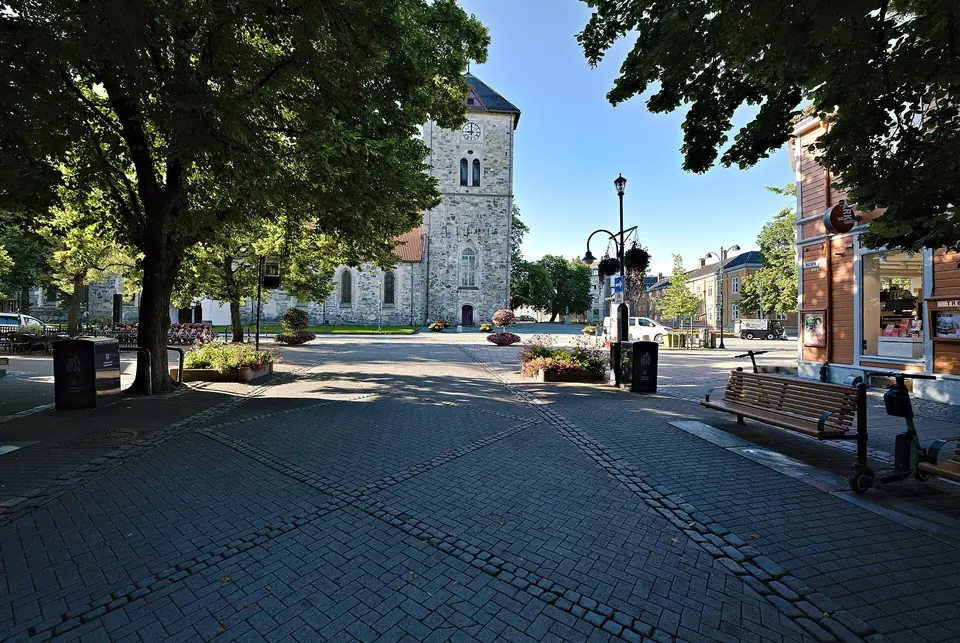
One block south on Munkegata opens Torvet, the central square laid out in Cicignon's 1681 plan. Rising from the middle of the square is the statue of city founder Olav Tryggvason on a high column by sculptor Wilhelm Rasmussen, unveiled on 18 September 1921 to mark the opening of the Dovre Line railway; for the 900th anniversary of St. Olav in 1930, a cobblestone sundial was set around the base so the column's shadow marks the hours. At the southeastern edge stands Tone Thiis Schjetne's 1983 bronze sculpture Go'dagen (Torgkona), while the northeast corner is framed by Sommergården. Just east along Kongens gate stands Vår Frue kirke (Church of Our Lady), whose stone choir and eastern nave survive from the medieval St. Mary's Church mentioned in Sverris saga around 1200, expanded after the 1651 fire with its west tower added in 1739 to 1742.
Inside Stiftsgården: Rococo Craftsmanship and Royal State Rooms
During the summer tourist season, guided tours take visitors through the principal reception rooms on the upper floor (piano nobile) of Stiftsgården, revealing how late-eighteenth-century Trondheim artisans blended European court styles with local timber building techniques. Behind the pale painted exterior panelling along Munkegata and Dronningens gate, the structural walls are constructed of massive horizontal notched logs (laftet tømmer). Inside, rooms are arranged in an enfilade sequence around the central ballroom and state dining room, decorated with carved overdoors, English and French wallpapers, painted canvas wall hangings, delicate ceiling plasterwork, and tall cast-iron and ceramic stoves made in Norwegian ironworks.
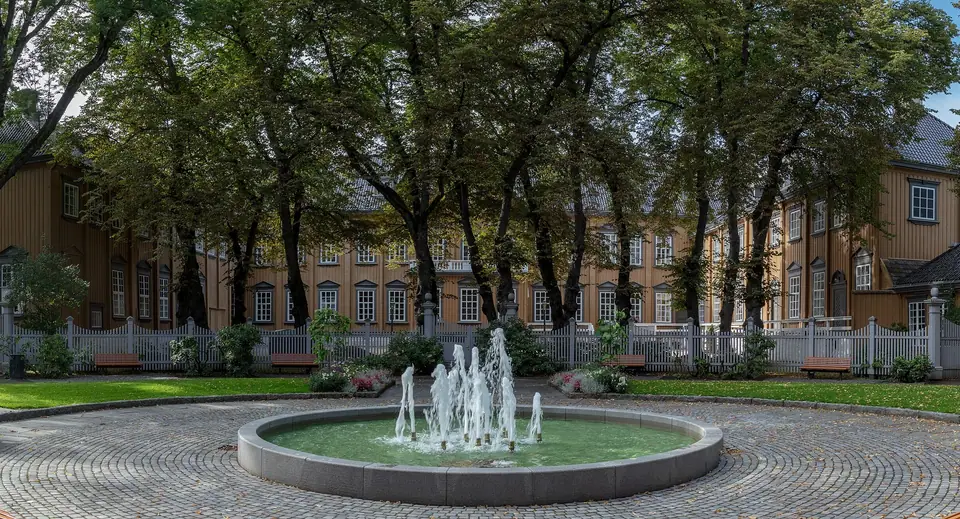
Immediately west of the courtyard wings lies Stiftsgårdsparken, a public garden opened in 1906 from part of Cecilie Christine Schøller's eighteenth-century Baroque pleasure grounds. With its shaded benches, fountain, formal hedges, and flowerbeds linking Munkegata with the pedestrian shopping street of Nordre gate, the park offers a quiet pause in the middle of Midtbyen.
Torvet's 2018 to 2020 Renewal and Surrounding Landmarks
Between 2018 and 2020, Torvet underwent a comprehensive stone-paving upgrade that cleared visual clutter around the 1921 Olav Tryggvason column and 1930 cobblestone sundial, creating an open pedestrian plaza laid with Norwegian slate in traditional rose patterns. Standing at the crossroads of Munkegata and Kongens gate, the square connects several key civic and historic buildings within a short walk:
- Sommergården: Framing the northeastern corner of Torvet at Kongens gate, a historic timber merchant residence now housing the preserved Svaneapoteket pharmacy interior with its late-nineteenth-century carved woodwork and glass apothecary jars.
- Hornemansgården: Occupying the southeastern quadrant of the square, a long low wooden complex from the eighteenth century used as a cultural and community centre by residents.
- Go'dagen (Torgkona): Tone Thiis Schjetne's 1983 bronze statue near the southeastern edge of the square, honouring Anna Kornelia Holm and the generations of coastal and country women who sold produce and handicrafts on the market cobbles.
- Vår Frue kirke and Tordenskioldsparken: Located half a block east on Kongens gate, where the medieval stone nave of the Church of Our Lady faces a small green square beside the nineteenth-century Britannia Hotel.
Because Torvet sits at the geometric midpoint of Munkegata, you can walk three blocks south to reach Nidaros Cathedral and Erkebispegården or three blocks north to reach the fish hall and Munkholmen ferry quay at Ravnkloa. In December, the square hosts the wooden chalets and canvas lavvo tents of Trondheim's winter market (see our seasonal guide), serving traditional Trøndelag sodd, cured meats, and local baked goods around open fire pits.
Architectural enthusiasts walking along Munkegata and Dronningens gate should also look closely at the symmetrical window framing, carved pilasters, and double portal doors of Stiftsgården's street facade. Unlike stone palaces elsewhere in Europe, the entire exterior relies on precision-milled wooden boards painted in a soft pale yellow hue that catches the northern sun while harmonising with the neighbouring eighteenth- and nineteenth-century timber townhouses of central Midtbyen. Pair a morning visit here with our three-day Trondheim itinerary. Even when the royal family is in residence and the interior rooms close briefly to tours, visitors can still admire the courtyard wings from Dronningens gate and relax beneath the trees of Stiftsgårdsparken before continuing across the river to Bakklandet.
Traveller tips
Real advice from people who have been to Stiftsgården Royal Residence, Torvet Square and Vår Frue Kirke. Every tip is read by our team before it goes live.
No tips yet. Been here? Yours could be the first.
Thank you! Your tip will appear here after a quick review.
More in Trondheim
Continue exploring Trondheim with related neighbourhood, food, and planning guides
Ringve Music Museum, NTNU Gløshaugen and Bymarka Trails
Trondheim, Norway
What to Eat in Trondheim: Sodd, Skjenning, Seafood and Dahls
Trondheim, Norway

How to Get to Trondheim: Værnes Airport, Rail Lines and Port
Trondheim, Norway

Where to Stay: Midtbyen, Bakklandet, Solsiden and Brattøra
Trondheim, Norway
