Nidaros Cathedral, Archbishop's Palace and the Crown Jewels
Visit the world's northernmost medieval cathedral (1070 to 1300), the 12th-century stone wings of Erkebispegården, and the Norwegian Crown Regalia.
Built over the burial site of King Olav Haraldsson (c. 995 to 1030), who fell at the Battle of Stiklestad in 1030 and was declared St. Olav one year later, Nidaros Cathedral (Nidarosdomen) is the northernmost medieval cathedral in the world and the second largest church in the Nordic region. According to Snorri Sturluson's Heimskringla, Olav's body was buried in a sandbank beside the Nidelva river before being moved to St. Clement's Church. Around 1070, King Olav Kyrre began a stone church on the site completed around 1090 and dedicated to the Trinity, called Christchurch (Kristkirken).
Romanesque Transept and Gothic Octagon
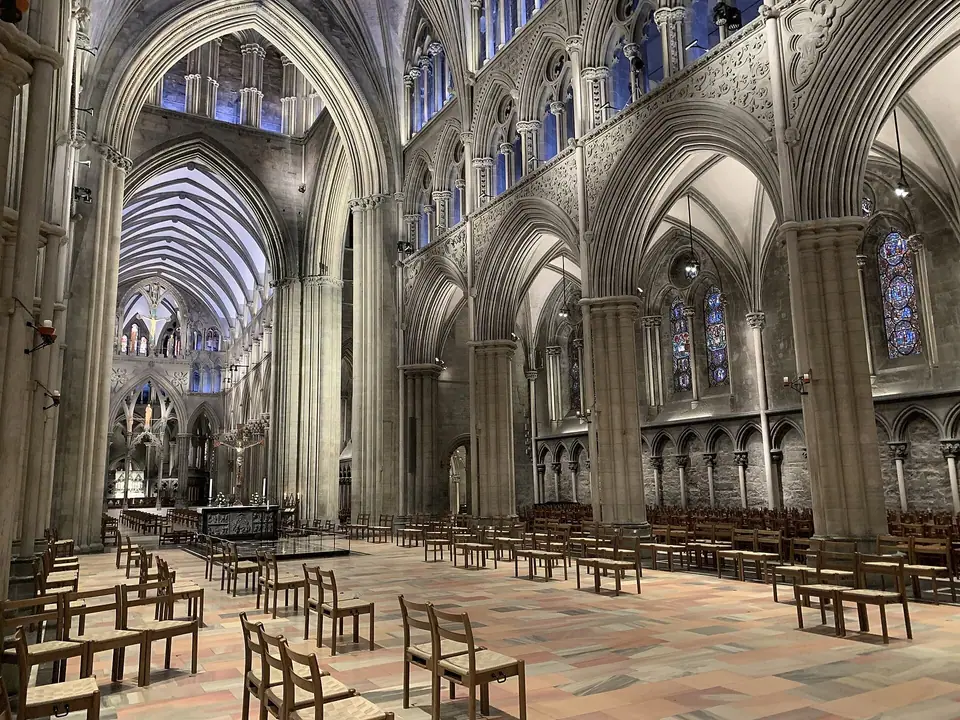
When Pope Eugene III established the Catholic Archdiocese of Nidaros in 1152, the church was enlarged westward with a central tower and a Romanesque transept displaying Anglo-Norman stonework. Following his exile in England from 1180 to 1183, Archbishop Øystein Erlendsson introduced Early English Gothic architecture, replacing the choir and adding the octagonal ambulatory (Oktogonen) around St. Olav's silver reliquary on the high altar.
The West Front and 1869 to 1983 Restoration
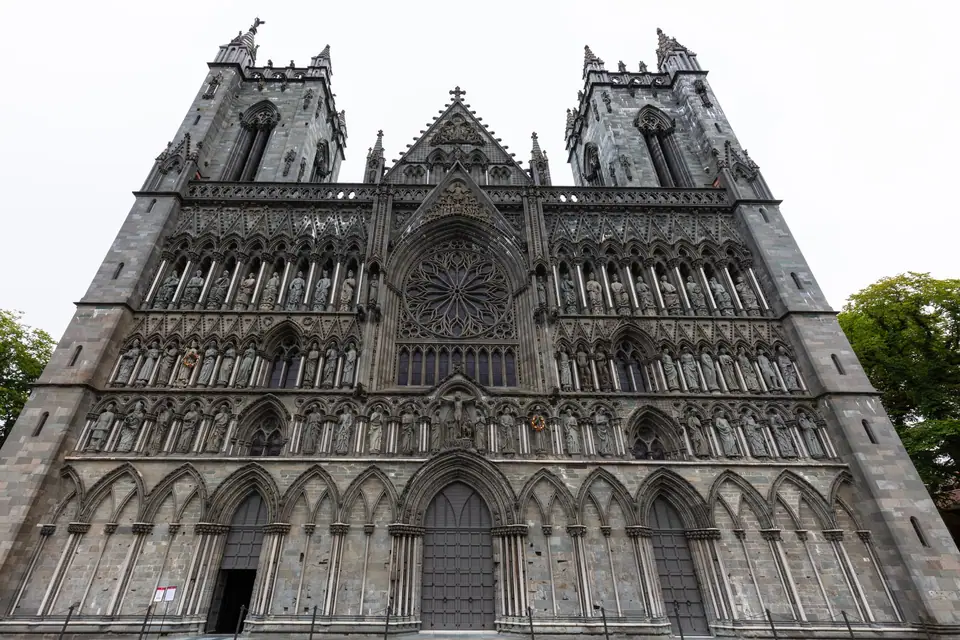
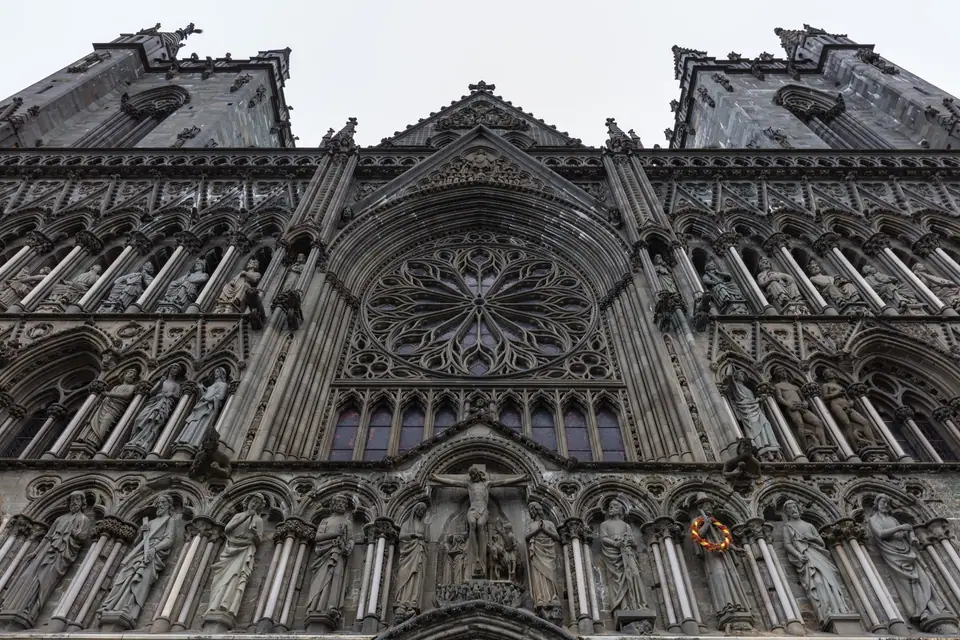
Construction reached completion around 1300 after the foundation stone of the Gothic nave and West Front was laid in 1248 under Archbishop Sigurd Eindridesson. Repeated fires in 1327, 1432, 1531, 1708, and 1719 left the nave a roofless ruin until formal restoration began in 1869 under architect Heinrich Ernst Schirmer, followed by Christian Christie from 1872 to 1906 and Olaf Nordhagen from 1909. The West Front sculpture programme and its rose window of more than 10,000 pieces of glass by Gabriel Kielland were completed in 1983.
Coronations, Royal Benedictions, and the Two Pipe Organs
Norway's 1814 Constitution designated Nidaros Cathedral as the coronation church: Carl III Johan (1818), Carl IV (1860), Oscar II (1873), and Haakon VII with Queen Maud (1906) were crowned here, while Olav V (1958) and Harald V with Queen Sonja (1991) received royal benedictions inside the cathedral while staying at Stiftsgården. The interior houses two historic organs: the 1930 Steinmeyer organ (restored in 2014 to 125 stops and roughly 9,600 pipes) and the 1738 to 1740 Baroque Wagner organ by Johann Joachim Wagner (restored by Jürgen Ahrend in 1994).
Erkebispegården, the Palace Museum, and the Crown Regalia
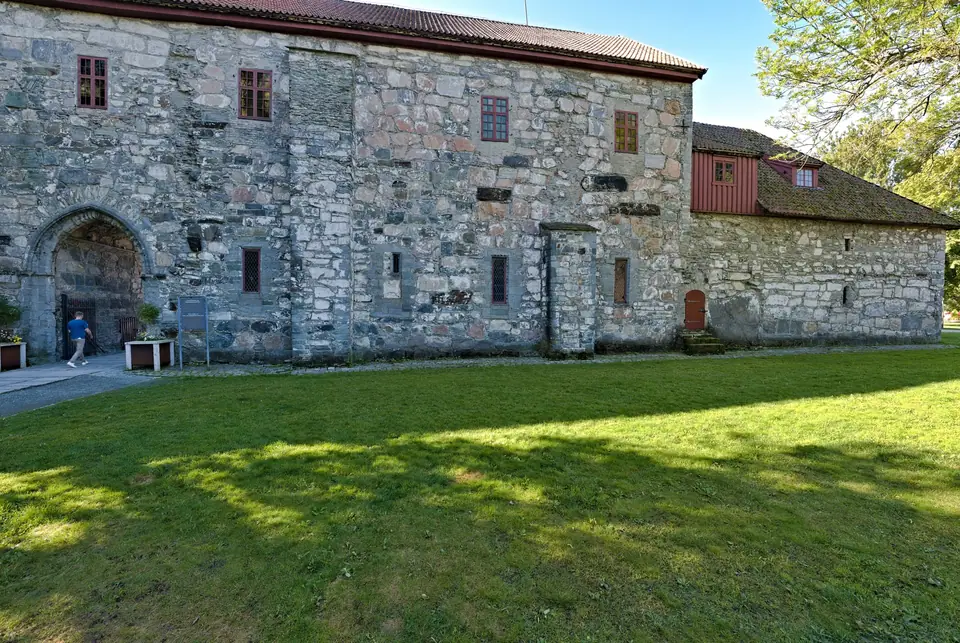
Immediately south stands Erkebispegården (the Archbishop's Palace), begun in the second half of the 12th century by Archbishop Øystein Erlendsson and inhabited until Archbishop Olav Engelbrektsson fled in 1537. Its north wing (with a main hall completed around 1250) and east wing (Lavetthuset) are the oldest secular stone buildings in the Nordic countries. After a 1983 fire destroyed two wooden wings, excavations between 1991 and 1995 uncovered the archbishop's mint (active 1483 to 1537) before the Archbishop's Palace Museum opened in 1997 alongside Rustkammeret and the Norwegian Crown Regalia (Riksregaliene) in the west wing. Check the official site for tickets before crossing Gamle Bybro to Bakklandet.
Reading the Sculptural Rows of the West Front
Approaching the cathedral from the gravel forecourt at the southern foot of Munkegata, visitors face the screen facade of the West Front, where tiered Gothic niches hold stone figures of kings, prophets, apostles, saints, and virtues modelled on medieval French and English cathedral fronts such as Lichfield, Lincoln, and Wells. Because solely the lowest row of medieval statues survived the fires of the fourteenth to eighteenth centuries in recognizable condition, twentieth-century sculptors working in the cathedral restoration workshops carved new soapstone figures inspired by historical and biblical iconography, culminating in the completion of the facade in 1983. High in the centre, Gabriel Kielland's circular rose window catches the afternoon light, setting off the grey-blue Trøndelag soapstone with deep ruby and cobalt glass.
Inside the building, the shift in architectural style from east to west tells the story of medieval Norway's contact with European mason guilds. In the twelfth-century Romanesque transepts, thick round arches, chevron mouldings, and small chapels reflect Anglo-Norman building traditions brought across the North Sea. Moving eastward into the choir and the Octagon ambulatory, pointed arches, slender marble shafts, and finely carved foliate capitals mark the transition to Early English Gothic initiated under Archbishop Øystein Erlendsson after his return from exile in England in 1183.
Inside the Archbishop's Palace Courtyard
Stepping through the gateway immediately south of the cathedral brings you into the cobbled quadrangle of Erkebispegården, enclosed by medieval stone halls on the north and east and later brick-and-masonry museum buildings on the south and west. A visit to the complex covers three distinct historical collections that contextualize the cathedral's spiritual and political role:
- The Archbishop's Palace Museum (Museet Erkebispegården): Built over the archaeological trenches excavated between 1991 and 1995 following the 1983 fire, displaying original medieval stone sculptures removed from the cathedral exterior alongside the timber and stone remains of the late-medieval archbishops' coin mint active from 1483 to 1537.
- The Norwegian Crown Regalia (Riksregaliene): Housed in the vaulted west wing, exhibiting the royal crowns, sword of state, sceptres, orbs, and anointing horn used in nineteenth-century coronations at the cathedral, together with historic ceremonial robes and coaches.
- The Armed Forces Museum (Rustkammeret): Tracing the military history of Trøndelag from the Viking Age and the seventeenth- and eighteenth-century border wars through the 1940 to 1945 occupation.
Allow enough time during your visit to walk completely around the exterior of the cathedral through the quiet tree-shaded graveyard path on the south and east sides, where carved medieval mason marks remain visible on the lower soapstone courses of the Octagon and chapter house (Kapittelhuset). From the eastern edge of the cathedral park, a shaded footpath drops directly down the river embankment to Gamle Bybro and Bakklandet, while heading straight north up Munkegata leads to Torvet and Stiftsgården. For a structured route combining the cathedral precinct with the rest of the peninsula, consult our three-day city itinerary and orientation guide.
Music lovers should also check whether an organ recital or choral service is scheduled during their stay. Hearing Johann Joachim Wagner's Baroque organ in the north transept or the mighty 1930 Steinmeyer instrument beneath the western rose window demonstrates how the vaulted stone acoustics of the nave and choir carry sound across the full length of the building. Outside in the courtyard, pilgrims completing the modern St. Olav Ways (Pilegrimsleden) over the Dovrefjell mountains or along the fjord still gather at the milestone marker beside the cathedral Visitor Centre.
Traveller tips
Real advice from people who have been to Nidaros Cathedral, Archbishop's Palace and the Crown Jewels. Every tip is read by our team before it goes live.
No tips yet. Been here? Yours could be the first.
Thank you! Your tip will appear here after a quick review.
More in Trondheim
Continue exploring Trondheim with related neighbourhood, food, and planning guides