


























Carolina Rediviva & the Silver Bible: Uppsala University Library Guide
Inside Uppsala University Library's 1841 landmark at the top of Drottninggatan and its UNESCO-listed manuscript treasures.
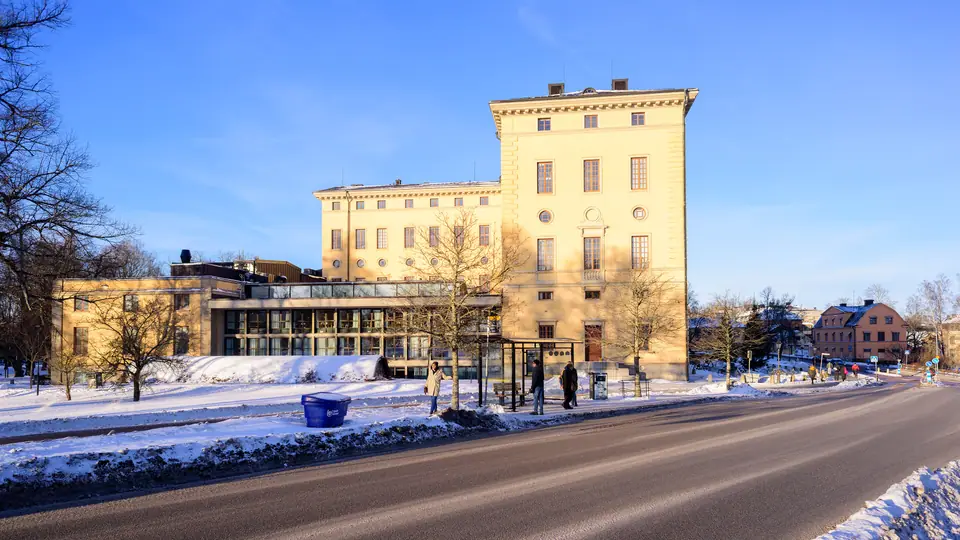
Crowning the crest of Carolinabacken at the western end of Drottninggatan between Uppsala Castle, the tree-lined avenue of Odinslund, and the English Park (Engelska parken), Carolina Rediviva is the flagship building of Uppsala University Library and the oldest and largest university library building in Sweden. Its Latin name, meaning 'Carolina Revived', commemorates the medieval Academia Carolina building south of Uppsala Cathedral, which housed the university's book collections during the 18th century prior to its demolition in 1778.
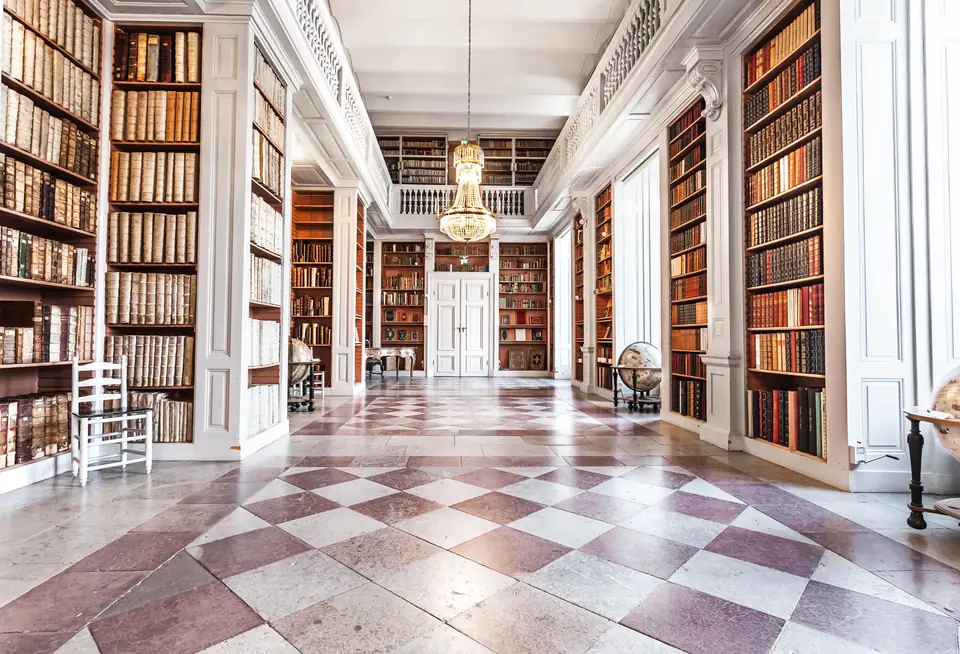
Today Carolina Rediviva is one of 11 branch libraries within Uppsala University Library (headed since 2024 by Chief Librarian Johanna Hansson), holding printed collections and manuscripts across the humanities, theology, and sociology, while welcoming visitors into its ground-floor exhibition gallery, reading rooms, and café.
Designing and Building Carolina Rediviva (1813 to 1841)
When the cupola and halls of Gustavianum could no longer contain the university's rapidly growing book donations in the early 19th century, royal architect Carl Fredrik Sundvall was commissioned to design a fireproof library and ceremonial assembly hall on the high ridge west of the town centre. Sundvall's initial 1813 drawings proposed a severe neoclassical three-storey structure with an 11-window facade and two rear wings, which he expanded in his approved 1819 design to a monumental 15-window yellow-plastered facade accented by a central four-column classical portico supporting the balcony where university rectors still wave white student caps every 30 April during Valborg celebrations.
Although the foundation stone was laid on 14 June 1817 and King Charles XIV John officiated at the formal start of construction on 19 October 1819, building work proved protracted and contentious. After construction supervisor Lieutenant Colonel Jacob Magnus Nordencreutz altered the interior plans without permission, Sundvall resigned from the project in February 1821 and was succeeded by Professor K. J. Hjelm, a former pupil of French architect Louis Jean Desprez, who added an upper half-storey lit by small round oculi windows beneath the roof cornice. Carolina Rediviva finally opened at noon on 10 October 1841, and later 19th- and 20th-century extensions, reading rooms, and rear book wings were designed by architects Axel Johan Anderberg and Peter Celsing.
The Codex Argenteus (Silver Bible): From Ravenna to Prague
Inside the climate-controlled exhibition hall just off the entrance vestibule rests Sweden's most celebrated manuscript treasure: the Codex Argenteus, known in Swedish as Silverbibeln (the Silver Bible) and inscribed on the UNESCO Memory of the World Register in 2011. Produced in the early 6th century in northern Italy, almost certainly in a court scriptorium at Ravenna for the Ostrogothic king Theodoric the Great (who died in 526), this deluxe Gospel book preserves the 4th-century Gothic translation of the New Testament prepared by Bishop Wulfila (Ulfilas), making it the principal surviving monument of the extinct Gothic language.
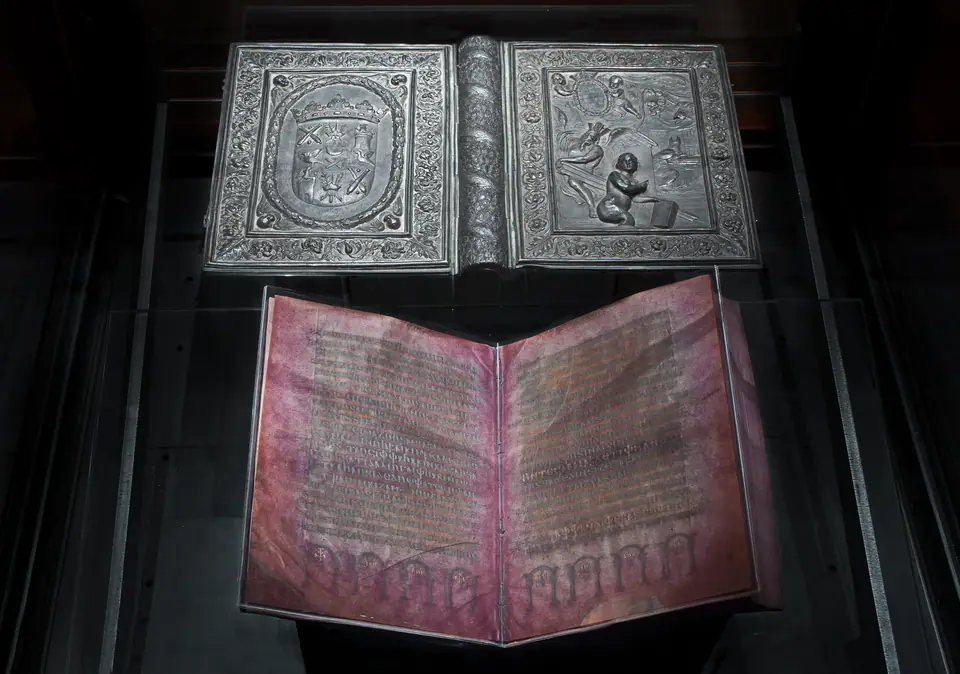
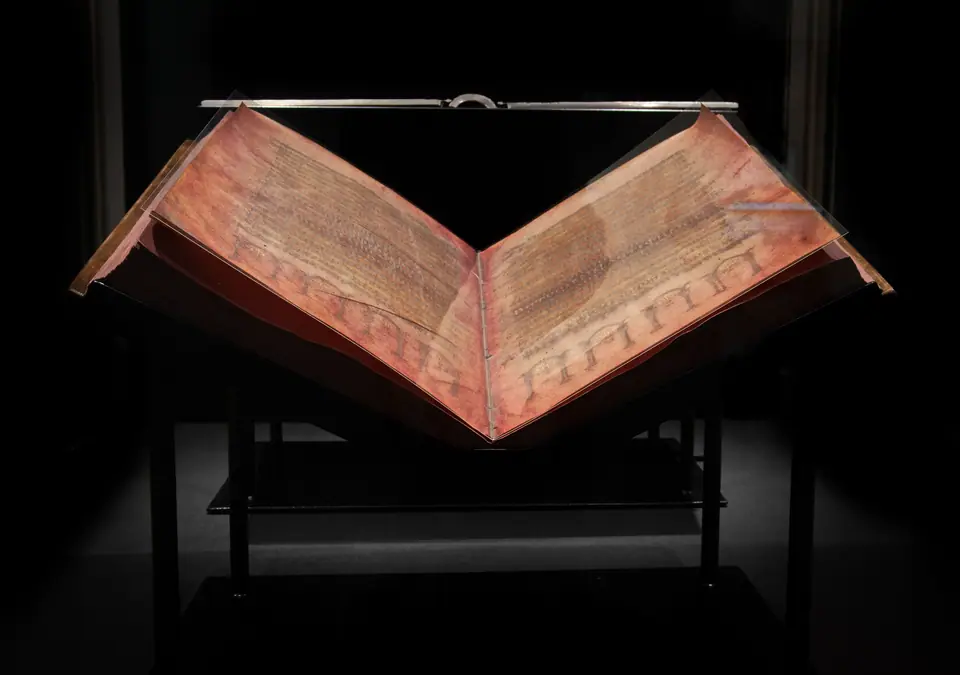
Each leaf was made from ultra-thin calfskin vellum stained royal imperial purple and calligraphed in metallic silver and gold ink using the uncial script crafted by Wulfila, with four decorative arcades running along the bottom of every page enclosing the canon tables of the four Evangelists Matthew, John, Luke, and Mark. After the collapse of the Ostrogothic kingdom, the manuscript surfaced during the Middle Ages at the Benedictine abbey of Werden near Essen in the Rhineland, where 187 of its original 336 parchment folios survived before being acquired in the late 16th century by Holy Roman Emperor Rudolf II for his imperial cabinet of curiosities at Prague Castle.
Swedish War Booty, De la Gardie's Gift and the Speyer Leaf
In July 1648, during the closing days of the Thirty Years' War, Swedish troops under General Hans Christoff von Königsmarck stormed the Lesser Quarter of Prague and seized the imperial treasures of Prague Castle as war booty for Queen Christina in Stockholm. When Queen Christina abdicated the throne at Uppsala Castle in 1654, she settled her debts by allowing her Dutch librarian Isaac Vossius to take the Codex Argenteus to Amsterdam.
Determined to recover the manuscript for Sweden, University Chancellor Count Magnus Gabriel De la Gardie purchased the codex from Vossius in the 1660s, commissioned court goldsmith Hans Bengtsson Selling to fashion its ornate repoussé silver binding adorned with allegories of Time and Truth, and formally donated the volume to Uppsala University in 1669. Three centuries later, in October 1970, one additional surviving leaf (folio 336, the final page of the Gospel of Mark) was unexpectedly discovered wrapped inside a reliquary parchment in St. Afra's Chapel at Speyer Cathedral in Germany. To protect the light-sensitive purple parchment, Carolina Rediviva exhibits one original vellum leaf alongside De la Gardie's 17th-century chased silver covers and a complete facsimile of the text block.
Olaus Magnus's 1539 Carta Marina and Cancionero de Upsala
Surrounding the Silver Bible in the permanent exhibition are several other landmark works from the university's special collections. Foremost among them is a hand-coloured copy of the Carta marina, the monumental woodcut wall map of the Nordic countries and Baltic Sea published in Venice in 1539 by exiled Swedish ecclesiastic Olaus Magnus, which gave Renaissance Europe an unprecedented geography of Scandinavia populated by sea monsters, reindeer sleds, and northern towns.
Nearby cases display the Cancionero de Upsala, a singular 1556 Venetian printed collection of Spanish Renaissance villancicos (including works associated with the Duke of Calabria's court), medieval Swedish provincial law manuscripts, a rare early-19th-century manuscript copy of the Poetic Edda, and original autograph musical scores by Wolfgang Amadeus Mozart from the Düben and Silverstolpe collections.
Visiting the Exhibition Hall, Reading Rooms and Odinslund
Today Carolina Rediviva is protected as a listed historic monument (byggnadsminne) and serves daily as a working research library with quiet study halls, a periodical reading room, and a special collections reading room for fragile archival documents. Visitors can step directly inside the entrance hall to browse the exhibition cases, pause in the ground-floor café, and then pair the library with a leisurely walk through the shaded parklands of Engelska parken and Odinslund or down the slope to the Botanical Garden; check the official site of Uppsala University Library for current seasonal hours and guided tour availability before visiting.
Traveller tips
Real advice from people who have been to Carolina Rediviva & the Silver Bible: Uppsala University Library. Every tip is read by our team before it goes live.
No tips yet. Been here? Yours could be the first.
Thank you! Your tip will appear here after a quick review.
More in Uppsala
Continue exploring Uppsala with related neighbourhood, food, and planning guides
Where to Stay in Uppsala: Best Areas Around Fyrisån, Stora Torget & Station
Uppsala, Sweden
Best Time to Visit Uppsala: Seasons, SMHI Weather & Valborg Calendar
Uppsala, Sweden
Uppsala 3-Day Itinerary: Cathedral, Gamla Uppsala, Sigtuna & Skokloster
Uppsala, Sweden
Uppsala: Essential Planning for Sweden's University City
Uppsala, Sweden
