


























Uppsala Cathedral (Domkyrka): Gothic Architecture, Royal Tombs & Treasury
History, French Gothic architecture, royal burial chapels, and the Treasury Museum inside Scandinavia's largest cathedral.
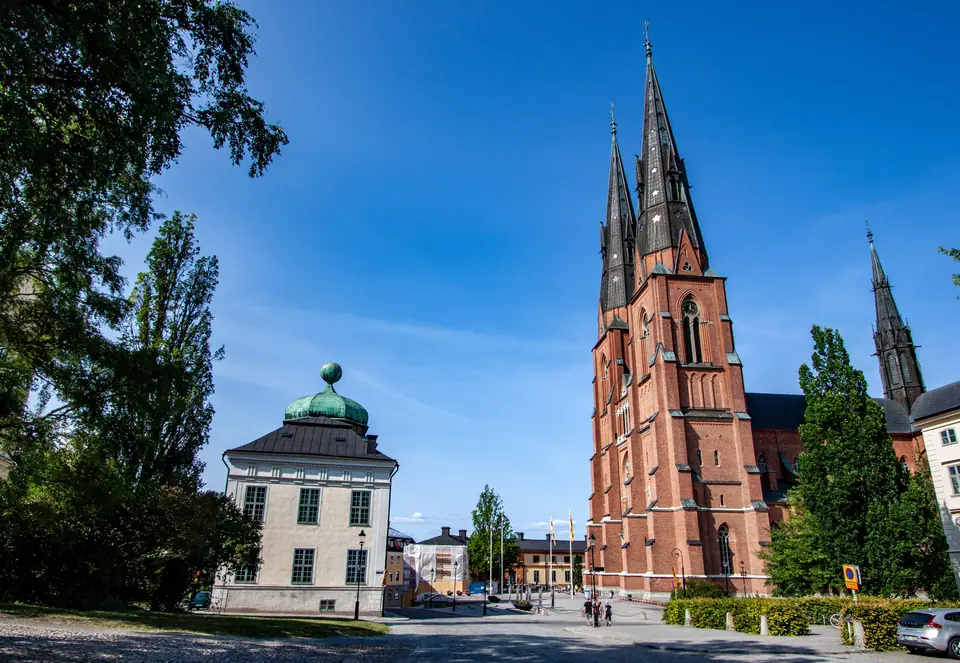
Rising from the Domberget hill between University Hall and the banks of the Fyrisån, Uppsala Cathedral (Uppsala domkyrka) is the seat of the Archbishop of Uppsala, primate of the Evangelical-Lutheran Church of Sweden, and the principal national sanctuary of the realm. After fire damaged the earlier Romanesque cathedral at Gamla Uppsala, Pope Alexander IV granted permission in 1258 to relocate the archiepiscopal see south to the harbour town of Östra Aros. Building work began in 1272 or 1273 under an unnamed French master architect, and in 1287 stone master Étienne de Bonneuil was summoned from Paris with a team of French masons to continue the choir chapels and sculpted portals.
Constructed in high French Gothic style using warm red brick rather than the limestone of northern France, the three-aisled basilica with polygonal ambulatory chapels and Gotland limestone piers took more than a century and a half to complete. Consecrated in 1435 and dedicated to Saint Eric, Saint Lawrence (celebrated across Uppland since the pagan temple era), and Norway's patron Saint Olof, the cathedral served as the coronation church for all but three Swedish monarchs from 1441 until Ulrika Eleonora in 1719.
The 118.7-Metre Spires and Neo-Gothic Restoration
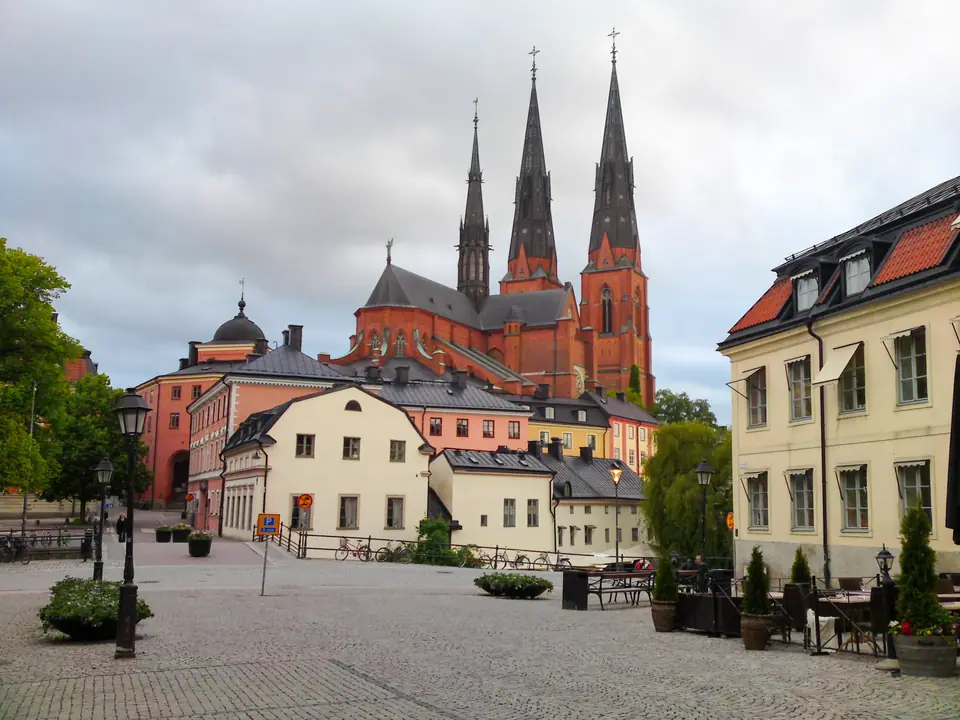
The cathedral's twin western towers were initially completed in the 16th century and repeatedly reshaped after fires. During the devastating Uppsala city fire of 16 May 1702, the medieval roof and spire superstructures collapsed, after which royal architect Carl Hårleman capped the towers with low Baroque lanterns in 1735. Between 1885 and 1893, architect Helgo Zettervall carried out a sweeping Neo-Gothic restoration that added pointed copper-clad spires reaching 118.7 metres, matching the building's exact 118.7-metre exterior length as the tallest and largest Gothic church in the Nordic countries.
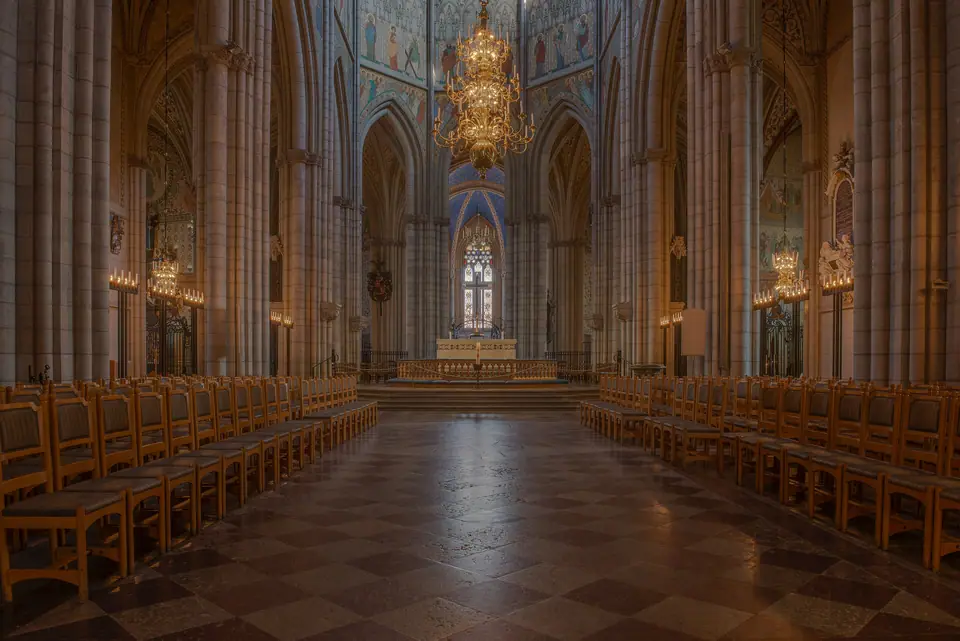
After structural problems appeared in Zettervall's external cement ornaments during the mid-20th century, a major restoration in the 1970s stripped loose concrete additions and stabilized the medieval brickwork. Inside the soaring nave, the 1970s work uncovered late-medieval vault paintings and decorative motifs that had been whitewashed after the Protestant Reformation, while master glassmakers maintained the monumental rose and lancet windows. Above the ornate 14th-century south portal sits Sonens fönster (the Window of the Son), which at 119 square metres is the largest church window in Sweden.
The Vasa Burial Chapel and Jagellonian Monuments
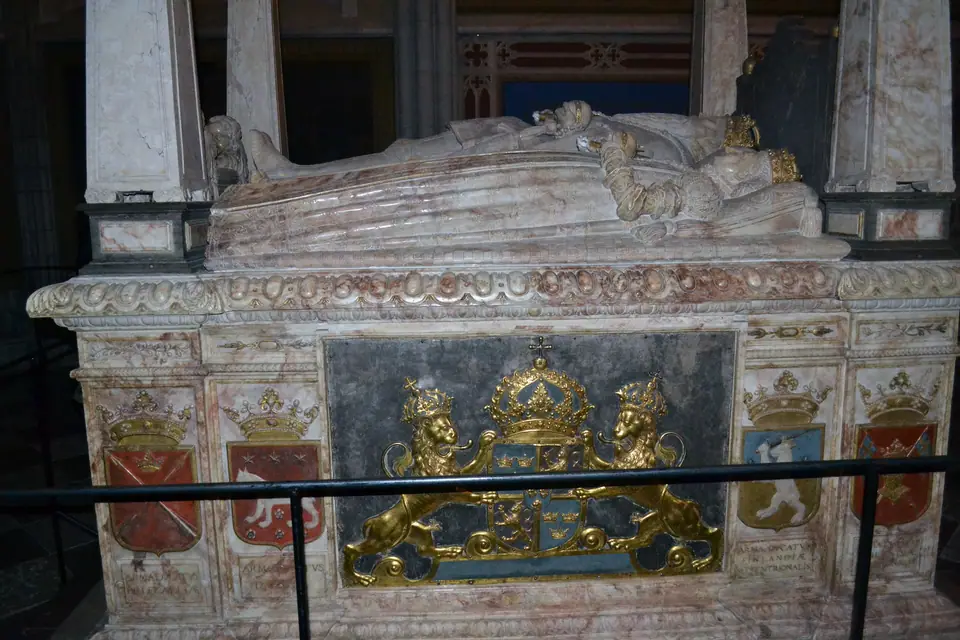
Walking clockwise around the vaulted ambulatory and side chapels reveals a royal and ecclesiastical pantheon of extraordinary historical depth. Behind the high altar, the former medieval Lady Chapel serves as the Vasa Burial Chapel (Vasakoret). In the centre of the floor rests the carved Renaissance limestone and alabaster sarcophagus of King Gustav Vasa (1496 to 1560), founder of the Vasa dynasty and builder of Uppsala Castle, flanked by his three consorts Catherine of Saxe-Lauenburg, Margaret Leijonhufvud, and Katarina Stenbock. Around the chapel walls, large 19th-century historical frescoes painted by Carl Gustaf Hellqvist depict key scenes from Gustav Vasa's life, alongside the resting place of his son King John III (died 1592) and his second wife Gunilla Bielke.
In the adjacent northern choir chapels, the Jagellonian Chapel houses the magnificent Italianate marble wall monument of Queen Catherine Jagiellonica, Polish princess and first wife of John III, crowned by an arched niche showing the historical silhouette of Uppsala. Nearby, the Finsta Chapel preserves the medieval tomb of Birger Persson and Ingeborg Bengtsdotter, parents of Sweden's patron mystic Saint Bridget (Heliga Birgitta), while the Sture Chapel memorials recall the noblemen killed by King Eric XIV during the Sture Murders.
The Gilded Shrine of Saint Eric and Modern Liturgical Art
Near the northern side of the chancel stands the gilded silver reliquary chest of King Eric IX (Eric Jedvardsson), who was killed in Uppsala in 1160 and venerated as Sweden's national patron saint. When the archbishopric moved from Gamla Uppsala in 1273, Saint Eric's bones and royal crown were carried in solemn procession to the new cathedral site; the current late-16th-century reliquary, commissioned by King John III and Queen Catherine Jagiellonica, still holds his remains alongside a modern reliquary chest containing relics of Saint Bridget donated from Rome. Nearby in the northern transept stands the folk-inspired white wooden sculpture Maria återkomst (The Return of Mary) by Anders Widoff and the candle holder Ljusbäraren.
Graves of Carl Linnaeus, Swedenborg and Rudbeck
The cathedral also honours the scholars who made Uppsala University famous across Europe. Just inside the northern nave near the western entrance lies the dark porphyry wall medallion and floor ledger stone shared by botanist Carl Linnaeus (1707 to 1778), whose gardens are detailed in our Botanical Garden and Linnaean Garden guide, and his son Carl von Linné the Younger. Across the nave, a red granite sarcophagus holds the remains of scientist, philosopher, and Christian mystic Emanuel Swedenborg (1688 to 1772), whose body was brought back from London to Uppsala by naval warship in the early 20th century.
Further east in the transept and choir lie the burial stones of polymath Olaus Rudbeck the Elder, whose voice famously directed firefighters from the roof of Gustavianum while the cathedral burned, Reformation Archbishop Laurentius Petri, and Archbishop Nathan Söderblom, recipient of the Nobel Peace Prize for his ecumenical leadership.
The Treasury Museum, Bells and Visitor Etiquette
High inside the northern western tower, reached by lift or stairs, the Treasury Museum (Skattkammaren) exhibits an exceptional European collection of medieval liturgical textiles, gold and silver communion vessels, and the funeral crowns, sceptres, and swords recovered from the royal Vasa tombs. Its centrepiece is Queen Margaret's golden gown (Drottning Margaretas gyllene kjortel), an intact Italian gold-brocade court dress dating from around 1400 and associated with Queen Margaret of the Kalmar Union. The north tower also houses Storan, Sweden's largest church bell, cast after the 1702 fire. Because the cathedral is an active parish church hosting daily prayers, organ recitals, and university ceremonies, check the official site for service schedules and Treasury access before continuing to Carolina Rediviva or down Dombron to Uppsala Saluhall for lunch beside the rushing river weir and historic mill island on Sankt Eriks torg, just steps below the cathedral hill and the tree-lined embankments of the Fyrisån.
Traveller tips
Real advice from people who have been to Uppsala Cathedral (Domkyrka): Gothic Architecture, Royal Tombs & Treasury. Every tip is read by our team before it goes live.
No tips yet. Been here? Yours could be the first.
Thank you! Your tip will appear here after a quick review.
More in Uppsala
Continue exploring Uppsala with related neighbourhood, food, and planning guides
Uppsala Castle (Uppsala Slott): Vasa Fortress, Queen Christina & Art Museum
Uppsala, Sweden
Uppsala's Botanical Gardens: Botaniska Trädgården, Linnéträdgården & Hammarby
Uppsala, Sweden
Gamla Uppsala: The Royal Mounds, Vendel History & Medieval Church
Uppsala, Sweden
Carolina Rediviva & the Silver Bible: Uppsala University Library Guide
Uppsala, Sweden
