




















Al-Khazneh (The Treasury): Architecture, Cliff Viewpoint Scams, Lighting & Crowd Timing
Explore Al-Khazneh (The Treasury) in Petra: its 39.5-metre Hellenistic rock-cut facade, newly excavated subterranean tombs, lighting angles, and how to avoid cliff viewpoint and camel scams.
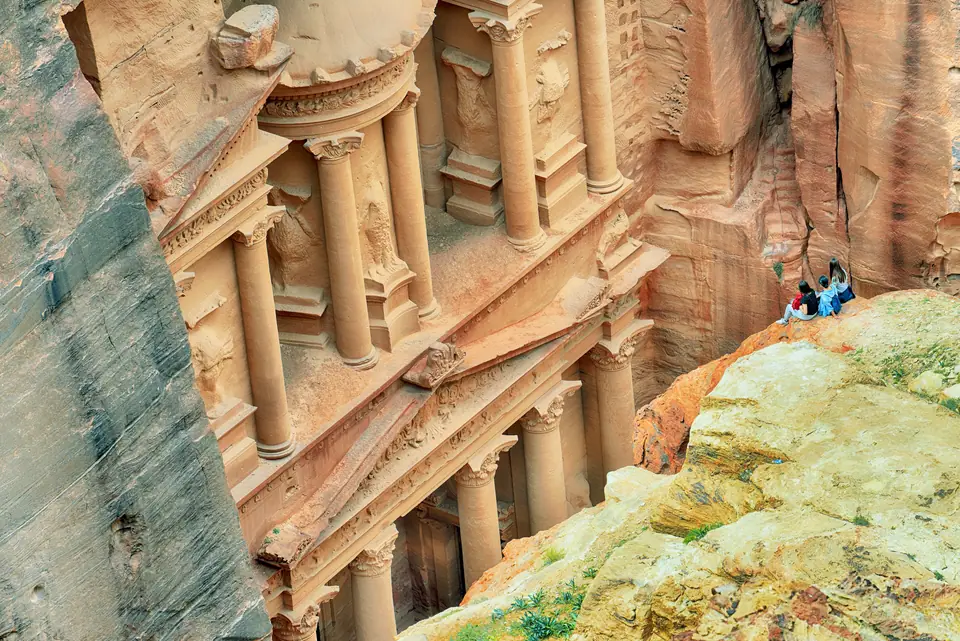
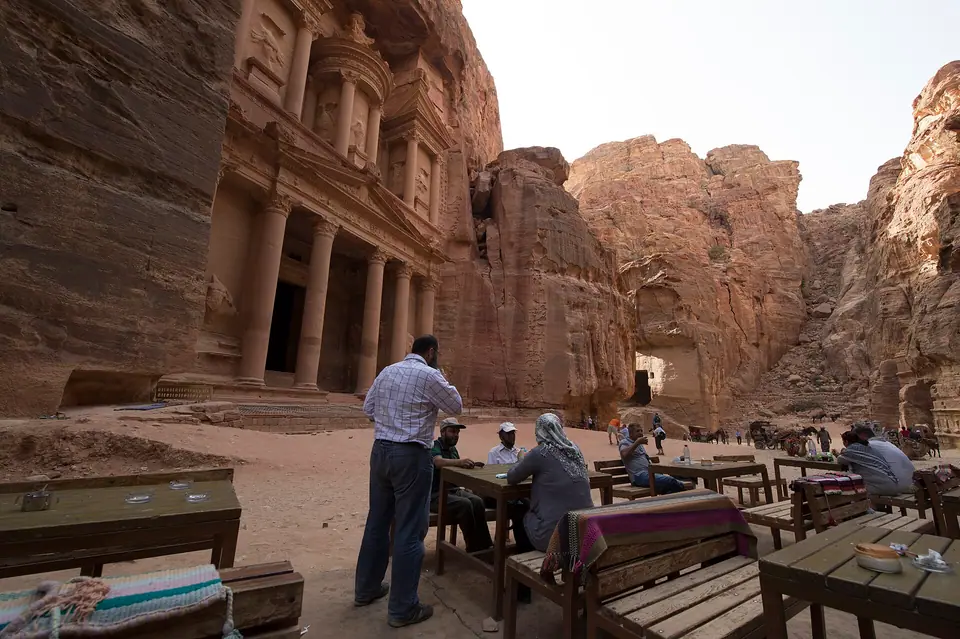
Nothing in Jordan prepares you for the theatrical transition at the western end of the 1.2-kilometre Siq. Here a dark, three-metre-wide fault fissure opens onto a sunlit cliff-walled amphitheatre dominated by Al-Khazneh (al-KHAZ-neh, "The Treasury"). Rising 39.5 metres (130 feet) high and 25.3 metres (83 feet) wide out of a vertical face of rose-red Umm Ishrin sandstone, this two-storey royal monument is the masterpiece of Nabataean and Hellenistic rock-cut architecture. Yet the small sand plaza in front of the facade is also the epicentre of Petra's commercial touts, camel photo hustles, and cliff-viewpoint scams. Understanding both the archaeology of the facade and the rules of the plaza ensures your visit lives up to the monument.
Why a royal Nabataean mausoleum is called "The Treasury"
Despite its popular English and Arabic name, Al-Khazneh was never a bank or state treasury. Local nineteenth-century Bedouin tribes called it Khaznet Fir'aun ("The Treasury of the Pharaoh"). Local legend held that an Egyptian pharaoh pursuing the Israelites had hidden his gold inside the solid stone urn crowning the upper rotunda. If you look closely at that crowning urn, you can still see pockmarks where rifle bullets chipped the sandstone in vain attempts to shatter the stone and release the imagined treasure.
Archaeological excavations conducted by the Jordanian Department of Antiquities in 2003, expanded by 2024 ground-penetrating radar discoveries of intact burial chambers beneath the threshold, confirmed the building's true purpose. A monumental royal mausoleum carved during the first century CE, almost certainly commissioned by Nabataean King Aretas IV Philopatris (reigned 9 BCE to 40 CE) at the height of Petra's frankincense wealth. In 2003, archaeologists dug beneath the modern canyon floor on the left side of the entrance steps. They uncovered an older structural platform holding four earlier Nabataean burial chambers 4 to 6 metres below today's plaza level, still visible through an iron grate.
Top-down carving and Hellenistic-Nabataean iconography
Because Umm Ishrin sandstone is relatively soft and friable, Nabataean masons could not erect timber scaffolding high enough to support heavy stone blocks. Instead, they engineered Al-Khazneh entirely by subtractive carving from the top down. Stonecutters first hacked small foothold steps up the side cliff, still visible in vertical rows along the outer canyon frame. They then bevelled back the upper rock face and carved the crowning urn and upper tholos before working downward. Notice why the facade remains so crisply preserved after 2,000 years compared with the eroded monuments in the open Basin. The overhanging cliff wall and the deep recess cut into the mountain shield Al-Khazneh from both desert wind abrasion and direct rainwater runoff.
Architecturally, the two tiers blend Ptolemaic Alexandrian baroque design with Nabataean religious symbolism guiding the dead to the afterlife:
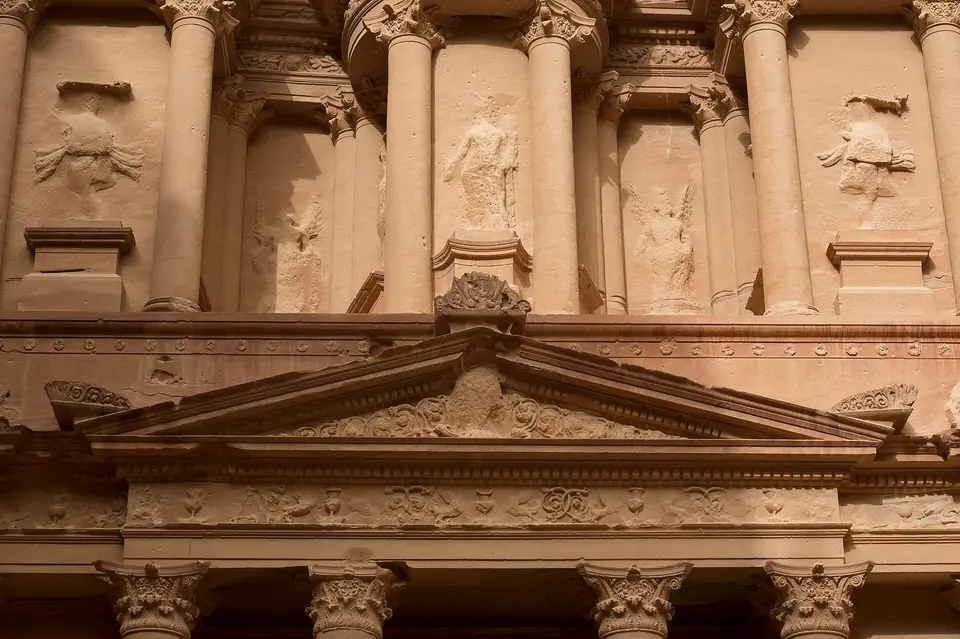
- The Lower Corinthian Portico. Six twelve-metre-tall columns topped with acanthus-leaf Corinthian capitals support a triangular pediment and a frieze of griffins, craters, and floral vines. Only the central left freestanding column collapsed in antiquity and was reconstructed by the Department of Antiquities in 1960. Flanking the outer bays stand large equine relief panels depicting Castor and Pollux (the Dioscuri), the Greco-Roman twin horsemen who escorted souls to the Elysian Fields.
- The Upper Broken Pediment and Central Tholos. Above the portico rises a split pediment framing a cylindrical central pavilion (tholos) topped by a conical roof and the 3.5-metre stone funerary urn. In the bays between the columns stand relief sculptures of dancing Amazons brandishing double axes and winged Victories (Nike). Meanwhile, the central figure on the tholos represents Isis-Tyche (merged with the Nabataean goddess Al-Uzza) holding a cornucopia and sistrum.
- Interior Access Restriction. Behind the tall central doorway lies an unadorned 12-by-12-metre cubic burial hall flanked by two smaller side chambers. To prevent sandstone floor erosion and overcrowding, PDTRA permanently closed the interior doorway to tourist entry. You admire the monument entirely from the plaza and cliff viewpoints outside.
Field engineering: How to defeat the three Treasury plaza tourist traps
The sandy amphitheatre in front of Al-Khazneh measures barely 60 metres wide, concentrating hundreds of visitors with three persistent commercial traps that you should prepare for before stepping out of the Siq:
- Trap 1: The Illegal Short Cliff Scramble vs the Legal Al-Khubtha Trail. At the far right (northern) corner of the Treasury plaza, young self-appointed "guides" beckon tourists toward a steep, crumbling sandstone gully. They offer to lead you up in "ten minutes" to the cliff-edge rug tent looking down at Al-Khazneh. This short scramble is unregulated, unbarricaded, and frequently closed by PDTRA rangers due to sheer drop-offs and fatal rockfalls. Worse, visitors who follow a tout up are confronted on the narrow ledge with demands for an arbitrary guide fee per person. Next comes a second demand from the tent operator to buy an overpriced tea or pay a "platform viewing fee" just to step to the edge for a photo. How to handle it: Never climb the unguarded northern plaza gully with an unlicensed tout. For the exact same dramatic high-angle view safely, legally, and without paying a tout, walk 800 metres further into the park past the Royal Tombs and climb the official, stone-cut Nabataean steps of the Al-Khubtha Trail.
- Trap 2: The "Low-Height Side Ledge" Photo Spot Hustle. On the left (southern) side of the plaza opposite the facade, handlers guard a low 6-to-8-metre boulder ledge. They tell visitors that climbing up for a head-on selfie requires paying a ticket fee or buying from their stall. While sitting inside a private Bedouin tea shelter warrants buying a drink, public rocks on the plaza perimeter do not carry an official PDTRA admission surcharge. If a handler aggressively blocks a boulder, step ten metres back onto the main plaza sand where the full 39.5-metre height fits cleanly into a wide-angle lens without upward distortion.
- Trap 3: Sitting Camels and the "One Dinar Photo / Ten Dollar Dismount" Trick. Richly tasselled dromedary camels kneel directly across the centre of the Treasury plaza. Handlers often invite passers-by to "sit for a quick photo for one Dinar" or hand you the lead rope. They then command the camel to stand up, walk a thirty-second circle around the sand, and demand ten or twenty US Dollars to make the camel kneel so you can dismount. How to handle it: Never accept a lead rope or mount a camel unless you want a ride. Agree on the exact total price in Jordanian Dinars (JOD), confirming that it covers both mounting and dismounting, before touching the saddle.
Best hours for photography light and crowd avoidance at Al-Khazneh
Because Al-Khazneh faces east-northeast into a deep vertical canyon, direct sunlight reaches the facade for only a narrow morning window:
- 06:00 to 08:30 (Soft Reflected Glow & Empty Plaza). During the first two hours after park opening, the facade sits in even, shadowless open shade, allowing balanced high-dynamic-range photographs without harsh contrast and zero tour-bus crowds.
- 09:00 to 11:00 (Direct Golden-Pink Sunbeam). Depending on the month in our seasonal weather calendar, a diagonal shaft of direct morning sun slices down between the cliffs of the Siq and illuminates the rose-red sandstone columns from top to bottom. Pair this morning timing with our 3-day Petra itinerary and Petra orientation guide.
Where to rest, washrooms, and navigating out of the Treasury plaza
Practical amenities around Al-Khazneh are intentionally kept tucked out of sight so modern structures do not intrude on the ancient sandstone amphitheatre. At the far southern end of the plaza, a recessed rock cove sits opposite the facade. Inside you will find a small official souvenir shop, a shaded Bedouin refreshment stall selling bottled water and sage tea, and a uniformed Tourism Police and PDTRA ranger desk. Public washrooms are not located directly in front of the Treasury. The nearest clean toilet facilities sit either back near the Visitor Center and dam entrance or 350 metres further down the Outer Siq just past the Street of Facades toward the Nabataean Theater. When you are ready to continue deeper into Petra, follow the wide sandy floor exiting the right-hand (northwestern) corner of the plaza into the Outer Siq.
When photographing Al-Khazneh from the ground plaza, experiment with two classic compositions beyond the standard central shot. First, step thirty metres back into the dark throat of the Siq so the vertical black silhouettes of the canyon walls frame a narrow slice of the rose-red Corinthian columns and upper tholos urn. Second, walk to the far southern corner of the sandy amphitheatre near the ranger desk to capture an angled three-quarter view that shows the deep architectural recess carved into the Umm Ishrin sandstone cliff.
Where it is
- 1Al-Khazneh (The Treasury)
- Ramon International Airport (ETM) · about 78 km from here in a straight line
- Directions in Google Maps
Traveller tips
Real advice from people who have been to Petra. Every tip is read by our team before it goes live.
No tips yet. Been here? Yours could be the first.
Thank you! Your tip will appear here after a quick review.
More in Petra
Continue exploring Petra with related neighbourhood, food, and planning guides
Bab al-Siq & The Siq Walk: Djinn Blocks, Obelisk Tomb, Dam & Nabataean Water Channels
Petra, Jordan
Street of Facades, Nabataean Theater & The Royal Tombs: Urn, Silk, Corinthian & Palace Tombs
Petra, Jordan
The Basin Core: Colonnaded Street, Great Temple, Qasr al-Bint, Byzantine Church & Petra Museum
Petra, Jordan
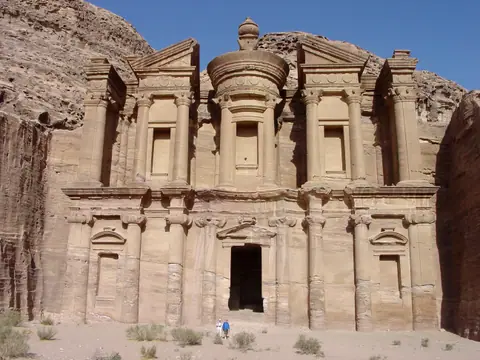
Ad-Deir (The Monastery) & Little Petra Back-Door Hike: 800 Steps vs 4x4 Shuttle Route
Petra, Jordan
