


























Best Things to Do in Petra: The Siq, Treasury, Monastery, High Place & Little Petra
Explore the essential monuments and hikes in Petra, from the 1.2 km Siq slot canyon and Al-Khazneh to the Royal Tombs, Qasr al-Bint, Ad-Deir Monastery, and Little Petra.
Visitors who treat Petra as a two-hour walk to the Treasury and back see less than ten percent of the ancient Nabataean metropolis. Carved across 26,171 hectares of Palaeozoic sandstone gorges between the fourth century BCE and the second century CE, the UNESCO World Heritage park rewards unhurried hikers. You get the richest experience when you combine the main canyon floor with the sacrificial and monastic staircases cut into the surrounding mountain ridges. Below, we break down the ten defining experiences in Petra and the history behind each monument. We also cover how long each route takes on foot and how to link them without midday exhaustion.
Ten essential experiences across the archaeological park and Al-Beida
- Walk the Bab al-Siq and the 1.2-kilometre Siq at dawn. Entering the park as the turnstiles open lets you experience the outer approach before horse carriages and tour groups fill the gorge. Along the open 800-metre Bab al-Siq track stand three monolithic cube tombs known as the Djinn Blocks (Sahrij) and the two-storey Obelisk Tomb and Bab al-Siq Triclinium. That double facade stacks four Egyptian-style funerary pyramids (nefesh) above a classical Doric banquet hall. Beyond the reconstructed Nabataean flood dam, step into the 1.2-kilometre Siq. Formed by a tectonic fault split rather than water erosion alone, this winding slot canyon narrows to 3 metres wide beneath 80-to-180-metre sandstone cliffs. Along its walls run dual Nabataean water channels, sacred betyl god-niches, and a life-sized relief of a camel caravan leader.
- Stand before Al-Khazneh (The Treasury) as morning sun strikes the urn. At the western mouth of the Siq, the dark gorge opens onto the rose-red facade of Al-Khazneh (pronounced al-KHAZ-neh). Measuring 39.5 metres high and 25.3 metres wide, this first-century CE royal mausoleum was carved from the top down into iron-rich Umm Ishrin sandstone. Archaeologists date its creation to the reign of Nabataean King Aretas IV Philopatris (9 BCE to 40 CE). Its lower Corinthian portico and upper broken pediment with a central cylindrical tholos showcase the fusion of Alexandrian Hellenistic architecture and Nabataean funerary art. Arrive between mid-morning and late morning if you want direct sunlight illuminating the pink sandstone columns, or at dawn for cool shadow and empty cobbles.
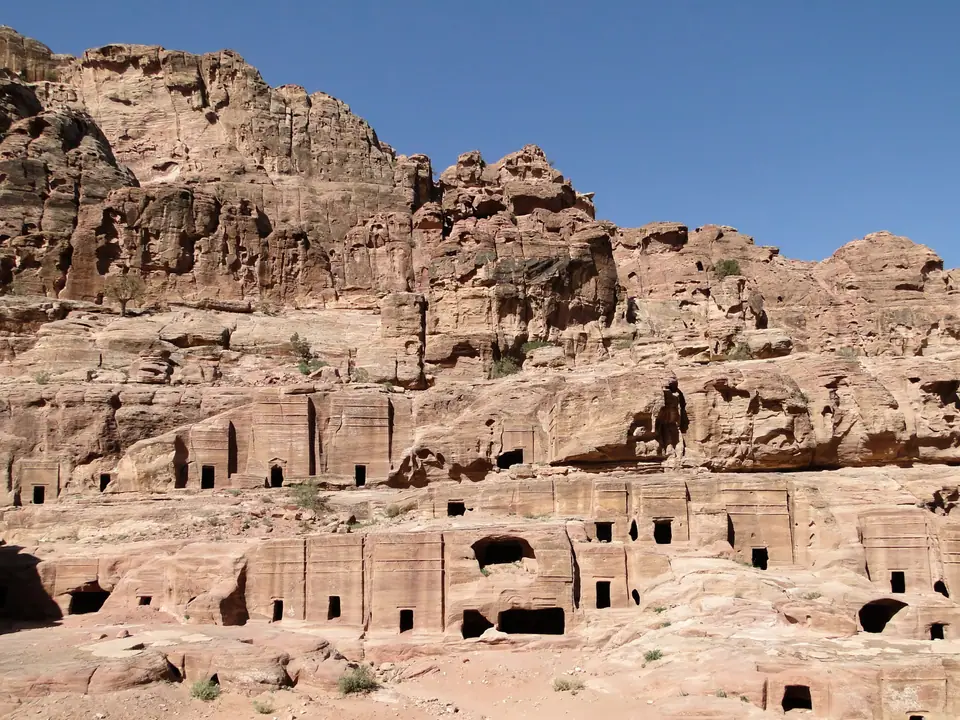
- Trace the Street of Facades and the 7,000-seat Nabataean Theater. Turning right (northwest) out of the Treasury plaza leads into the Outer Siq. Here more than forty tombs arranged in vertical rows form the Street of Facades. Look closely at the double-stepped crow-step crenellations carved above each doorway, an ancient Arabian and Assyrian motif representing stairways to heaven. Immediately beyond sits the first-century CE Theater. Spanning 45 rows of seats for roughly 7,000 spectators, it is the only theater in the ancient world carved predominantly out of solid bedrock rather than built up with freestanding masonry arches. Its builders sliced straight through an earlier tier of Nabataean shaft tombs in the rear wall.
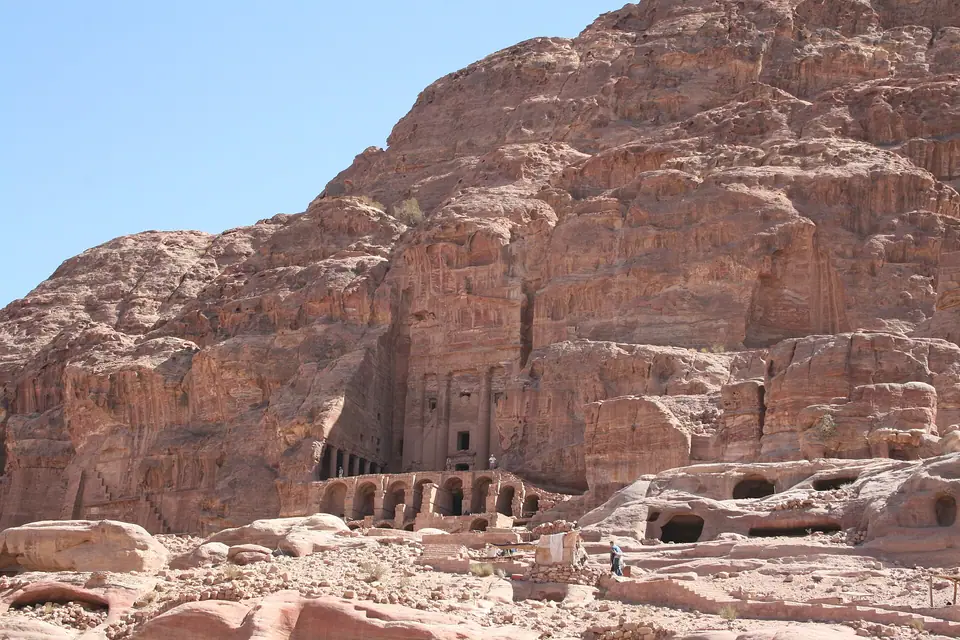
- Explore the four Royal Tombs on the cliff of Jabal al-Khubtha. Rising along a broad stone shelf opposite the Theater are the four monumental Royal Tombs. Climb the vaulted double-arched substructure of the Urn Tomb, carved around 70 CE and converted into a Byzantine cathedral on 24 July 446 CE according to a Greek inscription inside its hall. Next door, photograph the swirling pink, white, and ochre iron-oxide mineral bands of the Silk Tomb and inspect the floral capitals of the Corinthian Tomb. Just beyond rises the five-storey facade of the Palace Tomb, whose upper tiers were completed with built stone blocks where the cliff ran out of height.
- Hike the official Al-Khubtha Trail for the legal aerial view of the Treasury. Skip the unauthorized tout scramble at the bottom of the Treasury plaza and continue past the northern flank of the Palace Tomb. Here official PDTRA signs mark the start of the Al-Khubtha Trail. Approximately 600 rock-cut Nabataean steps ascend the western face of Jabal al-Khubtha past a high-altitude cistern and rock shrine. From the top, the trail traverses the plateau crest to a cliffside viewpoint looking down onto Al-Khazneh from high above the Siq floor. Allow 2 to 2.5 hours round trip from the Royal Tombs.
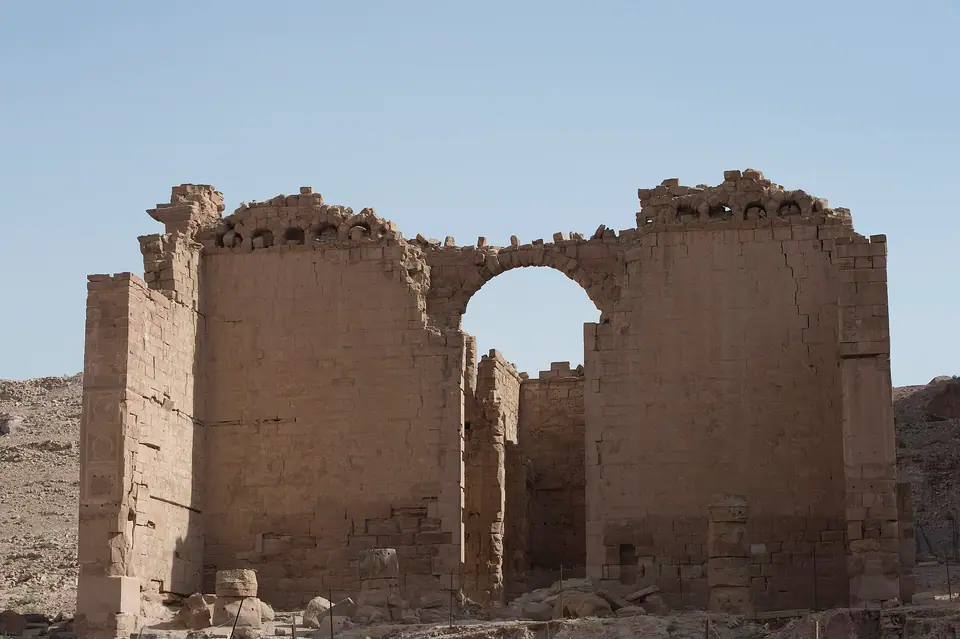
- Walk the Roman Colonnaded Street to the Great Temple, Byzantine Church, and Qasr al-Bint. Where Wadi Musa meets the central valley floor, Roman engineers after the 106 CE annexation paved a six-metre-wide marble and limestone Colonnaded Street. Market shops line the road beside a public Nymphaeum fountain shaded by a centuries-old pistachio tree. On the southern terrace rises the 7,560-square-metre Great Temple complex with its elephant-headed limestone capitals and inner theatron. Across the wadi on the northern slope stands the fifth-century Byzantine Church, famed for its intact seasonal aisle mosaics and the December 1993 discovery of 140 carbonized sixth-century Greek papyrus scrolls. At the western end of the street rises Qasr al-Bint, a 23-metre-high freestanding ashlar masonry temple dedicated to the chief Nabataean deities Dushara and Al-Uzza.
- Climb to Ad-Deir (The Monastery) or hike in via the Little Petra Back Door. High in the northwestern massif above the Basin sits Ad-Deir (pronounced ad-DAYR, "The Monastery"). Measuring 45 metres high and 47 to 50 metres wide with an 8-metre-tall central doorway, it is the largest carved monument in Petra. You can climb the classic 800-plus rock steps up a shady side gorge from the Basin restaurant in 45 to 60 minutes. Alternatively, take the official 4x4 shuttle from Little Petra to hike the scenic plateau Back-Door trail. This approaches Ad-Deir largely downhill across open desert ledges before descending the steps into the Basin.
- Traverse the High Place of Sacrifice (Al-Madbah) and Wadi Farasa loop. Starting just south of the Street of Facades, an ancient processional stairway climbs Jabal al-Madbah past two 6-metre rock-carved obelisks. At the summit sits the High Place of Sacrifice, an open-air hilltop altar platform commanding 360-degree views toward Jabal Haroun. Instead of retracing your steps down the steep eastern staircase, descend the quieter western back side through Wadi Farasa. Along the way, you pass the rock-carved Lion Fountain, the Garden Tomb, the Roman Soldier Tomb, and the Painted Triclinium before emerging near Qasr al-Bint.
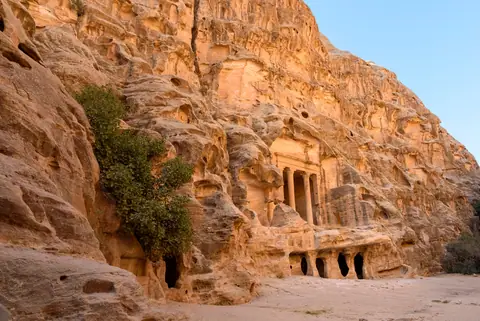
- Visit the Painted Biclinium at Little Petra (Siq al-Barid). Located 9 kilometres north of Wadi Musa and free to enter, the 350-metre slot canyon of Little Petra (Siq al-Barid, "Cold Canyon") served as a caravan staging suburb. Merchants quartered their camel trains here outside the sacred core. Inside its shaded rock rooms sits the Painted Biclinium (Painted House), restored by conservators between 2006 and 2010. Its ceiling preserves rare first-century CE Hellenistic frescoes of grape vines, birds, and figures linked to Dionysos and Dushara.
- Tour the JICA-funded Petra Museum at the Visitor Center gate. Opened in April 2019 with grant support from the Japan International Cooperation Agency (JICA), the 2,000-square-metre Petra Museum displays over 280 excavated stone sculptures, terracotta hydraulic pipes, Nabataean coins, and interactive digital models across five thematic galleries right beside the park entrance.
How to group your sightseeing to avoid double-walking the canyon
Smart route grouping saves kilometres of redundant backtracking across the sandstone floor:
- The Downhill Morning Rule. Because the Main Trail drops 190 vertical metres from the Visitor Center to the Basin, walk straight through to your farthest afternoon objective while your legs are fresh, or use the Little Petra Back-Door route on Day 2 so you walk through the park in one continuous direction from northwest to east without walking the Siq twice in a single day.
- One High Mountain Trail per Half-Day. Each of the three elevated circuits (Ad-Deir, the High Place of Sacrifice and Wadi Farasa loop, and the Al-Khubtha Trail) involves 600 to 850 rock-cut steps. Attempting all three on the same day turns a cultural visit into an exhausting march. Spread them across our 3-day Petra itinerary and wear the lug-soled footwear recommended in our Petra packing guide. Each evening, refuel with traditional Jordanian lamb and mezze dishes from our Wadi Musa food guide.
Practical trail sequencing and midday shade strategy
Linking these ten highlights smoothly depends on matching each canyon zone to the sun angle. During the morning hours, the high eastern cliffs cast deep shade over Bab al-Siq, the Siq, and the eastern stairs of Jabal al-Madbah. Use those cool hours before 10:30 for steep uphill ascents. Save the open floor of the Central Basin, the Colonnaded Street, and the air-conditioned galleries of the Petra Museum for early afternoon. When the sun drops toward Wadi Araba after 15:00, walk back toward the Royal Tombs or linger on the Monastery forecourt as the iron-rich sandstone turns deep amber and rose.
Where it is
- 1Petra
- Ramon International Airport (ETM) · about 78 km from Petra in a straight line
- Directions in Google Maps
Traveller tips
Real advice from people who have been to Petra. Every tip is read by our team before it goes live.
No tips yet. Been here? Yours could be the first.
Thank you! Your tip will appear here after a quick review.
More in Petra
Continue exploring Petra with related neighbourhood, food, and planning guides
Petra 3-Day Itinerary: Main Spine, Little Petra Back-Door Hike & High Place of Sacrifice
Petra, Jordan
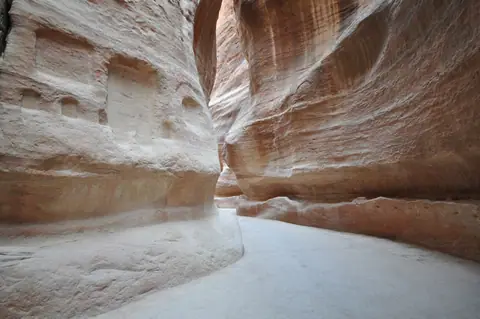
Bab al-Siq & The Siq Walk: Djinn Blocks, Obelisk Tomb, Dam & Nabataean Water Channels
Petra, Jordan
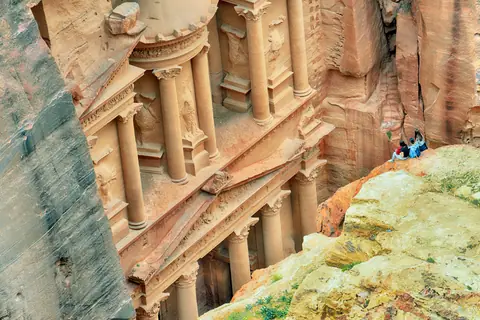
Al-Khazneh (The Treasury): Architecture, Cliff Viewpoint Scams, Lighting & Crowd Timing
Petra, Jordan
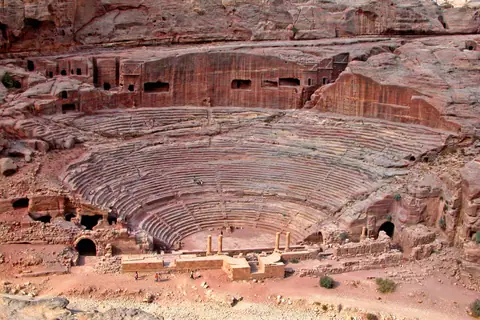
Street of Facades, Nabataean Theater & The Royal Tombs: Urn, Silk, Corinthian & Palace Tombs
Petra, Jordan
