






















Petra Orientation: Wadi Musa Layout, Main Trail Spine, Jordan Pass Rules & Field Traps
Master the physical layout of Petra and Wadi Musa, how the 8 km main trail and elevation drop work, Jordan Pass visa rules, and how to avoid horse, donkey, and viewpoint scams.
Most visitors arrive in southern Jordan picturing Petra as a single rose-red facade at the end of a short canyon path. On the ground, the reality is far larger, steeper, and more physically demanding. Inscribed as a UNESCO World Heritage Site in 1985 (Reference 326), the Petra Archaeological Park covers 26,171 hectares (261.7 square kilometres). Its sandstone valleys drop from the Jabal ash-Sharah mountain plateau toward the desert rift of Wadi Araba. Known to its ancient Arab builders as Raqmu (RAHK-moo), the Nabataean capital holds more than 800 registered tombs, temples, altars, dams, and cisterns. Private cars are barred past the entrance plaza in Wadi Musa (WAH-dee MOO-sah, "Valley of Moses", postal code 71810). Your visit depends on reading the canyon's downhill gradient, understanding ticket rules, and sidestepping persistent animal and viewpoint touts inside the gorge.
How the Wadi Musa slope and the 8-kilometre Main Trail spine fit together
Topography shapes every decision you make in Petra. The gateway town of Wadi Musa clings to a steep limestone bowl above the ancient sandstone basin. At the top of town near Ain Musa (Moses' Spring) and the main roundabout, the elevation reaches 1,350 to 1,450 metres above sea level. From that ridge, the street grid drops down a three-kilometre valley to the Petra Visitor Center and the adjacent Petra Museum at 1,080 metres elevation. That 300-metre vertical gap is the first field trap in town. Booking the wrong hotel zone in Wadi Musa's upper or lower districts adds a punishing uphill road climb to the end of your day.
Once you pass through the ticket turnstiles at the Visitor Center, the archaeological park unfolds along a single east-to-west main spine. This central corridor measures roughly 4 kilometres one way (8 kilometres round trip) before you add a single mountain staircase:
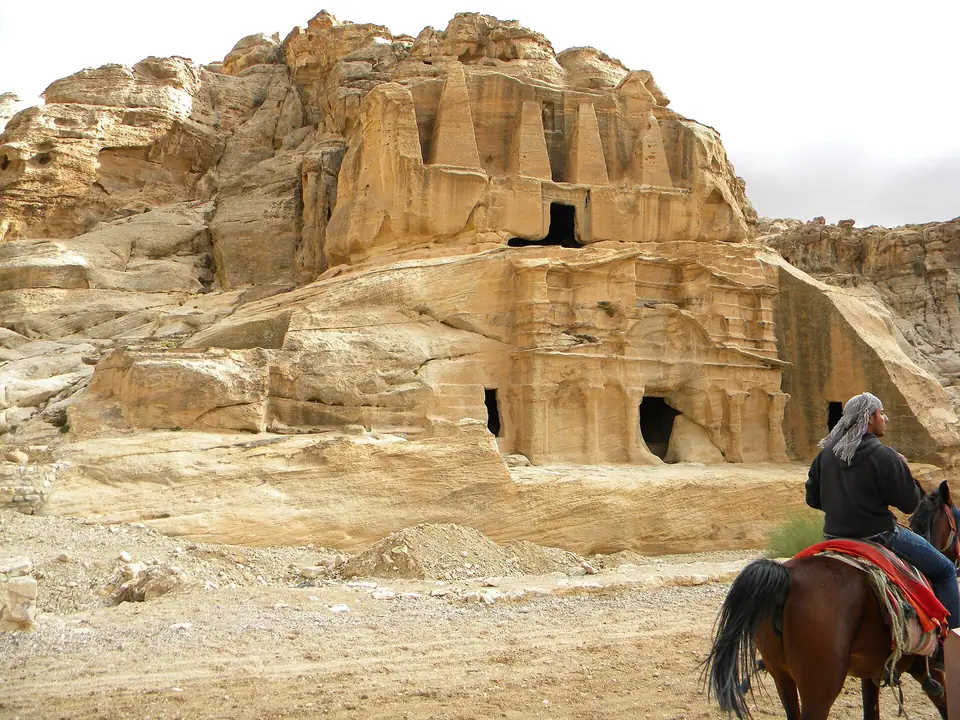
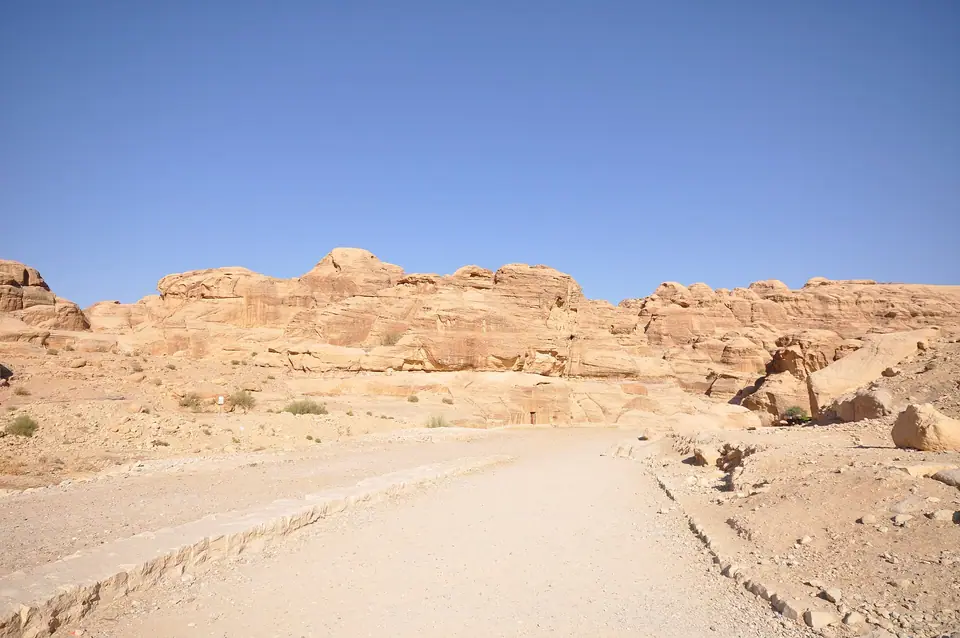
- Zone 1: Bab al-Siq (0 to 0.8 km from gate, 1,080 m to 1,040 m elevation). An open, unshaded gravel and stone track descends from the turnstiles. Along the way stand the monolithic Djinn Blocks and the Obelisk Tomb and Bab al-Siq Triclinium, ending at the Nabataean flood-diversion dam.
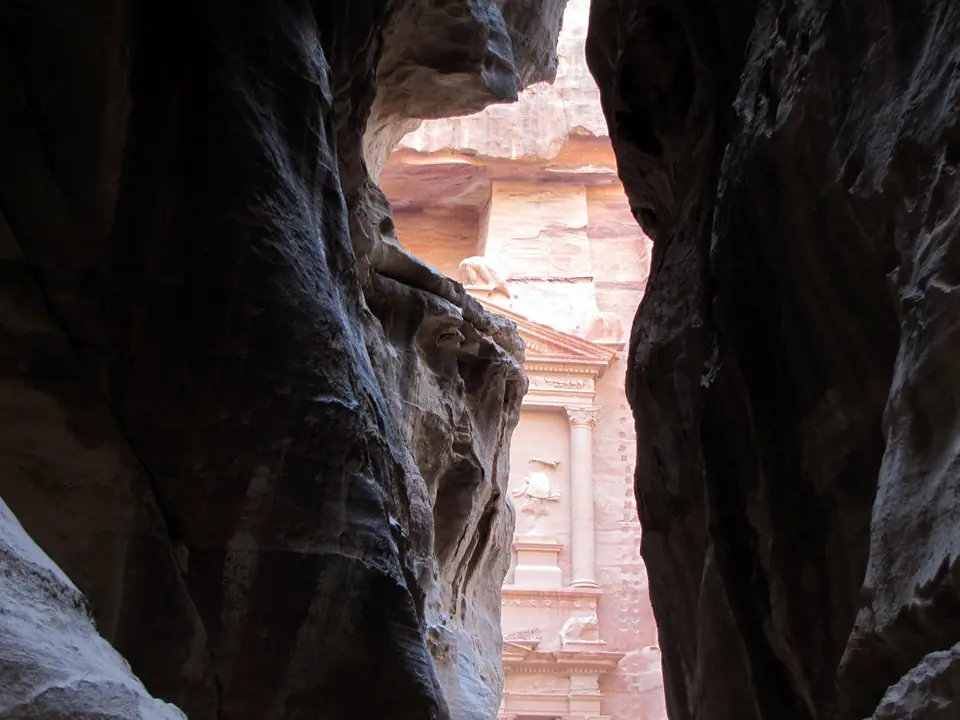
- Zone 2: The Siq (0.8 to 2.0 km, 1,040 m to 990 m). Beyond the dam begins the winding 1.2-kilometre tectonic split canyon. Sandstone cliffs rise 80 to 180 metres overhead while Nabataean water channels and Roman flagstones line the floor, as detailed in our Bab al-Siq and Siq walking guide.
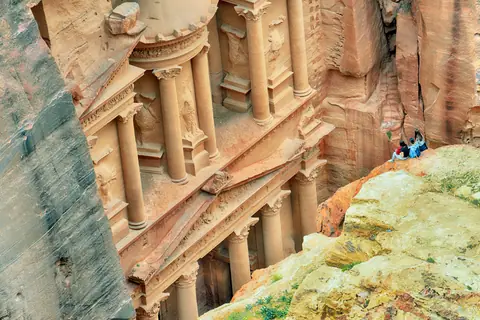
- Zone 3: Al-Khazneh and the Outer Siq (2.0 to 2.8 km, 990 m to 950 m). The narrow gorge empties into a cliff-walled plaza facing the 39.5-metre Al-Khazneh (The Treasury). Turning right leads northwest through the widening Outer Siq past the Street of Facades and the trailhead for the High Place of Sacrifice.
- Zone 4: The Theater, Royal Tombs, and Central Basin (2.8 to 4.0 km, 950 m to 890 m). The canyon opens into the wide city valley holding the 7,000-seat Nabataean Theater and the Royal Tombs on the cliff of Jabal al-Khubtha. From the Nymphaeum shade trees, the Roman Colonnaded Street, Great Temple, Byzantine Church, and Qasr al-Bint run west to the Basin restaurants.
- Zone 5: The High Mountain Trails (1,050 m to 1,100 m+) and Little Petra (Siq al-Barid). Behind the Basin restaurants begins the 2.5-kilometre staircase of over 800 rock-cut steps ascending to Ad-Deir (The Monastery). Meanwhile, the separate High Place of Sacrifice, Wadi Farasa, and Al-Khubtha trails scale the surrounding ridges, and Little Petra (Siq al-Barid) sits 9 kilometres north in Al-Beida.
Notice the physical trap built into that elevation profile. Walking from the Visitor Center (1,080 metres) down to Qasr al-Bint in the Basin (890 metres) is a gradual 190-metre descent during the cool morning hours. Walking those 4 kilometres back to the gate in mid-afternoon heat is an unbroken 190-metre uphill climb over uneven flagstones and deep canyon sand.
Decoding PDTRA ticket tiers, the Jordan Pass, and the same-day border penalty
Site access is managed by the Petra Development and Tourism Region Authority (PDTRA). Three ticketing rules govern every foreign visitor:
- The Jordan Pass (3-Night / 4-Day Minimum Rule). Issued by the Ministry of Tourism and Antiquities, the official Jordan Pass bundles 1-day, 2-day, or 3-day entry to Petra with over 40 Jordanian heritage sites. Buying it online before arrival waives the tourist entry visa fee if you stay at least 3 consecutive nights (4 days) in Jordan. On your first morning, bring your physical passport and QR code to the Visitor Center ticket hall for validation before the turnstiles.
- Overnight Stay Tariff vs Same-Day Arrival Penalty. Travellers staying at least one night in Jordan pay the standard 1-day, 2-day, or 3-day ticket rate. Visitors who enter Jordan and visit Petra on the same calendar day without staying overnight pay a higher same-day border tariff. If you pay that higher tariff on arrival day and sleep in Wadi Musa that night, do not worry. Bring your ticket, hotel receipt, and physical passport back to the Visitor Center window the next morning to claim the official cash difference refund.
- Petra by Night Exclusion. Held on select evenings along a candlelit Siq path to the Treasury, Petra by Night requires a separate ticket. It is not included in the Jordan Pass, and a valid daytime Petra ticket is required. Check the official Visit Petra portal for current schedules.
Field engineering: The six tourist traps inside Petra and how to handle them
Petra is remarkably safe from violent crime, as confirmed by UK Foreign, Commonwealth & Development Office (FCDO) advice. Jordanian Tourism Police maintain visible posts at the Visitor Center, the Treasury, and the Basin. What catches travellers off guard is an aggressive ecosystem of unlicensed touts, animal handlers, and self-appointed cliff guides. Knowing how these six traps operate before you enter the park removes almost all friction:
- Trap 1: The "Free Horse Ride" Pitch at Bab al-Siq. Tickets mention an included 800-metre horse ride from the Visitor Center to the Siq dam. Handlers call the ride free, then block the dam barrier and demand a steep cash tip. Decline with a firm "La, shukran" and walk the separated right-hand pedestrian path.
- Trap 2: The Unauthorized Treasury Cliff Scramble. At Al-Khazneh, touts offer to guide you up a steep, unbarricaded northern rock gully for an aerial photo. Rangers frequently close this hazardous scramble, and touts demand both a guide fee and a tent viewing charge at the top. Hike the legal 600-step Al-Khubtha Trail past the Royal Tombs instead.
- Trap 3: The "Trail Is Closed" Donkey Bait-and-Switch. In the Basin, donkey handlers tell hikers that Ad-Deir is "closed to walkers" or "three hours uphill". Others quote a low number that turns out to be in US Dollars or one-way only. Donkeys slip easily on the 800 polished steps and suffer severe saddle and joint injuries. Ignore claims from anyone outside an official PDTRA or Tourism Police uniform. The climb takes 45 to 60 minutes on foot.
- Trap 4: Official PDTRA Electric Club Cars. Visitors who want to skip the 190-metre return climb through the Siq can board official PDTRA electric club cars. These five-seat buggies run between the Visitor Center, the Treasury, and the Basin for a fixed cash fare and do not climb mountain stairs.
- Trap 5: The Little Petra Back-Door Taxi Claim. Town taxis cannot drive past the parking barrier at Little Petra in Al-Beida. Only the official Bedouin 4x4 cooperative drives the 5-kilometre dirt track to the Back-Door Monastery trailhead. Validate your Petra ticket at the main Visitor Center first.
- Trap 6: "Ancient Nabataean Coins". Trail vendors often offer blackened coins or clay lamps claimed to be washed out of the wadi. Buying or exporting real antiquities violates Jordanian Antiquities Law No. 21 of 1988, and trail coins are acid-aged replicas.
Currency, cash rules, electricity, and emergency contacts
Jordan uses the Jordanian Dinar (JOD), divided into 100 piastres (qirsh) or 1,000 fils. Inside the park, cash in JOD is essential for electric club cars, the Little Petra 4x4 shuttle, water stalls, and Bedouin tea tents. Withdraw cash at the ATMs near the Mövenpick Resort before entering the gate. Jordan uses 230V, 50Hz electricity with British Type G and European Type C/F outlets. Carry 2 to 3 litres of water per person into the canyon, as outlined in our seasonal weather guide and packing guide. The national emergency number is 911. Continue planning with our top things to do in Petra and our 3-day Petra itinerary.
Where it is
- 1Petra
- Ramon International Airport (ETM) · about 80 km from Petra in a straight line
- Directions in Google Maps
Traveller tips
Real advice from people who have been to Petra. Every tip is read by our team before it goes live.
No tips yet. Been here? Yours could be the first.
Thank you! Your tip will appear here after a quick review.
More in Petra
Continue exploring Petra with related neighbourhood, food, and planning guides
Al-Khazneh (The Treasury): Architecture, Cliff Viewpoint Scams, Lighting & Crowd Timing
Petra, Jordan
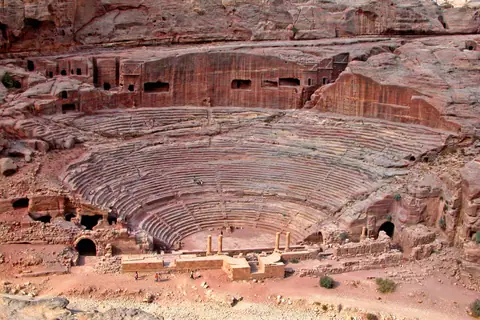
Street of Facades, Nabataean Theater & The Royal Tombs: Urn, Silk, Corinthian & Palace Tombs
Petra, Jordan
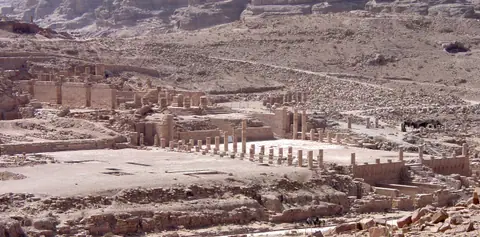
The Basin Core: Colonnaded Street, Great Temple, Qasr al-Bint, Byzantine Church & Petra Museum
Petra, Jordan
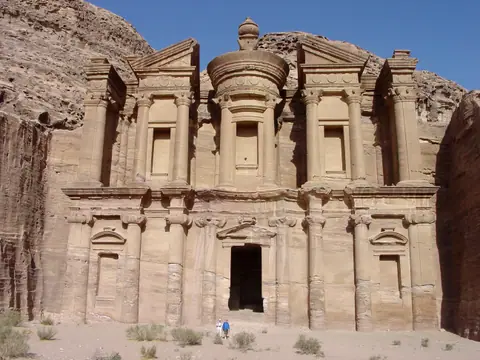
Ad-Deir (The Monastery) & Little Petra Back-Door Hike: 800 Steps vs 4x4 Shuttle Route
Petra, Jordan
