




















The Basin Core: Colonnaded Street, Great Temple, Qasr al-Bint, Byzantine Church & Petra Museum
Explore the urban centre of Petra along the Roman Colonnaded Street, including the 7,560 sq m Great Temple, Qasr al-Bint, the Byzantine Church mosaics, and the JICA Petra Museum.
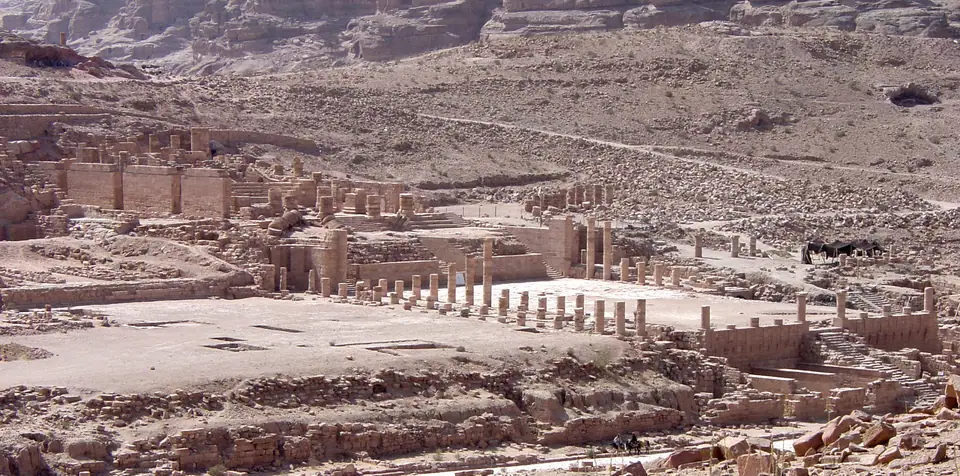
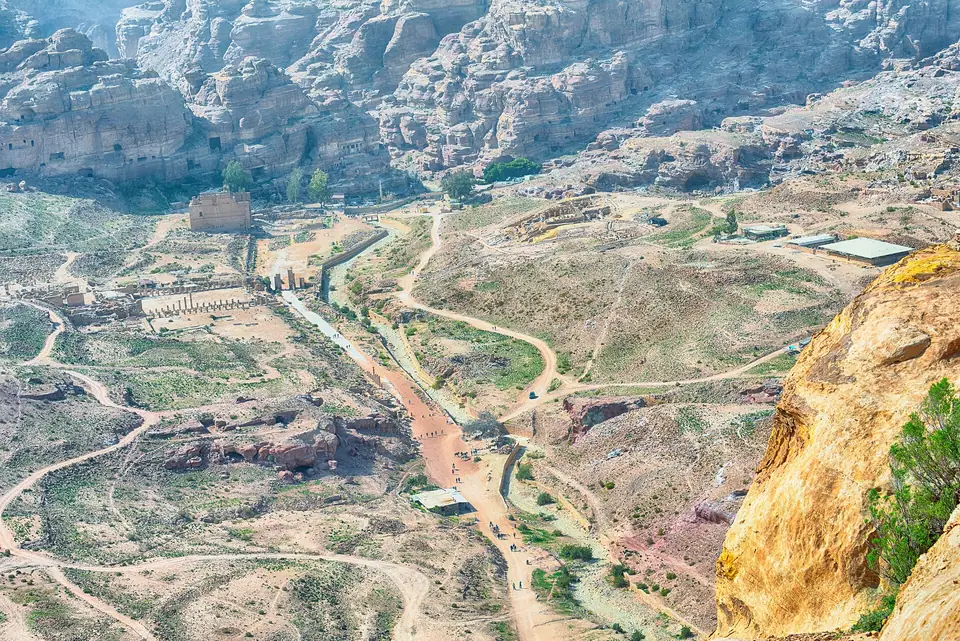
Because the rock-cut facades of the Treasury and Royal Tombs dominate travel photography, many visitors are surprised to learn that the actual living heart of ancient Petra was not inside the caves at all. West of the Theater and the Royal Tombs, the canyon opens into the broad valley known as the Basin. Here stood a freestanding Greco-Nabataean and Roman metropolis that housed 20,000 to 30,000 inhabitants. Along the south and north banks of Wadi Musa stand a paved marble-and-limestone Colonnaded Street, a 7,560-square-metre temple complex, fifth-century Christian church mosaics, and the 23-metre freestanding sanctuary of Qasr al-Bint. Below is how to navigate the central city floor and pair it with the modern Petra Museum at the Visitor Center gate.
The Nymphaeum and the Roman Colonnaded Street
Where the seasonal stream bed of Wadi Musa turns west below the Royal Tombs, the trail passes a large, centuries-old wild pistachio tree (Pistacia atlantica) shading the semi-circular ruins of the Nymphaeum. Roman engineers built this public ornamental fountain in the second century CE after Emperor Trajan annexed the Nabataean Kingdom as Arabia Petraea in 106 CE. Fresh water reached the fountain through the northern terracotta pipeline coming out of the Siq.
West of the Nymphaeum stretches the Colonnaded Street, the commercial spine of first- and second-century Petra. Nabataean town planners first laid out this market corridor under King Aretas IV. Roman engineers later monumentalized it into a 6-metre-wide paved limestone thoroughfare flanked by 72 sandstone columns and two-storey shops, running 240 metres along the wadi channel. Look at the deeply rutted wheel grooves in the paving stones and the raised pedestrian kerbs designed to protect shoppers from flash floods and cart traffic.
The 7,560-square-metre Great Temple and the Nabataean Garden and Pool Complex
Rising on artificial terraces immediately south of the Colonnaded Street are two major civic and royal complexes excavated over recent decades by American archaeological teams:
- The Garden and Pool Complex (Paradeisos). Just east of the Great Temple stairs sits an extraordinary desert luxury discovered in 1998. Here Nabataean engineers built a first-century BCE pleasure garden and swimming pool measuring 43 by 23 metres, holding over two million litres of water. Its central island pavilion and hydraulic pipes irrigated shade trees, date palms, and flowerbeds in the middle of the valley.
- The Great Temple Complex (7,560 Square Metres). A monumental Propylaeum staircase ascends south from the Colonnaded Street into the Great Temple, excavated by Brown University archaeologists led by Martha Sharp Joukowsky starting in 1993. It is the largest freestanding complex in Petra, spanning 7,560 square metres (105 by 72 metres). First constructed in the late first century BCE and expanded in the first century CE before collapsing in the 363 CE earthquake, it splits into two levels. The Lower Temenos is framed by triple colonnades originally crowned with 120 sculpted limestone elephant-headed capitals reflecting trade links with India and Egypt. Above it, the Upper Temenos houses a 28-by-40-metre building containing a 600-seat semicircular stone theatron (bouleuterion) for royal audiences and council assemblies.
Qasr al-Bint: Petra's 23-metre freestanding main sanctuary
At the western end of the Colonnaded Street stands the triple-bayed Temenos Gate, built in the late first or early second century CE. Passing through its arches brings you into a 200-metre sacred precinct ending at Qasr al-Bint (KAH-sar al-BINT, "The Palace of Pharaoh's Daughter"). Built between 30 BCE and 40 CE during the reigns of Obodas III and Aretas IV, Qasr al-Bint is the best-preserved freestanding stone temple in Petra:
- Earthquake-Resistant Ashlar Masonry. Resting on a high podium with a square footprint of roughly 32 by 32 metres and a 27-column marble-stepped forecourt staircase, the massive ashlar sandstone walls still stand 23 metres (75 feet) high. Why did Qasr al-Bint survive the 363 CE and 749 CE earthquakes when the adjacent Colonnaded Street and Great Temple fell? Nabataean builders inserted horizontal juniper and cedar timber tie-beams and wooden wedges inside the stone masonry to absorb seismic shockwaves. They also coated the exterior in brightly painted lime stucco, fragments of which still cling to the eastern and southern walls.
- Sanctuary of Dushara and Al-Uzza. Inside the rear adyton sit three raised compartments. A central elevated platform that held the sacred stone betyl of Dushara (lord of the Jabal ash-Sharah mountains). It stands flanked by two double-storey side chambers housing priest quarters and the cult of Al-Uzza.
The Byzantine Church mosaics, Winged Lions Temple, and the 2019 JICA Petra Museum
Directly across the wadi channel on the northern slope rise two essential sanctuaries. You can reach both via a footbridge before stopping at the Basin restaurants or starting the climb to Ad-Deir:
- The Temple of the Winged Lions (First Century CE). Occupying the hill west of the church, this Nabataean sanctuary dedicated to the supreme fertility goddess Al-Uzza takes its name from the winged feline sculptures decorating its altar capitals.
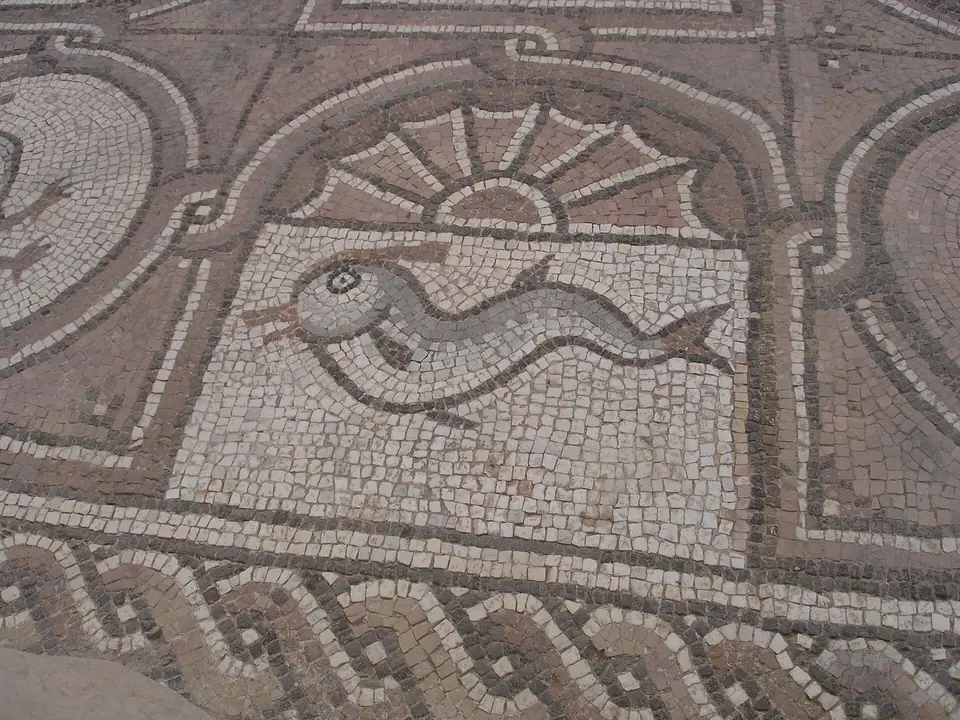
- The Petra Church (Byzantine Basilica, Late Fifth Century CE) and the 1993 Papyrus Scrolls. Sheltered under a protective modern canopy, this three-aisled Christian basilica preserves some of the finest sixth-century floor mosaics in the Levant. Look along the northern and southern side aisles to see lively tesserae medallions depicting the Four Seasons, Oceanus, Earth, Wisdom, giraffes, elephants, ostriches, fishermen, and amphora carriers. In December 1993, archaeologists excavating a storage room beside the northern apse uncovered the Petra Papyri, a cache of roughly 140 carbonized Greek papyrus scrolls from 537 to 593 CE. Chronicling the marriages, vineyards, taxes, and water rights of the archdeacon Theodoros, son of Obodianos, these records prove that Petra remained a prosperous agricultural bishopric long after the 363 CE earthquake.
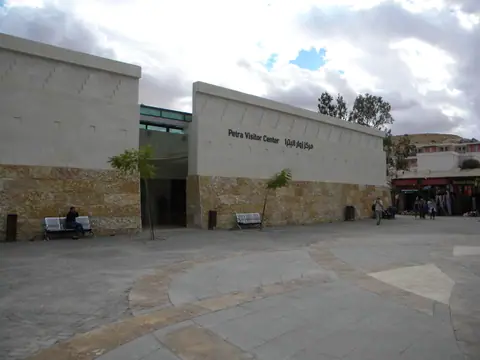
- The JICA-Funded Petra Museum (At the Visitor Center Gate). To see the original sculpted friezes, elephant-headed capitals, bronze lamps, and hydraulic pipes excavated from the Basin, save 60 minutes in our 3-day Petra itinerary. Visit the modern Petra Museum right outside the Visitor Center gate in Lower Wadi Musa. Admission is free for all visitors. Opened in April 2019 across 2,000 square metres with grant aid from the Japan International Cooperation Agency (JICA), the museum is free with your park pass. Its five galleries feature the first-century CE marble statue of Aphrodite of Petra, Nabataean coins, earthquake cross-sections, and interactive water-system models.
Facilities in the Central Basin: Washrooms, shade, and museum hours
The western end of the Colonnaded Street around Qasr al-Bint serves as the main logistical hub inside the archaeological park. Just behind Qasr al-Bint and across the wadi footbridge toward the Monastery trailhead sit the park's largest public washrooms, shaded picnic tables, two full-service restaurants, and craft kiosks. It is also the western turnaround point for the official PDTRA electric club cars returning up the Colonnaded Street and the Siq to the Visitor Center gate. When planning your visit to the JICA-funded Petra Museum outside the main entrance in Lower Wadi Musa, remember that its five air-conditioned galleries stay open into the early evening after hikers exit the canyon. Stopping at the museum either before your first walk or after your afternoon return brings the bare stone ruins of the Great Temple and Qasr al-Bint to life.
Rising directly behind Qasr al-Bint at the western edge of the Basin is the steep sandstone acropolis peak of Al-Habis. Ruined stone walls of a twelfth-century Crusader watchtower fort built under King Baldwin I crown the summit of Al-Habis. From this outpost of Shobak Castle, sentries watched over the central valley and the western tracks toward Wadi Araba. Around the base of Al-Habis runs a quiet path past the Unfinished Tomb, where Nabataean quarrymen left a half-carved facade frozen in stone. It shows how masons blocked out upper capitals first while the lower bedrock remained unexcavated.
Combining the Unfinished Tomb, Qasr al-Bint, the Great Temple, the Byzantine Church mosaics, and the JICA Petra Museum reveals how Petra evolved across a thousand years. The valley grew from early Nabataean tent camps and royal Hellenistic sanctuaries into a colonnaded Roman metropolis, a sixth-century Byzantine bishopric, and a twelfth-century Crusader outpost.
Allow two full hours to explore both sides of the Colonnaded Street and the Qasr al-Bint precinct at an unhurried pace. Morning light best illuminates the eastern steps of Qasr al-Bint, whereas late afternoon casts warm golden shadows across the limestone columns of the Great Temple.
Where it is
- 1The Basin Core
- Ramon International Airport (ETM) · about 79 km from here in a straight line
- Directions in Google Maps
Traveller tips
Real advice from people who have been to Petra. Every tip is read by our team before it goes live.
No tips yet. Been here? Yours could be the first.
Thank you! Your tip will appear here after a quick review.
More in Petra
Continue exploring Petra with related neighbourhood, food, and planning guides
Best Things to Do in Petra: The Siq, Treasury, Monastery, High Place & Little Petra
Petra, Jordan
How to Get to Petra: Amman (AMM) & Aqaba (AQJ) Airports, JETT Buses, Highways & Local Shuttles
Petra, Jordan
Best Time to Visit Petra: Wadi Musa Climate Normals, Flash Floods, Heat & Crowd Strategy
Petra, Jordan
What to Wear in Petra: Sandstone Canyon Footwear, Sun & Dust Protection & Modest Dress
Petra, Jordan
