Stavanger Cathedral (Domkirke), Kongsgård and Breiavatnet
Examine Norway's oldest cathedral on its original twelfth-century footprint beside the 1759 Kongsgård timber manor and Breiavatnet lake.
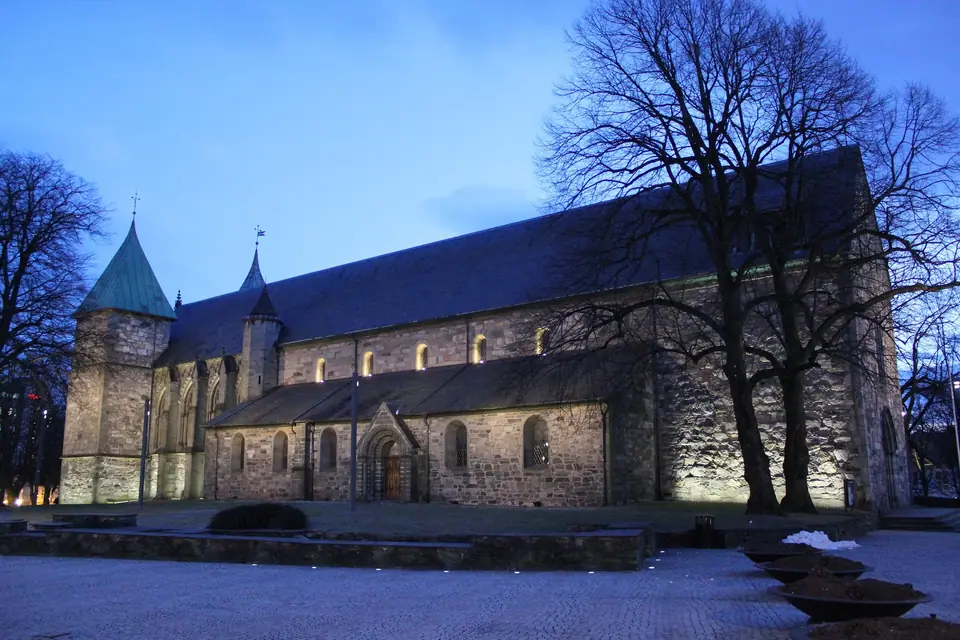
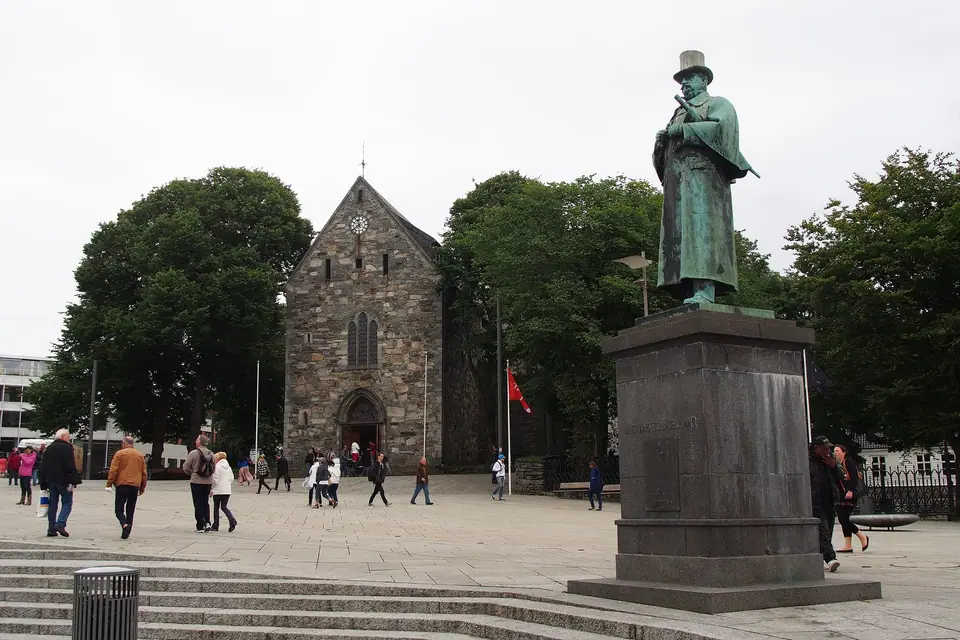
Standing between the market square of Torget and the tree-lined shore of Breiavatnet lake, Stavanger Cathedral (Stavanger domkirke) is Norway's oldest cathedral and the only medieval Norwegian cathedral to have remained in continuous ecclesiastical use while retaining its fourteenth-century architectural profile. Construction began around 1100 and was completed around 1150 after King Sigurd Jorsalfare established the Diocese of Stavanger between 1120 and 1125 and appointed Reinald, a Benedictine monk from Winchester in England, as first bishop. Reinald dedicated the church to the Anglo-Saxon patron Saint Swithun of Winchester and brought an arm relic of the saint to the high altar before being hanged on 18 January 1135 in Bergen by King Harald Gille during the Norwegian civil war era.
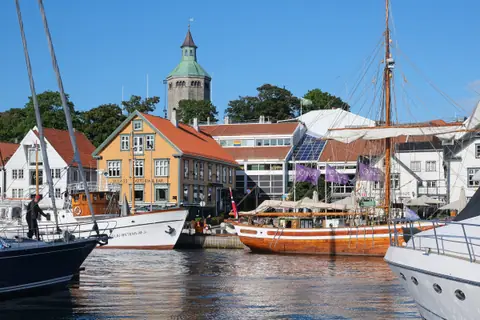
Situated on a low natural ridge between the salt water of Vågen and the fresh water of Breiavatnet, the cathedral formed the ecclesiastical and civic nucleus around which medieval Stavanger grew. Even today, its stone walls and twin eastern towers anchor the pedestrian transition between the busy harbour quays, the green lawns of Byparken, and the rail and bus terminals to the south, offering a quiet stone sanctuary steps from the waterfront. Royal visits, diocesan services, and chamber concerts still take place beneath the medieval arches throughout the year.
Anglo-Norman Nave and Post-1272 Gothic Choir
Because masons arrived from England, the three-aisled basilica nave was built in severe Anglo-Norman Romanesque style with heavy circular stone piers, cushion capitals, and chevron-carved semicircular arches. When a devastating city fire swept Stavanger in 1272, Bishop Arne (bishop from 1277 to 1303) replaced the ruined Romanesque apse and damaged west tower with a high vaulted Gothic choir flanked by twin eastern towers and pierced by a tall pointed-arch east window framed in carved soapstone.
Walking from the western entrance toward the altar allows visitors to read this architectural shift in a single glance. The thick, grounded masonry and rounded arcades of the twelfth-century nave give way at the chancel arch to slender Gothic shafts, ribbed stone vaults, and finely sculpted soapstone capitals decorated with foliage, grotesque masks, human heads, and medieval stonecarvers' motifs. Outside on the north and south walls, carved stone portals and window surrounds showcase the skill of the thirteenth-century workshop that rebuilt the choir. Because local soapstone is soft enough to carve in fine detail yet durable against Atlantic weather, the exterior corbels and portal mouldings retain crisp medieval lines across the centuries.
Baroque Carvings and Restorations
After the Protestant Reformation of 1537, when the reliquary of Saint Swithun disappeared and the bishopric was eventually moved to Kristiansand by King Christian V in 1682 (before King Haakon VII re-established the Lutheran Diocese of Stavanger in 1925 on its 800th anniversary), the interior gained rich seventeenth-century protestant furnishings. Scottish-born woodcarver Andrew Lawrenceson Smith created the ornate baroque pulpit in 1658 and carved five wooden epitaphs for prominent burgher families. Major architectural restorations under Conrad Fredrik von der Lippe (1866 to 1869), Gerhard Fischer (1939 to 1964), and the 900th-anniversary conservation completed for 2025 preserved the medieval soapstone portals and stained glass by Victor Sparre (1957).
The multi-year conservation work leading up to the cathedral's nine-hundredth anniversary carefully cleaned the interior stone surfaces, repaired mortar joints with traditional lime mixes, and updated lighting and climate systems while uncovering archaeological traces beneath the floor. Visitors can now examine the striking contrast between the austere medieval stonework and the exuberantly carved timber cartouches, biblical figures, and painted coats of arms from the seventeenth century, alongside the modern liturgical glass filtering eastern light above the altar.
Kongsgård and the Bishop's Precinct
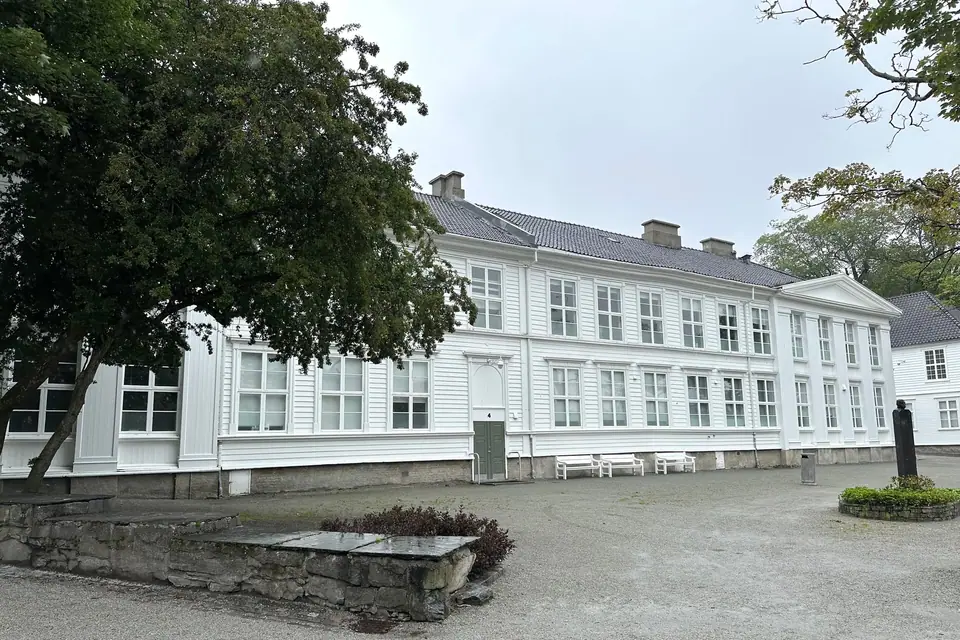
Immediately south of the cathedral stands the white timber main building of Stavanger Cathedral School (Kongsgård), erected over the medieval stone cellar walls of the thirteenth-century bishop's palace and county governor's residence. The current two-storey wooden manor dates principally from 1759, received its Louis XVI decorative details around 1800, and has housed the upper secondary school since 1826, where novelist Alexander Kielland studied in the 1860s. Between the cathedral and the school sits Bispekapellet, the thirteenth-century Gothic bishop's chapel built after the 1272 fire.
Although Kongsgård functions as an active school and its classrooms are not open to casual drop-in visits, the exterior courtyard, the medieval stone perimeter wall facing Torget, and the pointed Gothic portal of Bispekapellet can be admired from the surrounding public walkways. Together with the cathedral nave, they preserve the layout of a medieval Norwegian episcopal enclosure right in the middle of the modern city, illustrating how church administration, royal governance, and Latin education shared the same fortified compound above the harbour.
Byparken and Breiavatnet Lake
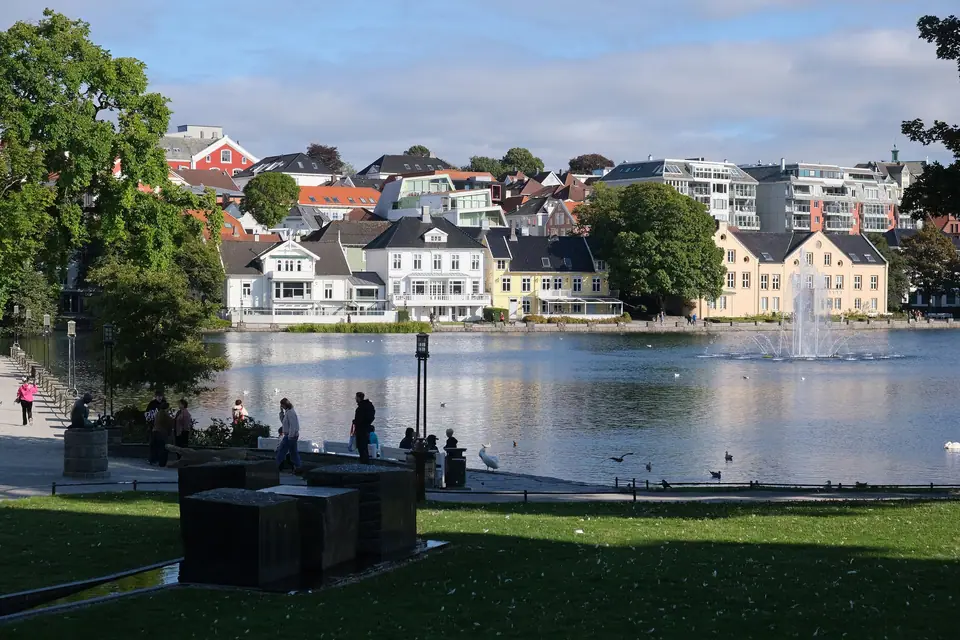
East of the cathedral, Byparken, laid out as a public municipal park in 1866 to 1868, wraps around the northern shore of Breiavatnet, a shallow freshwater lake fed by underground springs and inhabited by swans, ducks, and seagulls. Shaded benches, formal flower beds, historic statues, and gravel promenades make the park a calm daytime pause between museum visits, while a central fountain jet rises from the middle of the lake during the warmer months. On sunny afternoons, locals gather on the grass slopes and park benches overlooking the water.
Connecting the Cathedral Square to the Harbour
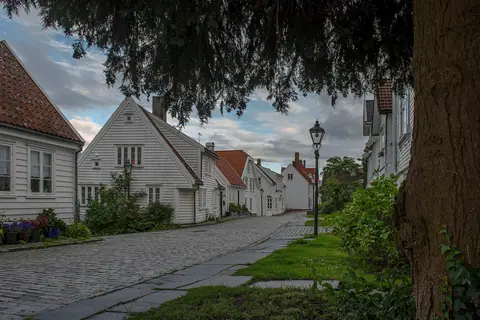
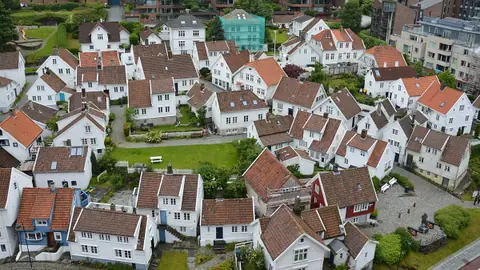
From the western steps of the cathedral, the newly repaved plaza at Torget slopes down to the water's edge at Vågen, where local buses, harbour ferries, and market stalls gather throughout the week. Walking the lakeside perimeter path links the cathedral precinct directly with Stavanger Station to the south, the white timber cottages of Gamle Stavanger to the west, and the colourful cafés of Øvre Holmegate to the north.
Around the edges of Torget and Byparken, the surrounding streets illustrate how nineteenth- and twentieth-century civic life gathered around the medieval cathedral enclosure. Across from the park lawns stand historic bank buildings, municipal offices, and cultural venues that frame the southern and western approaches to the church, while the broad stone steps descending to the harbour market square create a natural amphitheatre overlooking the boats in Vågen. Whether you pause inside the nave to study the heavy Romanesque masonry, walk beneath the specimen trees of Byparken as fountain spray drifts across Breiavatnet, or trace the medieval stone wall bordering Kongsgård toward the waterfront, the cathedral precinct remains the calm historic anchor of central Stavanger.
Traveller tips
Real advice from people who have been to Stavanger Cathedral (Domkirke), Kongsgård and Breiavatnet. Every tip is read by our team before it goes live.
No tips yet. Been here? Yours could be the first.
Thank you! Your tip will appear here after a quick review.
More in Stavanger
Continue exploring Stavanger with related neighbourhood, food, and planning guides