Øvre Holmegate (Fargegaten) and Valbergtårnet Watchtower
Stroll Craig Flannagan's 2005 pastel-and-neon timber street and climb Christian H. Grosch's 1853 octagonal stone fire tower on Valberget.
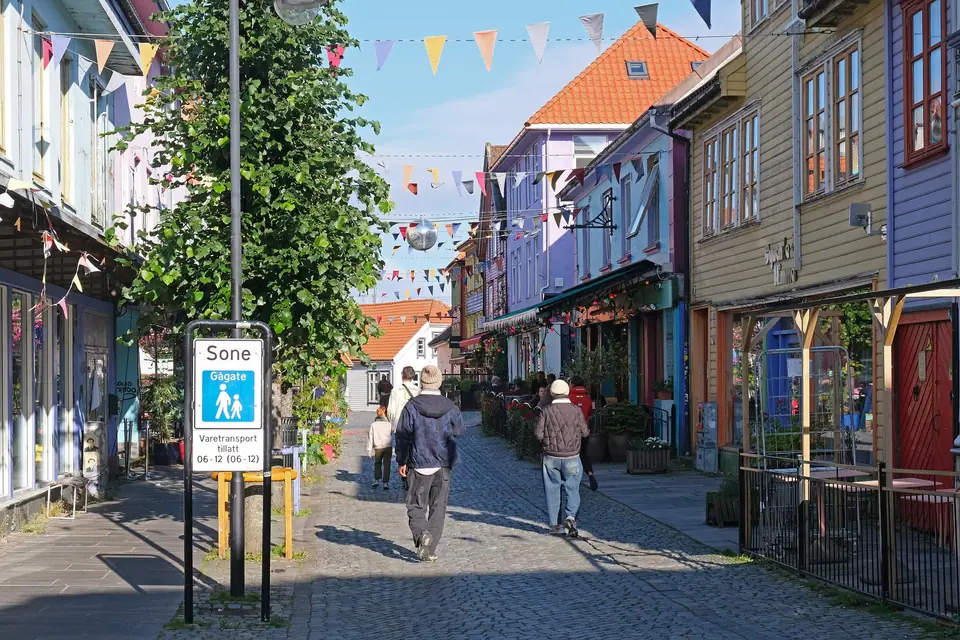
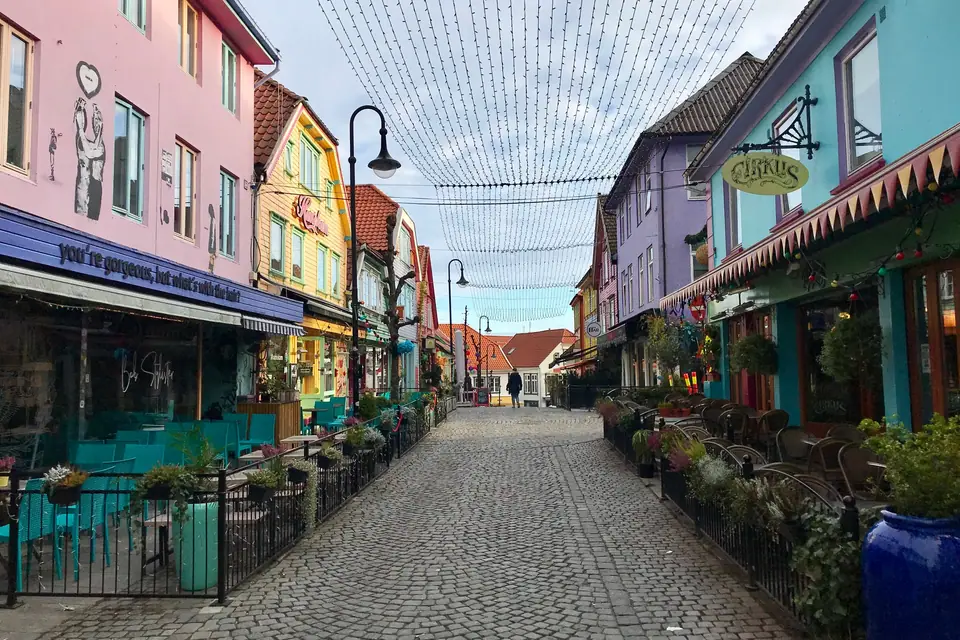
While Gamle Stavanger on the west side of Vågen is celebrated for its uniform white Empire timber facades, the pedestrian lane of Øvre Holmegate on the eastern side of the harbour, universally known in Norway as Fargegaten ('The Street of Colours'), presents a striking contrast in turquoise, magenta, mustard yellow, violet, and lime green. Stretching between Kirkegata and Skagen in the Kuholmen and Holmen quarter, the low nineteenth-century wooden houses have become Stavanger's liveliest daytime coffee and evening bar corridor.
Tucked just behind the waterfront warehouses of Skagenkaien and below the rocky crest of Valberget hill, the quarter preserves the intimate street proportions of nineteenth-century Holmen. Because motor traffic is excluded from the narrow paved lane and its intersecting cross-alleys, wooden benches, potted plants, and string lights spill out across the cobbles, creating a sheltered outdoor living room where locals and visitors gather from morning until late evening.
The 2005 Miami Vice Colour Plan
Until the early 2000s, Øvre Holmegate was a quiet backstreet of underused wooden shopfronts built after the nineteenth-century herring boom. In 2005 local hairdresser and entrepreneur Tom Kjørsvik proposed revitalising the entire street as a unified work of public art and commissioned Scottish-born, Stavanger-based artist Craig Flannagan to design a master colour scheme. Drawing inspiration from the pastel and tropical palette of the 1980s television series Miami Vice, Flannagan assigned specific contrasting body, window-trim, and door colours to every house along the street. Property owners agreed to follow the palette, transforming the four intersecting corners into an open-air gallery of independent cafés, vintage boutiques, sewing studios, and craft beer pubs.
What made the project transformative was its strict coordination across property boundaries. Rather than allowing each building owner to pick a random shade, the colour chart treated the entire street facade as a continuous canvas, pairing teal weatherboarding with coral window frames and purple doors next to warm ochre and mint-green gables. Today, independent baristas, chocolatiers, textile designers, and vinyl record sellers occupy the ground-floor rooms, keeping chain stores out of the lane and preserving its independent creative identity.
Valbergtårnet: Christian H. Grosch's 1853 Watchtower
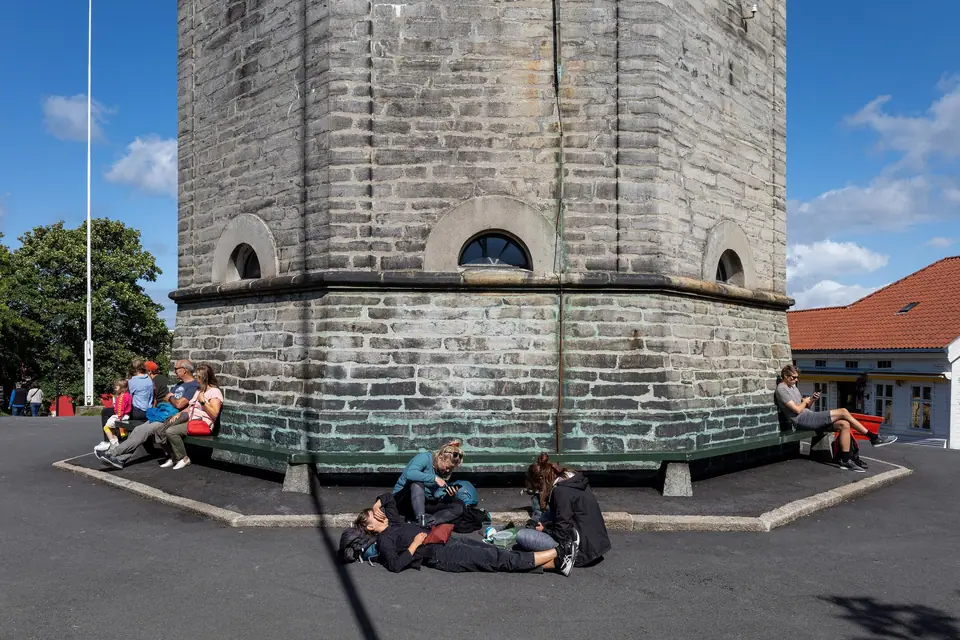
From the western end of Øvre Holmegate, a short cobbled lane climbs Valberget hill, an elevated natural vantage point on the eastern harbour peninsula, to Valbergtårnet. A wooden watchtower had stood on this rock since 1658 to spot fires among the city's tightly packed timber houses and replaced an earlier decayed structure. In 1848 City Bailiff Halvor Christensen contacted Christian H. Grosch, architect of the Royal Palace, the University buildings, and the Bazaar halls in Oslo as well as Stavanger's Gamle Tollbod customs house, to design a permanent stone replacement that retained the octagonal footprint of the old wooden tower.
Standing atop the exposed bedrock of Valberget, the tower commanded a clear line of sight over every timber roof between Vågen, Østervåg, and Breiavatnet. In an era when households heated their rooms with open wood stoves and lit workshops with oil lamps, a single spark whipped by North Sea winds could threaten the entire town, making the hilltop lookout a vital civic institution.
The Watchman Museum (Vektermuseet) on Valbergjet
In December 1849 the Stavanger municipal council voted 3,200 speciedaler for construction, though when the tower was built between 1850 and 1853 in neo-Romanesque cut granite with metre-thick walls and soapstone window arches over cast-iron columns, the final cost exceeded 9,000 speciedaler, surpassing Stavanger's entire municipal budget of 8,770 speciedaler in 1852. Measuring 26.66 metres tall and topped by a slate-roofed lantern and a 3.21-metre iron-and-copper spire with three copper spheres and a weathervane dated 1852, Valbergtårnet entered service on 9 November 1853. It served Stavanger's fire watchmen until 1922, with the last watchman, Tobias Sandstøl, retiring in 1904.
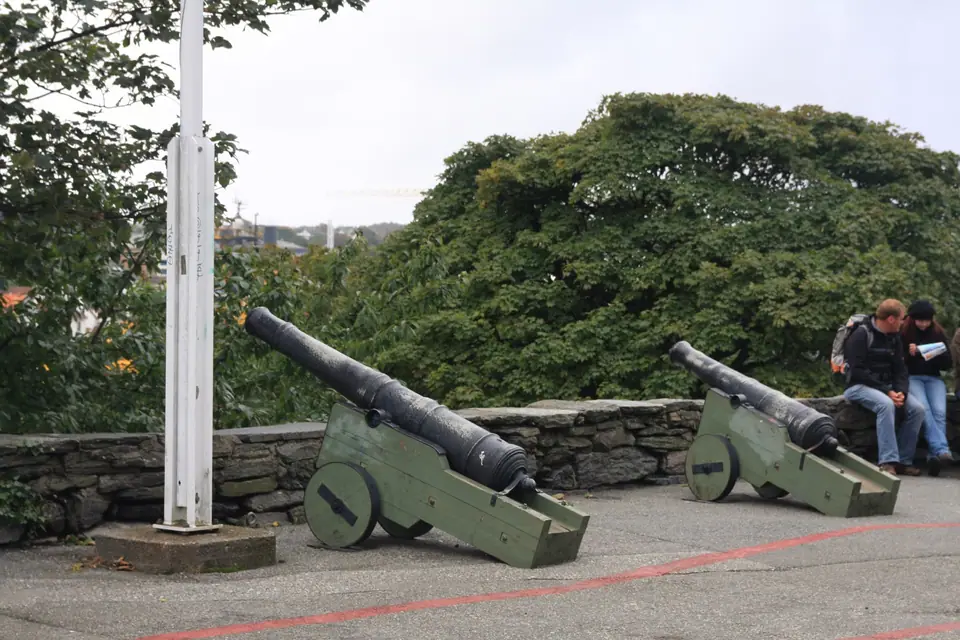
Today the tower houses the Watchman Museum (Vektermuseet) on its upper floors, displaying the brass-buttoned coats, lanterns, alarm horns, and fire-spotting instruments used by the night watchmen, alongside exhibits on the great city fires that reshaped Stavanger's neighbourhoods. From the upper viewing gallery and the hilltop terrace beside the historic iron signal cannons, visitors look directly down over Vågen harbour, the white cottages of Gamle Stavanger, and the islands of Ryfylke.
Combining Holmen, Kirkegata, and Skagenkaien on Foot
Because Øvre Holmegate and Valberget sit right between the harbour quays and the medieval cathedral core, they fit naturally into any morning or afternoon city walk. Start with a morning coffee among the painted facades of Fargegaten when the lane is quiet for photography, climb the granite steps to Valbergtårnet for panoramic harbour views, and then stroll south along Kirkegata toward Stavanger Cathedral or descend to Skagenkaien for a waterfront lunch.
Walking the length of Øvre Holmegate at different hours of the day reveals how the colour scheme interacts with the shifting northern light. On bright mornings, sunlight reflects off the painted horizontal clapboards and illuminates the narrow cross-lanes leading down toward Nedre Holmegate and the waterfront, while on overcast or rainy afternoons the saturated turquoise, magenta, and ochre facades bring warmth to the wet paving stones. Local shopkeepers and café owners regularly collaborate on street exhibitions, acoustic music evenings, and seasonal decorations, maintaining the cooperative neighbourhood spirit that began when the colour plan was introduced.
Up on the crest of Valberget, the small public park surrounding Valbergtårnet offers a quiet elevated perch above the busy harbour streets. Winding paths and benches sit atop the glacially smoothed rock, looking across the rooftops of Holmen toward the twin eastern towers of the cathedral in one direction and the steel-and-stone silhouette of the Norwegian Petroleum Museum in the other. Below the watchtower hill, the historic streets of Kirkegata, Østervåg, and Søregata preserve the commercial layout of old eastern Stavanger, where artisan workshops, watchmakers, bakeries, and clothing merchants established their premises after nineteenth-century town fires prompted stricter building codes alongside the harbour.
For travellers exploring on foot, the short climb up from Skagenkaien past Valbergtårnet and down into Fargegaten provides an ideal transition between the maritime quaysides and the shopping and café lanes of the eastern city centre. Allow an unhurried hour to browse the independent craft shops, step inside the Watchman Museum when open, and enjoy a coffee at one of the outdoor tables lining the cobbles.
Traveller tips
Real advice from people who have been to Øvre Holmegate (Fargegaten) and Valbergtårnet Watchtower. Every tip is read by our team before it goes live.
No tips yet. Been here? Yours could be the first.
Thank you! Your tip will appear here after a quick review.
More in Stavanger
Continue exploring Stavanger with related neighbourhood, food, and planning guides