Kyoto Higashiyama Guide: Kiyomizu-dera, Gion and the Philosopher's Path
How to walk Kyoto's eastern hills from Kiyomizu-dera to Gion and the Philosopher's Path: the right order, the quiet lanes, where to eat and how to avoid the crowds.
Higashiyama means the eastern mountains, and it is the name of the long green ridge that closes Kyoto in on its east side. At the foot of the ridge runs a strip of old Kyoto that has somehow survived the centuries: wooden teahouses on stone-paved lanes, a five-storey pagoda rising over the roofs, shrines that were already ancient when the city was young, and a canal path lined with cherry trees. Most visitors to Kyoto spend at least one day here, and many come back for a second.
The area holds more than a dozen major sights in a walk of about five kilometres, which is why it works so well on foot. It starts with the hilltop temple of Kiyomizu-dera in the south, drifts down through preserved lanes to Yasaka Shrine and the geisha district of Gion, and ends in the north at the Silver Pavilion and the Philosopher's Path. This guide explains the order we recommend, what each stop is like, where to eat along the way and how to keep the crowds from taking over your day.
Higashiyama at a glance
- How long? One long day covers the southern half, from Kiyomizu-dera to Gion. Two days let you add the northern temples and the Philosopher's Path at a gentler pace.
- Where to start? At Kiyomizu-dera, as early in the morning as you can manage. The lanes below it fill up quickly after breakfast.
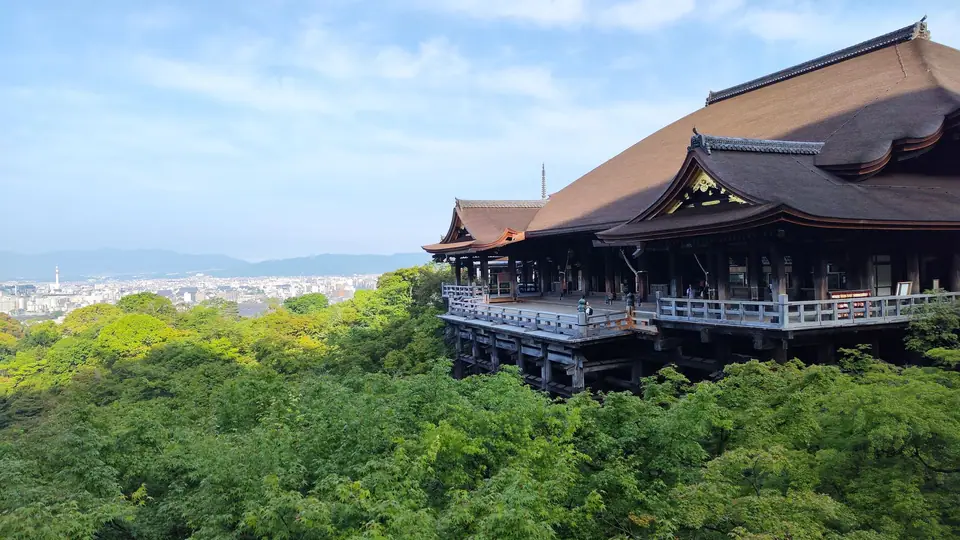
- The signature view: the wooden stage of Kiyomizu-dera with the city spread out below it.
- The best free sights: the lanes, Yasaka Shrine, Maruyama Park, the Shirakawa canal and the Philosopher's Path all cost nothing to enter.
- The classic evening: a slow walk through Gion at dusk, when the lanterns come on and the teahouses glow.
- The biggest mistake: arriving at Kiyomizu-dera at midday and then walking the whole route in a single shuffling crowd.
- When to go: spring and autumn are glorious and crowded, winter is calm and cold. See our best time to visit Kyoto guide.
- Where to sleep: near Gion-Shijo or Kawaramachi for convenience, or in a quiet guesthouse on the hill. More in our Kyoto where to stay guide.
The simplest plan that works: start at Kiyomizu-dera, walk down the lanes, cross Maruyama Park to Yasaka Shrine, finish the day in Gion, and give the northern temples their own morning. Our Kyoto 3-day itinerary shows how this day fits between the other big sights.
How the hillside is strung together
Higashiyama is not one neighbourhood but a chain of them, laid out roughly from south to north along the foot of the hills. In the south, the slope behind Kiyomizu-dera is steep and the lanes climb in a series of steps and bends. Further north the ground flattens into the district around Yasaka Shrine, which sits at the end of Shijo Street, the busiest east-west avenue in the city. Gion spreads out to the west and north of the shrine, bounded by the Kamo River on one side and the hills on the other.
North of Gion the sights thin out and spread apart. Chion-in and Shoren-in stand on the slope above the shrine, the great Zen temple of Nanzen-ji sits further on, and the Philosopher's Path begins close to Nanzen-ji and follows a canal north to Ginkaku-ji. Almost everything described here can be reached on foot from the one before it, with the odd short hop on a bus or train to cut out a long, flat stretch. The one thing to remember is that Kyoto's famous sights are small and they are set on hills, so comfortable shoes matter more than any guidebook advice.
Kiyomizu-dera
Kiyomizu-dera, the Pure Water Temple, was founded in the eighth century and takes its name from the spring that still runs beneath the main hall. The building is best known for its great wooden stage, which juts out over the hillside on a framework of tall pillars joined without a single nail. Looking out from it you see the whole city, and in autumn or spring the slope below turns red or pink. The expression "to jump off the stage of Kiyomizu" is still used in Japanese to describe taking a bold decision, because in the old days people did sometimes leap from it hoping for a miracle.
The path through the temple continues beyond the main hall, past the Jishu Shrine, where visitors try to walk between two stones with their eyes closed as a charm for success in love, and down to the Otowa waterfall. Three streams fall into a pool here, and each is said to bring a different blessing, such as long life, success at school or a happy love life. Queues for the water can be long, so decide if the wait suits your plans. The stairs and slopes are steep, and the temple is spread over a wide area, so give it a generous amount of time.
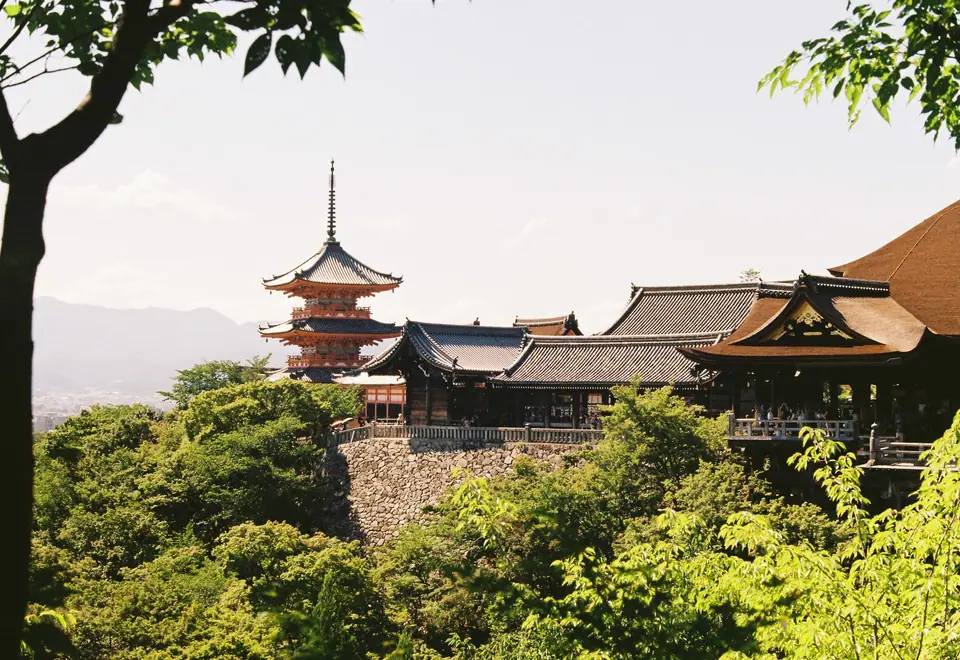
The most useful rule at Kiyomizu-dera is to go early. The temple opens in the morning and the first hour is almost another place, with soft light across the stage and room to stand at the railing. By late morning the platform is crowded and the photographs you came for become hard to take. Two of the best views of the temple are actually from outside it: from the pagoda terrace beside the path, and from the lookout across the valley a short walk away.
Ninenzaka, Sannenzaka and the lanes below the temple
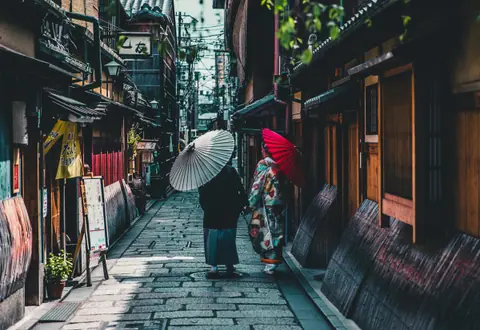
The road down from Kiyomizu-dera is the most photographed street in Kyoto. It begins as Kiyomizu-zaka, a sloping lane lined with shops that sell pottery, pickles, sweets and souvenirs, and then turns into the two preserved stairways of Sannenzaka and Ninenzaka. The buildings here are low, dark-timbered merchant houses and teahouses, and the stone paving keeps traffic out. There is a local superstition that anyone who trips on the Sannenzaka steps will have bad luck for three years, so watch your feet.
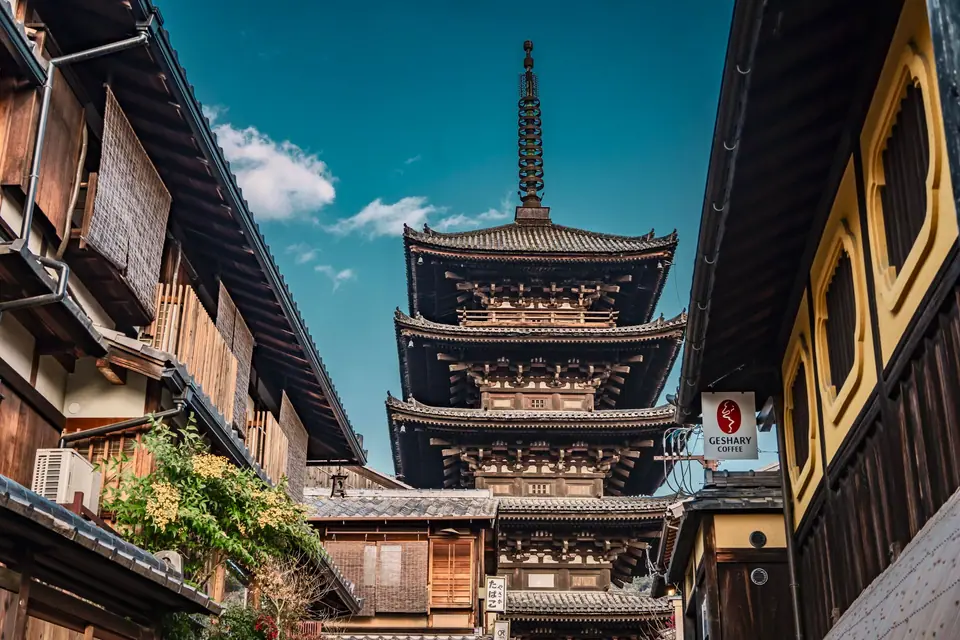
The icon of the area is the Yasaka Pagoda, the five-storey tower of Hokan-ji temple, which pops up above the rooftops at the end of a narrow side lane. It is best seen first thing in the morning, before the crowds arrive, and again in the last light of the evening. Many visitors rent a kimono for the day and walk the lanes in it, and rental shops are everywhere nearby. It is a fun and photogenic thing to do, but remember that kimono restrict your stride, so plan on shorter walking distances.
Small museums, galleries and tea rooms are tucked into the side streets. Some of the best are in the lanes around Kodai-ji, a temple reached by a stone-paved path that is quieter than the main stairways. Its gardens and its bamboo grove are lovely, and in some seasons the grounds are lit up in the evening. If the main lanes are packed, turn up any narrow street that looks empty. That is usually where the real Higashiyama still lives.
Yasaka Shrine and Maruyama Park
At the foot of Higashiyama, where the lanes meet Shijo Street, Yasaka Shrine marks the gateway to Gion. The shrine is the home of the Gion Matsuri, the grand July festival that has run for more than a thousand years, with its towering floats pulled through the streets. Outside festival time the shrine is open at any hour, and the main hall is hung with lanterns that glow at night. It costs nothing to enter, and it is a lovely place to stop when your feet need a rest.
Behind the shrine, Maruyama Park is the city's most famous place to watch cherry blossom. The central attraction is a giant weeping cherry tree, lit at night in spring. Outside the blossom season the park is a pleasant, shady spot with ponds and gravel paths, and it makes an easy link between the shrine and the northern temples. Food stalls and small cafes dot the paths, and in spring the whole park turns into a picnic.
Gion after the temples
Gion is the old entertainment district of Kyoto, and the best known of its five geisha districts. In Kyoto, geisha are called geiko and their apprentices are maiko. They work in the exclusive teahouses along Hanamikoji Street and the lanes around it, and you may spot one walking to an appointment at dusk, in a whiteface and a long kimono. Please remember that these are working women and not performers. Photographing a maiko without permission, blocking her path or touching her kimono is rude, and the district has introduced fines for trespassing on the private lanes.
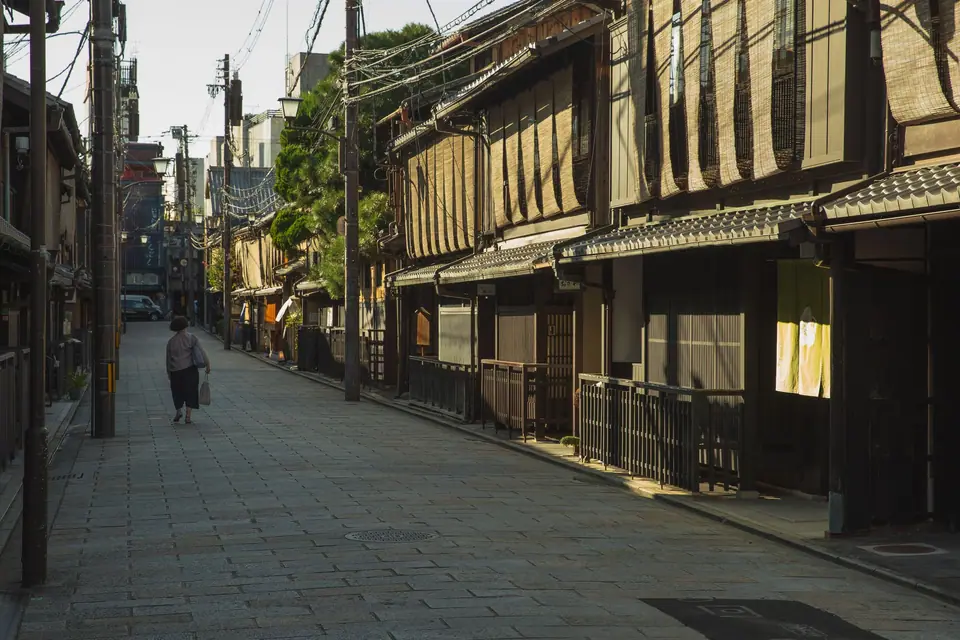
Away from Hanamikoji Street, the prettiest corner of Gion is around the Shirakawa canal, where weeping willows hang over the water and old teahouses face the stream. In the evening the lantern light on the water is a favourite for photographers. Our Gion guide covers the district in more detail, including how to arrange a dinner with a maiko, how to find the quietest streets and where to eat. To glimpse the arts that Gion is known for, a traditional dance show in spring or autumn is a calmer alternative to chasing maiko in the street.
Chion-in, Shoren-in and the quiet northern temples
North of Maruyama Park, the crowds drop away. Chion-in is the headquarters of the Jodo school of Buddhism, and it is entered through the Sanmon, one of the largest wooden gates in Japan. Climbing the stone stairs towards it gives a real sense of scale. The temple grounds are wide and calm, with a giant bell that is struck on New Year's Eve. Shoren-in, close by, is a smaller temple with a garden of old camphor trees and a veranda from which to look at the moss. Both are far less busy than Kiyomizu-dera.
A little further on, Nanzen-ji is one of the great Zen temples of Kyoto, with an imposing main gate and a red-brick aqueduct from the nineteenth century that runs through the grounds. Sub-temples with their own gardens lead off the main path, and in autumn this is among the best places in the city to see maple leaves. A few small restaurants nearby serve yudofu, tofu simmered in a hot pot, which is the local speciality.
The Philosopher's Path and Ginkaku-ji
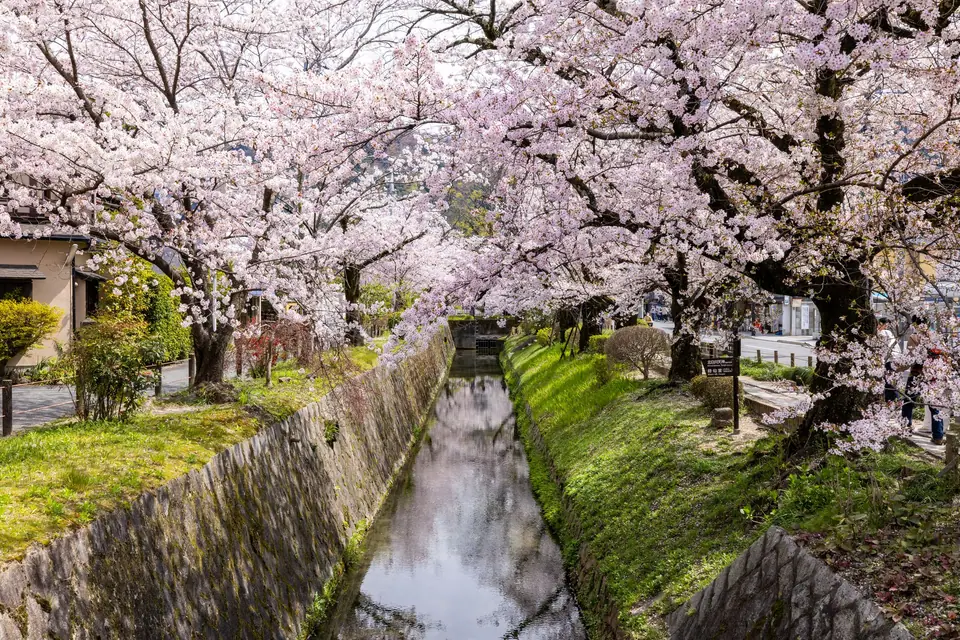
The Philosopher's Path is a gently winding stone path that follows a narrow canal for about two kilometres at the foot of the hills, named after the philosopher Nishida Kitaro, who used to walk it while thinking. It is lined with cherry trees, and in early April the canal fills with fallen petals. Small cafes, galleries and shops stand along the way, and at several points quiet lanes lead up to smaller temples, such as Honen-in, whose mossy approach is one of the prettiest in the city.
At its northern end the path reaches Ginkaku-ji, the Silver Pavilion. Despite the name, it was never covered in silver. The wooden pavilion was built in the late fifteenth century as a retreat for a shogun, and it is surrounded by a garden of raked white sand, a sand cone shaped like Mount Fuji and a moss garden. A short loop path climbs to a viewpoint above the temple. The whole visit takes about an hour, and it is a peaceful way to end a day of temples.
A tea break on the hill
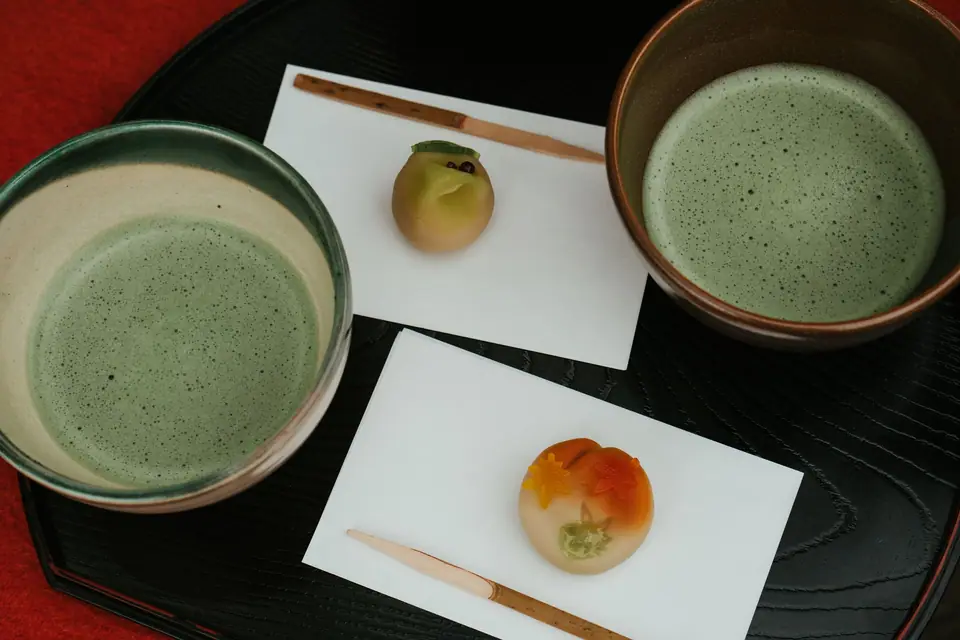
Higashiyama is the best part of Kyoto for tea, and it would be a pity to walk past the teahouses. Look for rooms where you sit on tatami and are served a bowl of matcha with a seasonal sweet, usually with a view of a small garden. Some of the more traditional places offer short lessons in the tea ceremony, and our Kyoto tea ceremony experience is a useful way to learn what the movements mean. Matcha parfaits, soft serve and warabi mochi are the modern favourites in the lanes.
One long day from Kiyomizu-dera to Gion
- Early morning: go straight to Kiyomizu-dera, before the tour groups arrive. Walk through the grounds and visit the waterfall only if the queue is short.
- Mid-morning: walk down Kiyomizu-zaka, Sannenzaka and Ninenzaka, ducking into the side lanes. Stop at the Yasaka Pagoda.
- Late morning: follow the path to Kodai-ji for a quieter garden, then cross Maruyama Park.
- Lunch: eat in the lanes around Yasaka Shrine, or cross into Gion for noodles or a set lunch.
- Afternoon: visit Yasaka Shrine, then walk north to Chion-in if you still have the energy.
- Late afternoon: wander the Shirakawa canal and Hanamikoji Street in Gion.
- Evening: have dinner in Gion, Pontocho or the streets near the river.
It is a long day on your feet, with plenty of stairs, so wear shoes that are easy to take on and off. The route can be shortened by skipping Chion-in, or lengthened by adding a tea stop.
Spreading Higashiyama over two days
If you have time, split the area in two. Give the first day to the southern half, with Kiyomizu-dera, the lanes, Kodai-ji and Gion. Give the second to the north, starting at Nanzen-ji, then walking the Philosopher's Path, visiting Honen-in and finishing at Ginkaku-ji. On the second day, you can also add Heian Shrine and its giant red torii gate, or the museums around Okazaki Park. This slower rhythm turns a checklist of temples into something closer to a stroll. The combination also leaves room for a sunrise or sunset visit, which is when the area is at its best.
Reaching the hills by bus, subway and on foot
Higashiyama is not served by a single station, so choose your entry point. For Kiyomizu-dera, the closest train stop is Kiyomizu-Gojo on the Keihan line, about a twenty-minute uphill walk from the temple. City buses stop closer, but they are slow and often crowded. For Gion and Yasaka Shrine, the Gion-Shijo station on the Keihan line or the Hankyu line at Kawaramachi are the easiest. For Nanzen-ji and the Philosopher's Path, the subway stop at Keage is the simplest, and from there it is a short walk to the temple.
The simplest approach is to take a taxi or the train to the start of the walk and then go on foot. Taxis are also useful for the tired and the late, and a short ride up to Kiyomizu-dera takes the sting out of the hill. For longer-distance connections, our how to get to Kyoto guide explains the trains from Osaka, Tokyo and the airports.
Sleeping in or near Higashiyama
Staying in Higashiyama itself is atmospheric. A handful of traditional inns and small guesthouses stand along the hill, where you can sleep on futons, soak in a bath and wake up to the temple bells. The trade-off is that dining options close early and transport is thinner. For more flexibility, most travellers choose a hotel near Gion-Shijo or Kawaramachi, which are within walking distance of the hills and close to trains and restaurants. Our Kyoto where to stay guide compares the areas.
What and where we eat on the hillside
Higashiyama has plenty of places to eat, but the best are not always the loudest. The area is known for yudofu, a simple tofu dish, and for kaiseki, the multi-course meal built around seasonal ingredients. Smaller teahouses serve soba and udon noodles, rice bowls and set lunches that suit the walking day. Along the lanes, you will find sweets such as yatsuhashi, a cinnamon-flavoured sweet, matcha ice cream and sesame dumplings.
For dinner, Gion is expensive and many of its best restaurants require reservations, so book ahead or head to the lanes along the river. Pontocho, a narrow alley running parallel to the Kamo River, has dozens of small restaurants and bars, and in summer some set out terraces over the water. If you need a cheaper meal, the covered Nishiki Market is a short walk across the river and sells snacks and street food in a lively atmosphere.
Souvenirs, sweets and crafts
The lanes below Kiyomizu-dera are the best place to buy Kyoto souvenirs. Look for Kiyomizu-yaki pottery, hand-painted fans, lacquerware, incense and the pickled vegetables Kyoto is known for. Tea shops sell matcha and green tea in tins that travel well, and sweet shops package yatsuhashi in boxes. Bargaining is not part of the culture, so expect marked prices and polite service. For handmade goods, look in the smaller galleries rather than the shops with the biggest displays at the front.
Crowds, shoes and manners on the temple lanes
A few simple habits make the day easier. Start early and walk against the flow of tour groups where possible. Carry a small bag, since you will often take off your shoes at temples and teahouses, and bring socks without holes. Carry cash for small shops and entrance gates, because not every stall takes cards. Rubbish bins are rare in Japan, so carry your wrappers until you find one. Eating while walking is considered impolite in many places, so finish your snack at the stall before moving on. Our what to wear in Kyoto guide covers clothing for temples and the seasons.
Photography is allowed in most of the grounds, but not inside many halls, and a few sub-temples ban photographs altogether. Be especially careful in Gion, where residents live in the lanes, and never walk into a private entrance for a picture. If you stay respectful, the locals are warm and helpful.
Cherry blossom, maple leaves and quieter seasons
Higashiyama changes dramatically through the year. Cherry blossom arrives in late March or early April and brings the biggest crowds, with Maruyama Park and the Philosopher's Path at their peak. Autumn colour, usually in November, is equally popular at Kiyomizu-dera, Nanzen-ji and Eikando, a temple famed for its maples. Summer is hot and humid, but the festival season brings lantern-lit evenings, and the early mornings are pleasant. Winter is the quietest time, with a fair chance of seeing the temples dusted in snow. In any season, the first hour of the day is always the calmest.
Kyoto beyond the eastern hills
The east side is only one part of the city. Fushimi Inari, with its thousands of red torii gates, is a short train ride south, and we describe it in our Fushimi Inari guide and in the Fushimi Inari hike. On the west side, Arashiyama has its bamboo grove and river, covered in our Arashiyama guide. In the city centre, the Nijo Castle and the Imperial Palace offer a different side of Kyoto's history.
Folding Higashiyama into a longer Japan trip
Most visitors treat Kyoto as the traditional counterpart to Tokyo, and Higashiyama is where that tradition is easiest to see. Our things to do in Kyoto page lists the other highlights, and the Kyoto 3-day itinerary shows how to combine them. For the wider picture, our Japan guides collect planning advice for the whole country.
Answers to the questions first-time visitors ask
Is one day enough for Higashiyama?
One day covers Kiyomizu-dera, the lanes, Yasaka Shrine and Gion. For the northern temples and the Philosopher's Path, add a second morning.
What is the best time of day to visit Kiyomizu-dera?
Early in the morning. The temple opens at the start of the day, and the first hour is much quieter than later in the morning.
Do I need to book anything in advance?
Most temples and shrines in the area need no booking. Dinner in Gion, a tea ceremony or a night in a traditional inn should be reserved ahead, especially in spring and autumn.
Should I rent a kimono?
If you like the idea, yes. It is easy to arrange near the main lanes. Remember that the narrow sleeves and shoes limit how far you can walk comfortably, and that you will need more time in each place.
Can I take photographs of geisha in Gion?
Not on private lanes, and never by stopping or following a maiko. Photograph the streets, not the people, and leave the women alone to get on with their work.
Is Higashiyama accessible for people who cannot manage stairs?
Partly. The slopes and steps are steep, particularly around Kiyomizu-dera. Taxis can drop you at the top of the hill, and the Philosopher's Path is flat and easy.
For everything else about planning your stay, our Kyoto travel guide covers money, transport, etiquette and how many days to give the city.