


























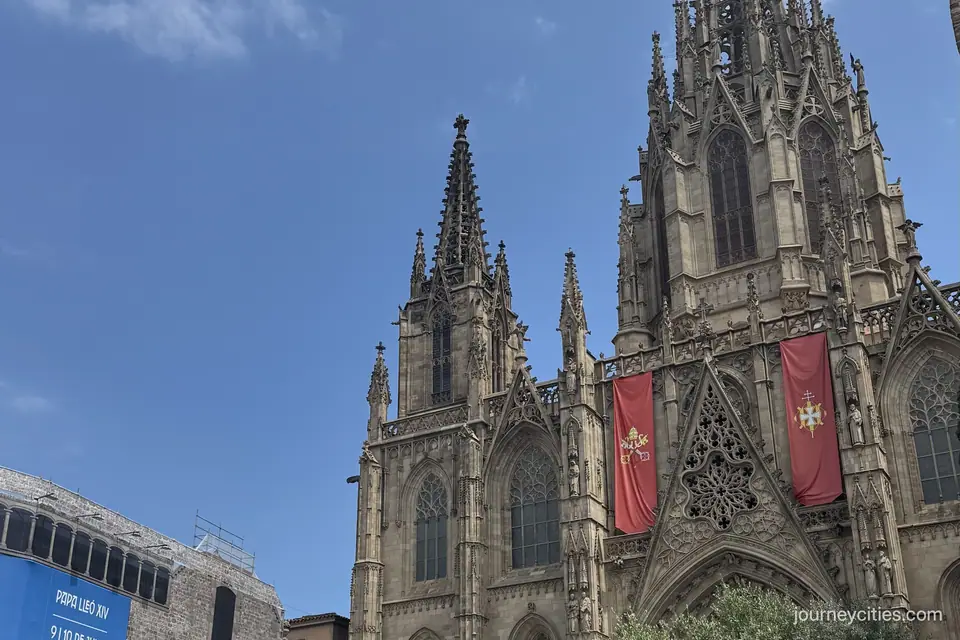
Photo: JourneyCities
Gothic Quarter Walking Guide: Roman Walls, Barcelona Cathedral and Medieval Squares
We trace Roman foundations and medieval stone lanes across the historic heart of the Catalan capital on foot.
Barcelona holds its deepest historical layers within the compact boundaries of the Barri Gòtic. Walking these stone flagstones reveals centuries of civic transformation, starting where ancient Roman fortifications blend directly into medieval church buttresses. Entering from Plaça Nova, we face reconstructed circular defense towers that once guarded the gate of Roman Barcino. Nearby, an evocative segment of an ancient aqueduct shows how water entered the settlement long before royal dynasties built palaces here. Today, municipal rules limit large tour party sizes and ban electronic loudspeakers in the historic centre, preserving a peaceful atmosphere for independent walkers.
A few paces past the Roman gate stands the main facade of the Gothic cathedral, dedicated to the holy cross and Saint Eulalia. Stepping inside the cool stone interior leads to the famous fourteenth-century cloister, where thirteen white geese wander among orange trees and carved fountains. These birds honour the young martyr, whose steadfast courage remains woven into the folklore of early Barcelona. Morning light cuts across the vaulted arcade, illuminating worn memorial stones embedded across the courtyard floor.
Hidden Roman Columns and Medieval Royal Courtyards
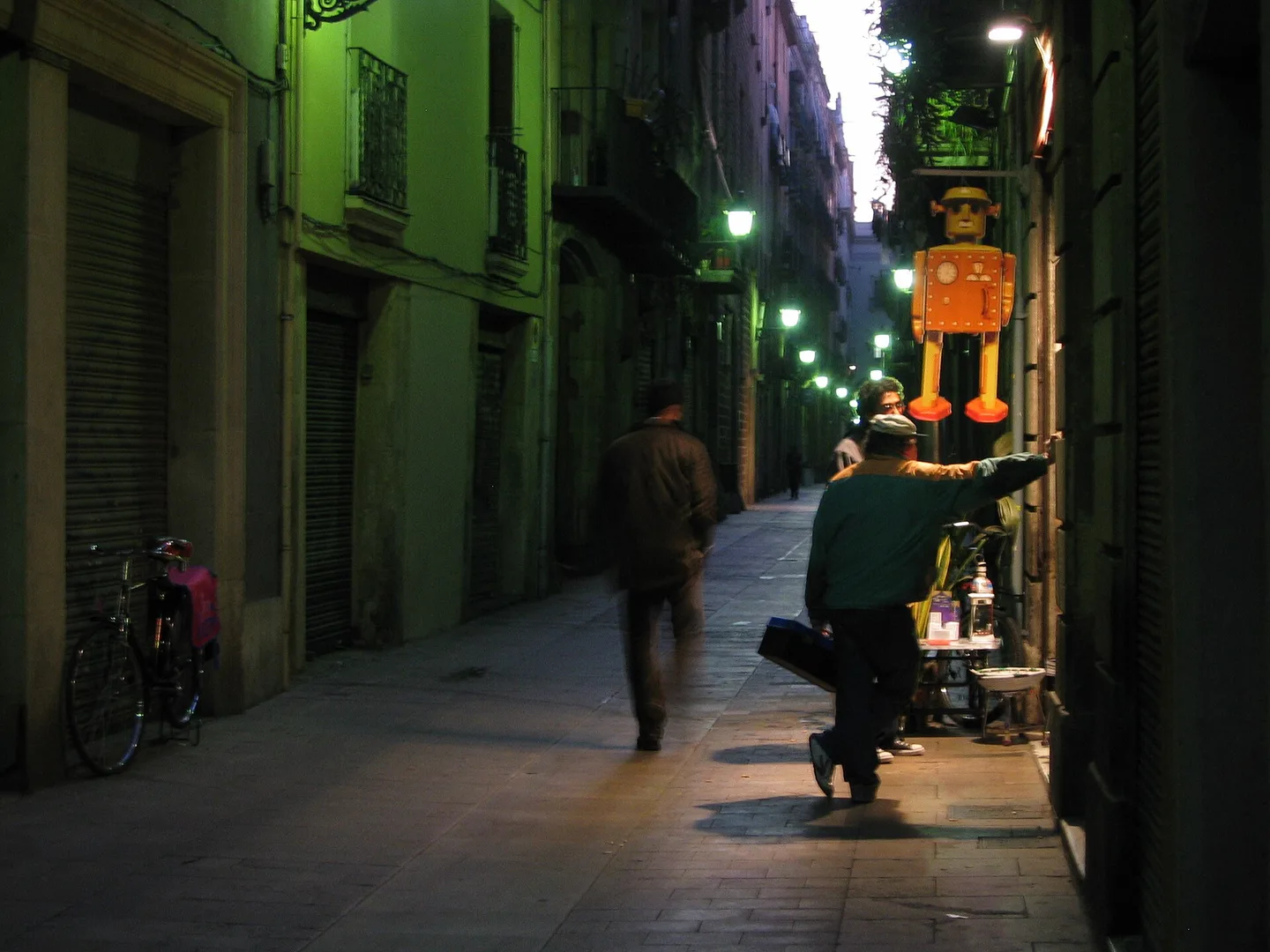
Wandering deeper into the district along Carrer del Paradís reveals one of the most astonishing domestic survivals in the city. Tucked inside the small vestibule of an apartment entrance hall stand four fluted Corinthian columns from the ancient Temple of Augustus. These massive limestone pillars rose on the summit of Mount Tàber, the humble natural crest chosen by Roman surveyors. Seeing classical Roman stone preserved within a quiet residential staircase highlights the dense architectural recycling characteristic of this old district.
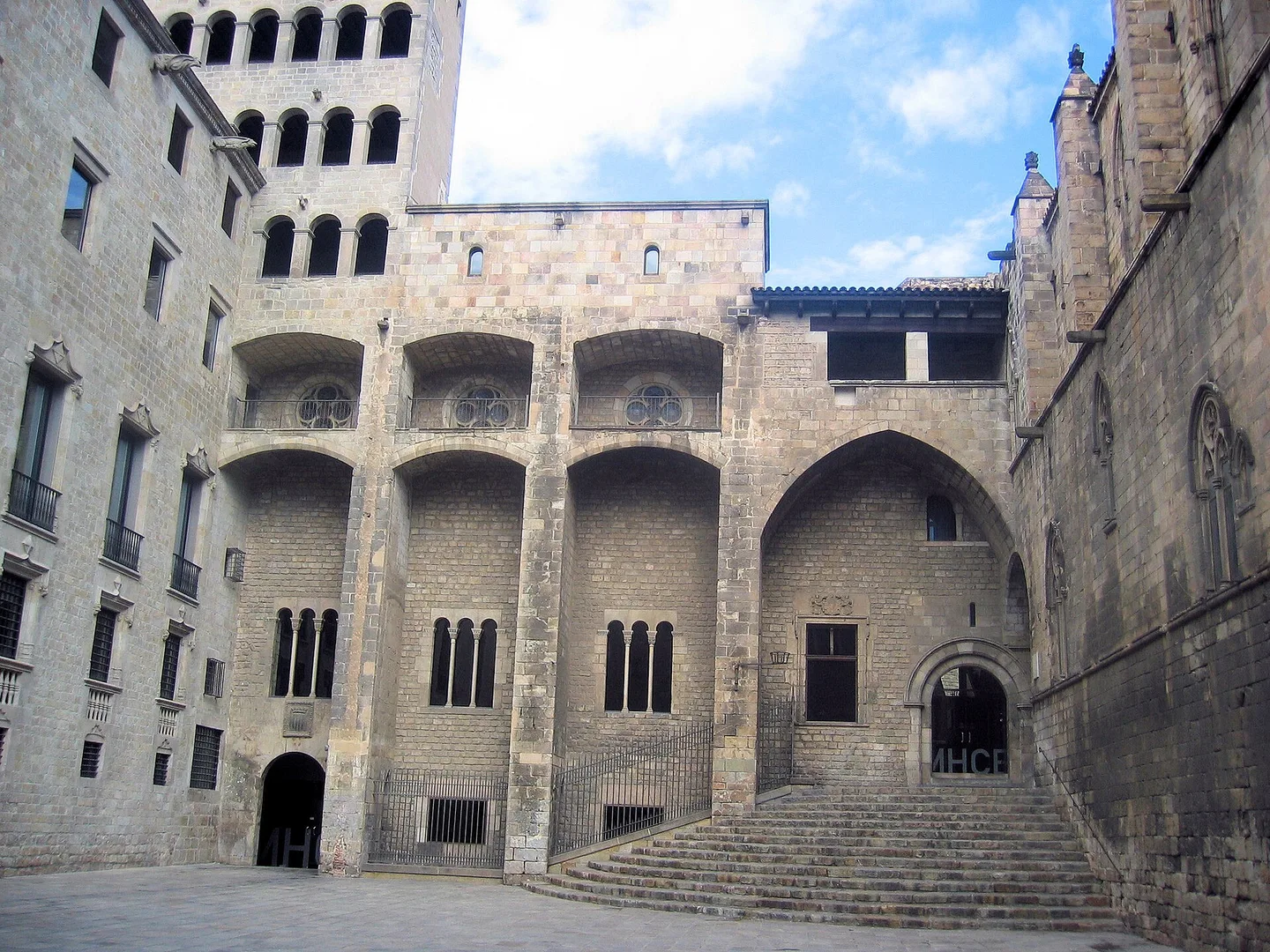
Just eastward lies Plaça del Rei, an enclosed medieval square framed by tall stone facades that served the Counts of Barcelona. Here, the royal palace complex forms a dignified courtyard where street musicians frequently take advantage of superb acoustics. Beneath the paved surface, the underground galleries of the city history museum display wine presses, dye workshops, and drainage channels from classical antiquity. Walking the upper terrace brings us close to the distinctive watchtower built by King Martí during the fourteenth century.
Quiet Plazas, Tragic Scars and Civic Crossings
Leaving the royal square behind, we follow narrow passages toward Plaça Sant Jaume, the political focus of modern Catalonia. The grand neoclassical facade of Barcelona City Hall faces the Renaissance entrance of the Palau de la Generalitat across open paving. This spacious clearing has hosted civic elections, folk dances, and human towers for generations. Independent walkers can pair this route with transport options found in our Barcelona guide to reach further quarters smoothly.
In contrast to the civic activity of Plaça Sant Jaume, the secluded Plaça de Sant Felip Neri offers quiet contemplation. An ancient fountain trickles at its centre, shaded by leafy acacia trees that soften the surrounding weathered stonework. The facade of the baroque church still carries deep, jagged shrapnel marks from aerial bombardment during the Spanish Civil War. Sitting along the stone benches allows visitors to appreciate how peacefully this enclosed space has healed over decades.
Plaça del Pi, Neo-Gothic Bridges and Arcaded Terraces
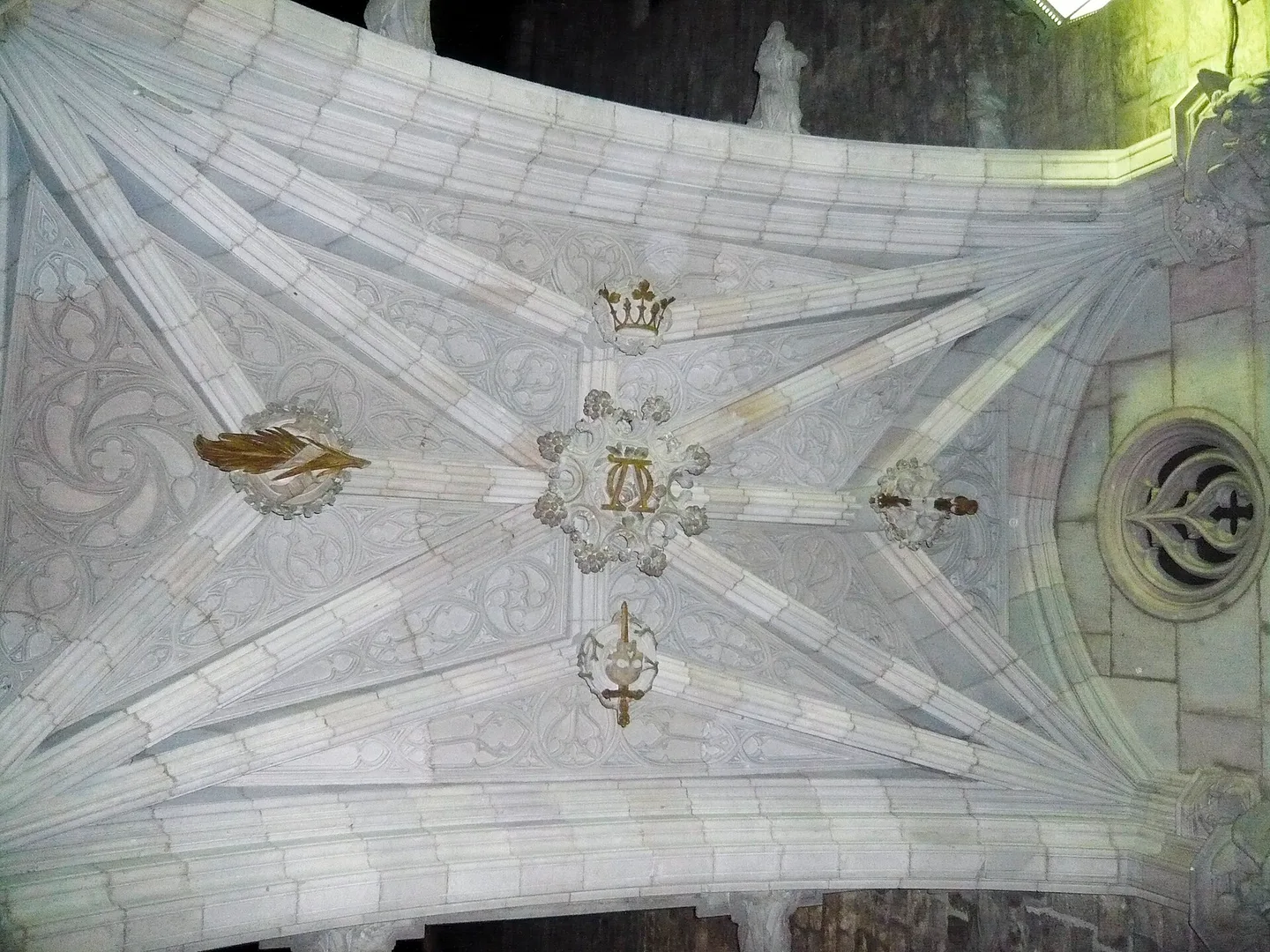
Connecting the cathedral to the regional government palace is the famous Pont del Bisbe spanning Carrer del Bisbe. While visitors often assume this ornate covered bridge dates from the Middle Ages, master builders actually constructed it in the late nineteen twenties. Carved stone gargoyles, delicate tracery, and a mysterious skull relief decorate its marble undercroft. Walking beneath the archway early in the morning avoids heavy foot traffic and lets you observe fine masonry details.
Nearby, Plaça del Pi clusters around the fourteenth-century Santa Maria del Pi church, celebrated for its enormous circular rose window. Open-air stalls regularly sell local honey, artisan cheeses, and dried fruits beneath the towering bell tower. Continuing westward, arcaded passages bring you to Plaça Reial, a stately nineteenth-century square framed by neoclassical facades, grand street lanterns, and tall palm trees. From here, independent travellers can head toward La Rambla and Boqueria Market to sample fresh Catalan specialities, or turn eastward into the lively alleys of the neighboring Ribera district.
- Start at Plaça Nova to see surviving Roman defensive towers and aqueduct segments.
- Enter the cathedral cloister to see the thirteen resident geese and leafy courtyard garden.
- Locate the Temple of Augustus columns hidden within the vestibule on Carrer del Paradís.
- Pause quietly in Plaça de Sant Felip Neri to reflect before crossing to arcaded Plaça Reial.
Where it is
- 1Gothic Quarter Walking
- Josep Tarradellas Barcelona-El Prat Airport (BCN) · about 13 km from here in a straight line
- Directions in Google Maps
Stations and taxi ranks: OpenStreetMap. Airports: OurAirports. Distances are in a straight line.
Traveller tips
Real advice from people who have been to Barcelona. Every tip is read by our team before it goes live.
No tips yet. Been here? Yours could be the first.
Thank you! Your tip will appear here after a quick review.
More in Barcelona
Continue exploring Barcelona with related neighbourhood, food, and planning guides
Getting to Barcelona by Air, High-Speed Rail, and Airport Transfers
Barcelona, Spain
Barcelona Seasonal Guide: Swimming Months, Festivals and Heat
Barcelona, Spain
What to Wear in Barcelona: Street Rules, Churches and Footwear
Barcelona, Spain
Sagrada Família Guide: Timed Entry, Towers and Interior Light
Barcelona, Spain
