Photo: JourneyCities
Montjuïc Guide: Museums, Views and the Magic Fountain
The hill above the port, with the best museums, the Olympic ring and a fountain show.
Montjuïc is less a sight than a district on a hill: museums, gardens, sports venues and a castle spread over a slope that's bigger than it looks from below. Most of what's there was built for two events, the 1929 International Exhibition and the 1992 Olympics, which is why the hill feels so ceremonial in places. Don't try to see everything. Choose two or three stops and let gravity do the rest.
Getting up the hill
- From Plaça d'Espanya on foot. Walk up Avinguda de la Reina Maria Cristina between the two Venetian-style towers, past the fountain and the Four Columns, then up the steps to the Palau Nacional. Outdoor escalators run alongside the stairs.
- The funicular. It climbs from Paral·lel metro station (L2 and L3) and is part of the metro network, so ordinary metro tickets work. It reopened in April 2026 after nearly six months of works.
- The Telefèric de Montjuïc. A cable car from the top of the funicular up to the castle, with separate tickets.
- The port cable car. The Transbordador Aeri swings across the harbour from Barceloneta to the Miramar side of the hill. It's a ride for the view rather than transport.
A route from the top down
- Castell de Montjuïc. An 18th-century fortress with a grim history as a military prison. The walls and the views over the port are the reason to come. Entry is free on Sunday afternoons and the first Sunday of the month.
- Fundació Joan Miró. Josep Lluís Sert's white building of 1975, full of light, holding one of the largest collections of Miró's work. The roof terrace has his sculptures and a view of the city.
- The Olympic ring. The Estadi Olímpic Lluís Companys, where Barça played during the Camp Nou rebuild, Arata Isozaki's Palau Sant Jordi and Santiago Calatrava's white communications tower. Fifteen minutes is enough unless there's an event on.
- The MNAC. The National Art Museum of Catalonia fills the Palau Nacional. Its Romanesque collection, wall paintings saved from small Pyrenean churches and reset in curved apses, is one of the finest in the world. Free on Saturday afternoons and the first Sunday of the month.
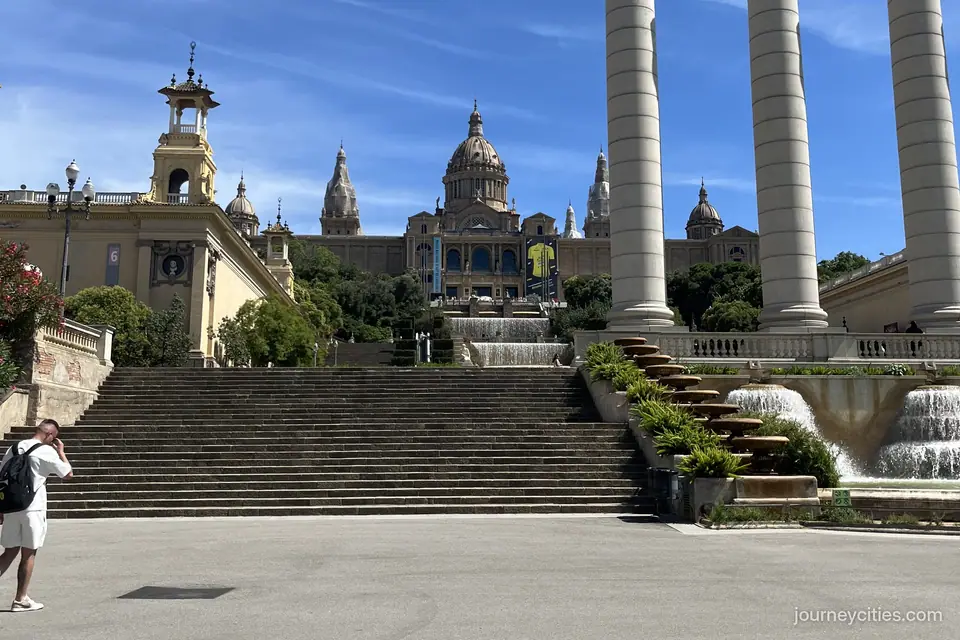
- The steps and the Four Columns. Puig i Cadafalch put up four Ionic columns here in 1919 to stand for the four stripes of the Catalan flag. The Primo de Rivera dictatorship pulled them down in 1928, and they were rebuilt in 2010.
That last stretch is where we were on the afternoon of 11 June 2026: the Four Columns and the steps up to the Palau Nacional, under a clear sky. From the foot of the steps you see the whole axis at once, columns in front and the palace's dome at the top, and from the top of the steps the view runs back over Plaça d'Espanya and the city.
The Magic Fountain in 2026
The Font Màgica, the big light-and-music fountain below the Palau Nacional, was switched off for three years during the drought and came back in September 2025. It's running in 2026, but only on certain evenings, and the nights change with the season: more of them in summer, a handful a week in autumn, and sometimes none in winter. Shows are free. Check the city council's website, barcelona.cat, for the current calendar before you plan an evening around it.
What to skip
The Poble Espanyol, an open-air village of copied Spanish buildings from 1929, is fine with children and skippable without them. If time is short, put it below the MNAC and the castle. For more, see our things to do list and the getting around guide.
Traveller tips
Real advice from people who have been to Montjuïc Guide: Museums, Views and the Magic Fountain. Every tip is read by our team before it goes live.
No tips yet. Been here? Yours could be the first.
Thank you! Your tip will appear here after a quick review.
More in Barcelona
Continue exploring Barcelona with related neighbourhood, food, and planning guides