


























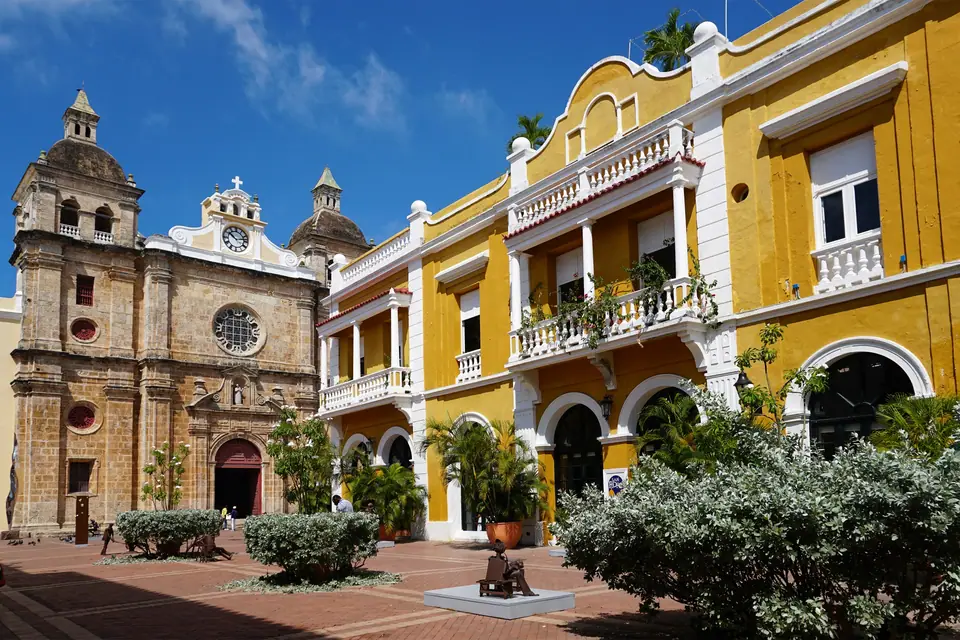
San Pedro Claver, Plaza de Santo Domingo and Colonial Plazas
Explore the southwestern and northern plazas of the Walled City, from the Jesuit cloister of San Pedro Claver and the Royal Customs House to Santo Domingo and Teatro Adolfo Mejía.
South and west of Plaza de Bolívar, the streets of Centro open onto a sequence of coral-stone churches, conventual cloisters, and open squares that reveal both the commercial power and the human cost of colonial Cartagena. Walking from the portside expanse of Plaza de la Aduana to the lively terraces of Plaza de Santo Domingo and Plaza de San Diego takes you across four centuries of Caribbean religious, artistic, and theatrical history.
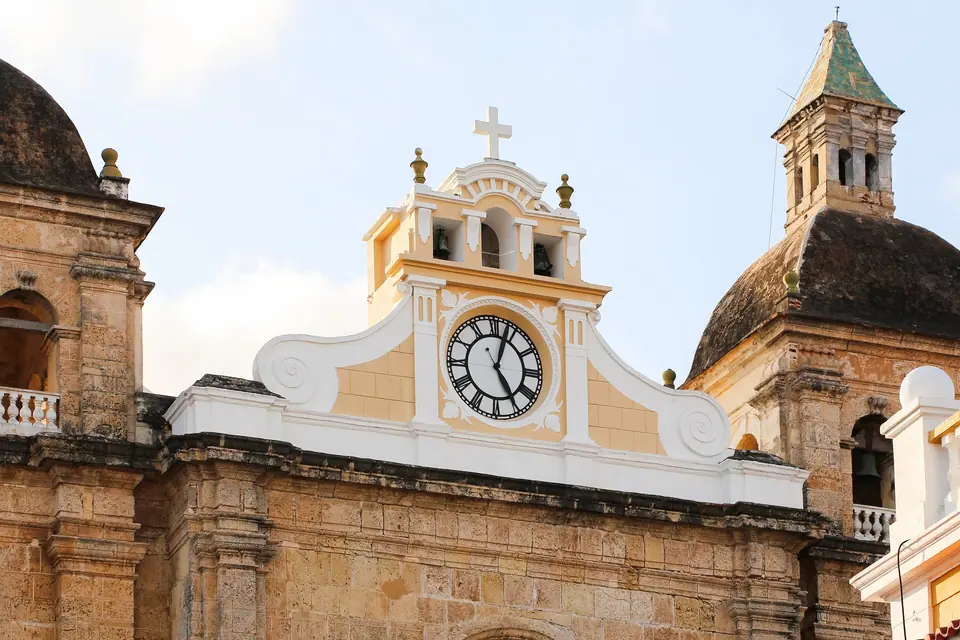
Sanctuary of San Pedro Claver and Plaza de la Aduana
Built by the Society of Jesus between 1580 and 1654 from warm golden-brown coral stone quarried on Tierra Bomba Island, the Santuario y Convento de San Pedro Claver is the most moving historical site in the Walled City. Here lived Catalan Jesuit priest Peter Claver (1580 to 1654), who arrived in Cartagena in 1610 and vowed to make himself “the slave of the Africans forever” (aethiopum semper servus). For forty years, until his death in a small upstairs cell overlooking the courtyard, Claver boarded the slave ships anchoring in Cartagena Bay to bring water, medicine, bread, and comfort to more than 300,000 enslaved people arriving from West and Central Africa.
Canonised by Pope Leo XIII in 1888 and declared the patron of human rights in Colombia, Saint Peter Claver’s remains rest inside a glass reliquary beneath the Italian marble high altar of the church, crowned by a dome designed by Gastón Lelarge. The adjoining three-storey cloister surrounds a courtyard of royal palms and houses pre-Columbian ceramics, colonial religious paintings, Afro-Caribbean sculptures, and Claver’s cell. Outside, Plaza de San Pedro Claver displays scrap-iron sculptures by Edgardo Carmona and leads east into Plaza de la Aduana, bordered by the former Royal Customs House (now City Hall).
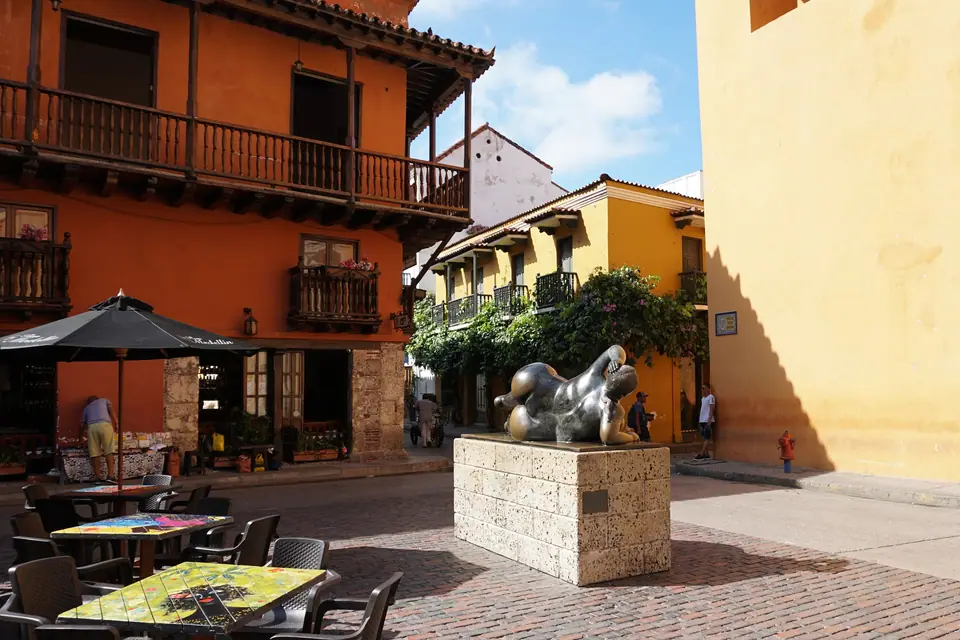
Plaza de Santo Domingo and Botero’s Gertrudis
Three blocks northwest near the sea ramparts lies Plaza de Santo Domingo, presided over by the ochre facade of the Iglesia de Santo Domingo. Begun by the Dominican Order around 1579, it is the oldest surviving conventual church in Cartagena, notable for its heavy protruding stone buttress and slightly twisted bell tower. Directly in front of the portal rests Gertrudis (installed in 2000), a 650-kilogram reclining bronze nude by Colombian master Fernando Botero, while the adjacent 16th-century Dominican cloister houses the Spanish Cooperation Training Centre (AECID).
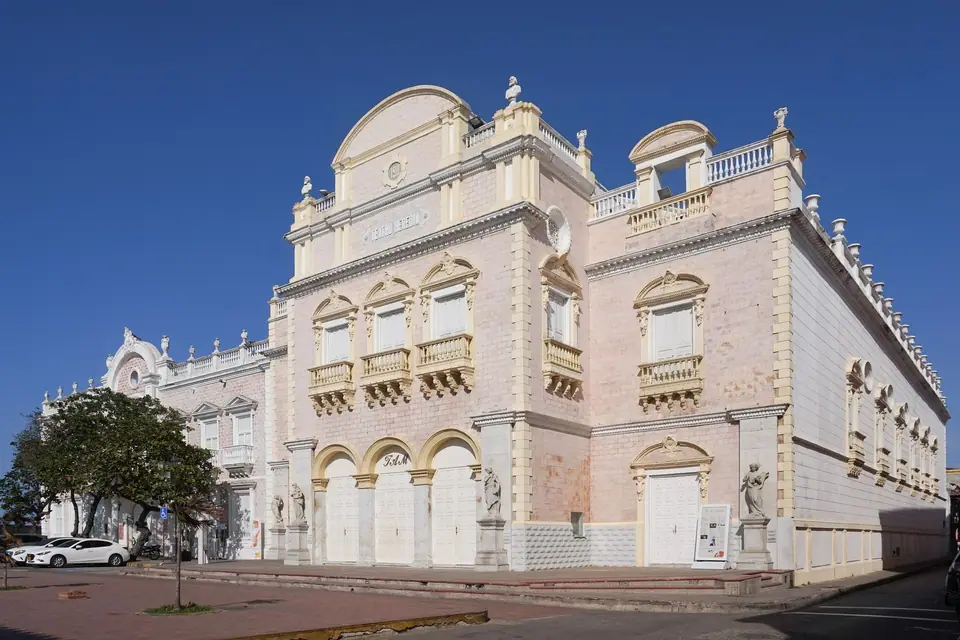
Teatro Adolfo Mejía, Plaza de la Merced and San Diego
Walk north along Calle de la Factoría to the Plazuela de la Merced (where Gabriel García Márquez’s ashes rest inside the University of Cartagena’s Claustro de la Merced) and the Teatro Adolfo Mejía. Inaugurated in 1911 and designed by Luis Felipe Jaspe Franco after Havana’s Teatro Tacón, the horseshoe-shaped theatre features wooden latticework boxes and a ceiling mural and stage curtain painted by Cartagenero artist Enrique Grau, three blocks west of Plaza de San Diego.
Traveller tips
Real advice from people who have been to San Pedro Claver, Plaza de Santo Domingo and Colonial Plazas. Every tip is read by our team before it goes live.
No tips yet. Been here? Yours could be the first.
Thank you! Your tip will appear here after a quick review.
More in Cartagena
Continue exploring Cartagena with related neighbourhood, food, and planning guides
Best Time to Visit Cartagena: Trade Winds, Rain and Festivals
Cartagena, Colombia
Where to Stay in Cartagena: Walled City, Getsemaní and Bocagrande
Cartagena, Colombia
3-Day Cartagena Itinerary: Walled City, Fortresses and Islands
Cartagena, Colombia
What to Eat in Cartagena: Arepa de Huevo, Coconut Rice and Seafood
Cartagena, Colombia
