


























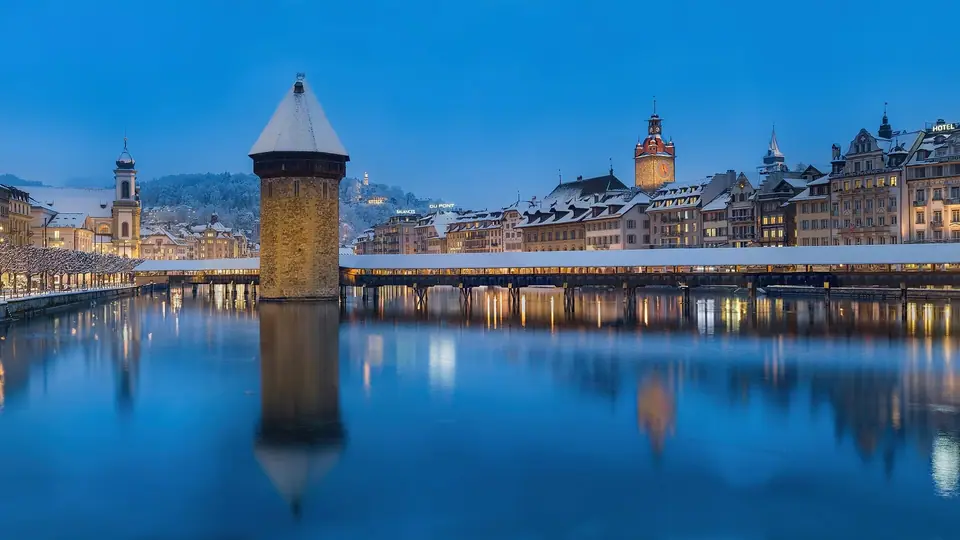
Kapellbrücke, Water Tower and Spreuerbrücke: Lucerne's Covered Bridges
Discover the history, architecture, and triangular roof paintings of Lucerne's two surviving medieval covered wooden bridges and the 34-metre Wasserturm.
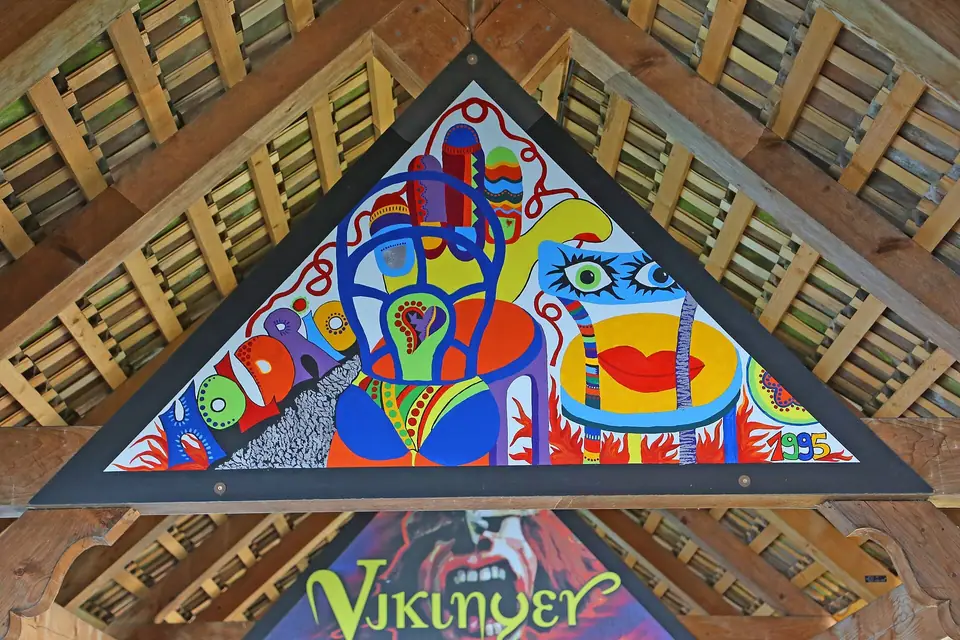
No other European city preserves covered medieval timber footbridges adorned with triangular interior gable paintings. Originally, three covered wooden bridges spanned the Reuss and the lake outlet in Lucerne: the Hofbrücke (built between 1252 and 1265 along the right lakeshore and demolished between 1834 and 1852 when Schweizerhofquai was reclaimed), the Kapellbrücke at the river mouth, and the Spreuerbrücke at the western edge of the Altstadt. Today the two surviving river crossings stand as Category A cultural monuments of national significance and form the backbone of any walk through our Lucerne travel guide.
More than decorative footbridges, these roofed timber structures formed an integral part of Lucerne's medieval defensive ring, linking the right-bank city walls and the Museggmauer with the fortified left-bank settlement of the Kleinstadt. Walking beneath their heavy oak rafters today lets you trace centuries of carpentry, hydraulic engineering, and Counter-Reformation civic art in a single riverside stroll, all within steps of the main railway station and Old Town squares. Both bridges are open to pedestrians around the clock throughout the year.
Medieval Defensive Origins of the Kapellbrücke
Named after nearby St. Peter's Chapel (Peterskapelle), the Kapellbrücke connects the St. Peter's quay in the Old Town with the Luzerner Theater on the left bank between the upstream Seebrücke and the downstream Rathaussteg. Built in the fourteenth century, around 1332 or 1365, as a defensive walkway fortified by lakeside wooden palisades (Schwirren) and a higher parapet facing the bay, the bridge was shortened by roughly 75 metres between 1833 and 1838 when the riverbanks were filled in. Measuring 202.90 metres today (204.70 metres including its roof canopies), it is the oldest covered wooden bridge in Europe and the second longest after the 203.70-metre Bad Säckingen bridge on the Rhine.
Why does the Kapellbrücke cross the Reuss at a diagonal angle with two gentle bends rather than a straight line? Medieval builders aligned the oak pilings with shallow gravel bars across the wide river mouth and linked the walkway directly to the pre-existing stone bastion of the Wasserturm, allowing guards to patrol from the right-bank town walls across the water to the left-bank Kleinstadt while shielding the interior town from approach by lake. During summer months, window boxes filled with red and pink geraniums line the outer timber balustrades along the entire span.
The Lost Hofbrücke and Changing Riverbanks
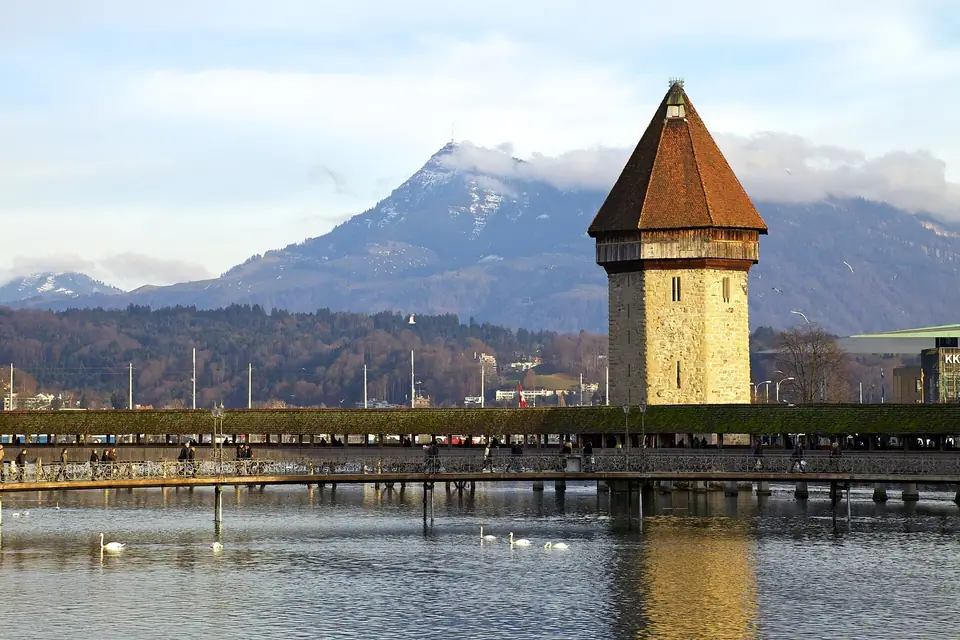
For nearly six centuries, the Kapellbrücke worked in tandem with the even longer Hofbrücke, which stretched from the town shore across the marshy lakeside reeds to the monastery of St. Leodegar im Hof. Like its surviving neighbours, the Hofbrücke carried a pitched timber roof and hundreds of devotional and historical paintings beneath its rafters. When nineteenth-century engineers constructed the straight stone embankments of Schweizerhofquai to accommodate horse carriages and lakeside grand hotels, the Hofbrücke was removed in stages between 1834 and 1852, leaving the Kapellbrücke as the ceremonial gateway between the lake bay and the Reuss.
The 1611 Painting Cycle and the 1993 Fire
Under the rafters, Catholic Counter-Reformation scenes commissioned by City Clerk Renward Cysat and painted after 1611 by Hans Heinrich Wägmann and his sons illustrated Lucerne's history and the lives of patron saints Leodegar and Maurice, sponsored by council members who added their coats of arms. Out of 158 original panels, 147 existed prior to 18 August 1993, when a fire thought to have started from a moored boat destroyed roughly two-thirds of the bridge and burned 78 of the 111 displayed paintings down to charred remnants, though 30 panels remained intact. Rebuilt and reopened on 14 April 1994, the bridge displays restored panels alongside 25 paintings salvaged from the nineteenth-century shortening.
Walking across the planks today, you can clearly distinguish the newly milled timber spans from the darkened medieval beams near the riverbanks, as well as the blackened edges of several surviving triangular frames. Each panel still bears the painted heraldic shields of the patrician husband and wife who funded its creation, accompanied by rhyming German couplets explaining the historical battle, local legend, or martyrology depicted above. Photographic panels near the middle of the bridge document how local carpenters and conservators reconstructed the burned sections in less than a year.
The 34-Metre Octagonal Wasserturm
Rising 34 metres above the Reuss midway along the Kapellbrücke, the octagonal Wasserturm predates the footbridge by about thirty years. Constructed around 1300 with a circumference of 38 metres, the stone bastion served over the centuries as a watchtower, city archive, treasury, prison, and torture chamber, and today houses the Lucerne Artillery Association guild hall, a small souvenir kiosk in the bridge passage, and nesting colonies of migratory alpine swifts that wheel above the pitched tile roof each spring and summer.
The Spreuerbrücke and Kaspar Meglinger's Dance of Death
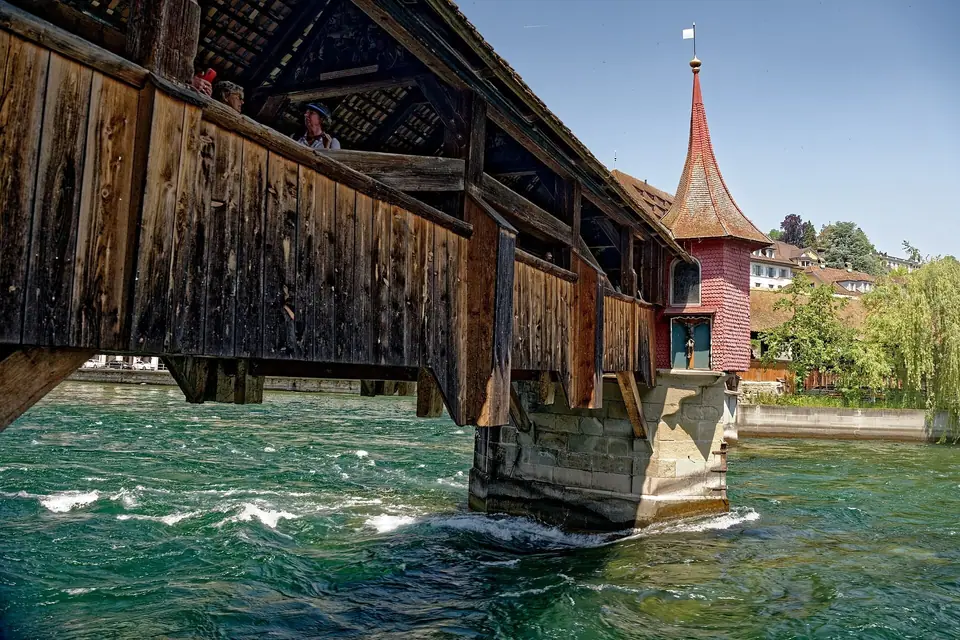
Downstream between Mühlenplatz and Kasernenplatz stands the 81-metre Spreuerbrücke, built to the mid-river mills in the thirteenth century and extended to the left bank in 1408. Its name comes from the medieval rule permitting citizens to dump wheat chaff (Spreu) and leaves into the Reuss only from this lowest crossing. Rebuilt in 1566 and 1591 after a flood, the bridge encloses a tiny chapel dedicated to the Virgin Mary (Maria auf der Reuss) and carries 45 of an original 67 triangular panels painted between 1626 and 1632 under Kaspar Meglinger, the largest public Totentanz (Dance of Death) cycle in the world, located below the Museggmauer. Unlike the bright historical scenes on the Kapellbrücke, Meglinger's darker oil-on-wood canvases portray Death appearing beside popes, emperors, merchants, brides, and artisans alike, complete with donor portraits and moralising verses.
The 1859 Nadelwehr Needle Dam and Riverside Walk
Just upstream from the Spreuerbrücke, look over the wooden railing to see the Nadelwehr, built between 1859 and 1860 across the Reuss. Rather than using modern steel sluice gates, workmen still regulate the level of Lake Lucerne by manually inserting or removing narrow vertical spruce timbers (Nadeln) against an iron frame in the riverbed to control water flow into the old mill canal. Combining both bridges with the Nadelwehr, the Altstadt squares, and the left-bank Jesuit Church creates a complete circular river walk in any season.
Traveller tips
Real advice from people who have been to Kapellbrücke, Water Tower and Spreuerbrücke: Lucerne's Covered Bridges. Every tip is read by our team before it goes live.
No tips yet. Been here? Yours could be the first.
Thank you! Your tip will appear here after a quick review.
More in Lucerne
Continue exploring Lucerne with related neighbourhood, food, and planning guides
Lion Monument, Glacier Garden and Bourbaki Panorama at Löwenplatz
Lucerne, Switzerland
Swiss Museum of Transport (Verkehrshaus), Planetarium and Hans Erni Museum
Lucerne, Switzerland
KKL Lucerne (Culture and Congress Centre) and the Twin-Towered Hofkirche
Lucerne, Switzerland
Lake Lucerne (Vierwaldstättersee): Paddle Steamers and Promenades
Lucerne, Switzerland
