


























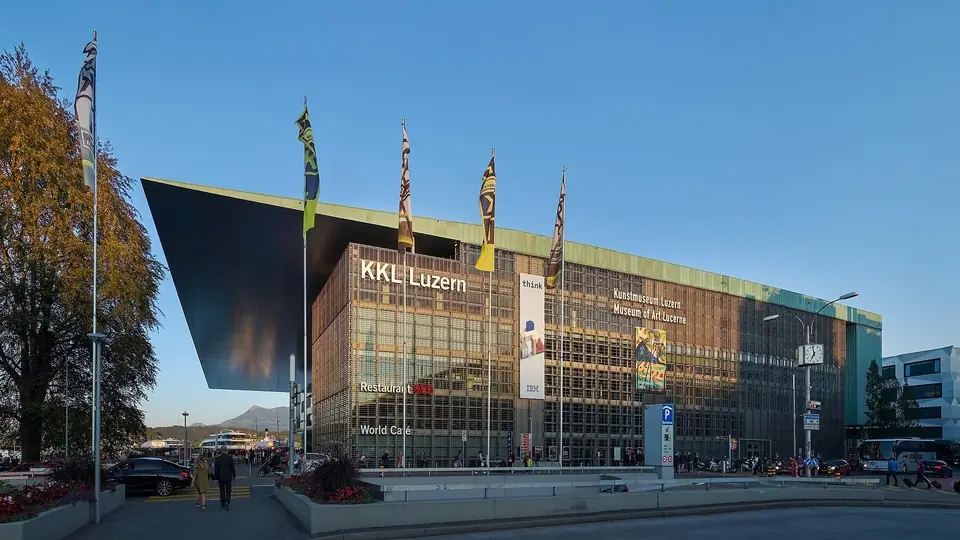
KKL Lucerne (Culture and Congress Centre) and the Twin-Towered Hofkirche
Compare Lucerne's two great musical and architectural landmarks: Jean Nouvel's lakeside KKL concert hall and the seventeenth-century Hofkirche St. Leodegar.
Framing the eastern curve of the Lucerne bay across from one another, the Culture and Congress Centre Lucerne (KKL) on Europaplatz and the twin-spired Hofkirche St. Leodegar above Nationalquai represent two defining chapters of the city's architectural and musical life: one a 1998 steel-and-glass landmark by French architect Jean Nouvel, the other a Late Renaissance collegiate church built during the Thirty Years' War. Together they anchor the cultural calendar covered in our best time to visit Lucerne guide and stand within a pleasant fifteen-minute walk around the water via the Seebrücke.
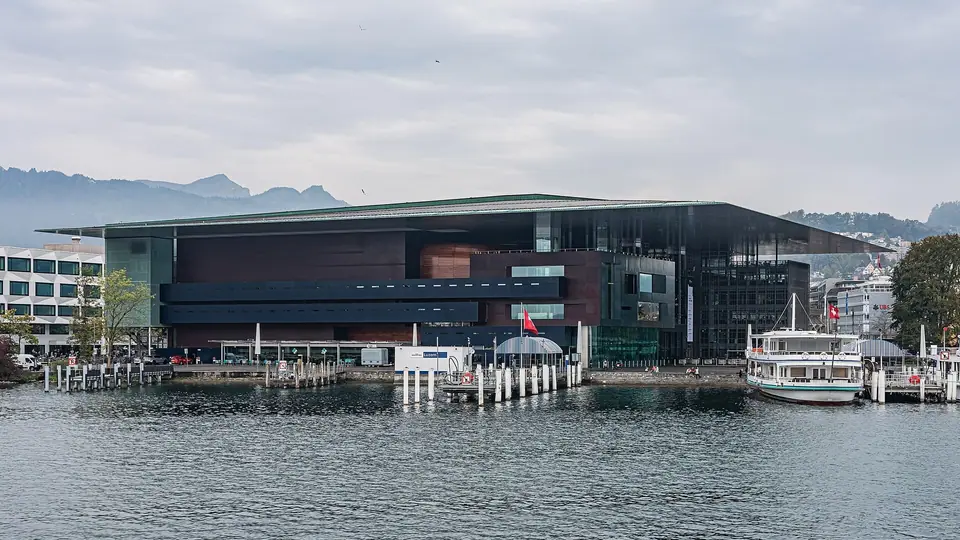
Seen from the deck of an arriving Lake Lucerne paddle steamer, these two silhouettes establish the visual balance of the bay: to the south, Nouvel's horizontal aluminium roof hovers inches above the waterline beside Bahnhof Luzern; to the north-east, the twin 69-metre stone towers of St. Leodegar rise above the Belle Époque hotel facades and chestnut trees of Nationalquai. Both venues welcome visitors throughout the year for concerts, organ recitals, art exhibitions, and architectural walks, linking the modern railway waterfront with the historic ecclesiastical quarter on the hill.
Jean Nouvel's KKL and the Principle of Inclusion
After publisher Alice Bucher donated 960,000 Swiss francs in 1988 under Konzerthaus Foundation president Walter von Moos to launch an architectural competition replacing Armin Meili's 1933 Kunst- und Kongresshaus, Paris architects Jean Nouvel and Emmanuel Cattani won the 1989 competition and opened the KKL in 1998. When urban and ecological rules prevented Nouvel from building a ship-shaped hall out into the lake, he reworked the project around the concept of Inclusion, declaring that since the building could not go out into the water, the water would be brought inside the building.
Two narrow water channels lead directly from the bay inside the complex beneath a monumental cantilevered aluminium roof projecting far out over Europaplatz and the lakeshore without supporting pillars at its outer corner. Those water channels divide the interior into three distinct vessel-like wings: the acoustic Concert Hall on the lake side, the multifunctional Luzerner Saal in the middle, and the Congress and Museum of Art Lucerne (Kunstmuseum Luzern) wing facing Bahnhof Luzern and the Wagenbach fountain on Europaplatz. Because the underside of the overhanging roof is clad in reflective metal panels, ripples of sunlight from the bay dance across the ceiling above pedestrians strolling the plaza.
Russell Johnson's Shoebox Concert Hall and the Lucerne Festival
Created by Jean Nouvel and American acoustician Russell Johnson of Artec Consultants, the KKL Concert Hall is shaped like a ship's hull built on the classical 1:1:2 "shoebox" ratio (22 metres high, 22 metres wide, and 46 metres long) with a volume of 19,000 cubic metres. Acoustics are tuned through massive concrete walls, airlock entrance doors that guarantee total silence inside, electrically adjustable high-volume echo chambers (Echokammern) behind motorised wooden doors around the upper perimeter, and roughly 24,000 square gypsum plaster reliefs measuring 20 centimetres per edge that diffuse high and mid frequencies across the white-and-maple auditorium.
Every August and September, the hall hosts the Summer Festival of the Lucerne Festival (founded in 1938 by Ernest Ansermet and Walter Schulthess with Arturo Toscanini's gala concert at Tribschen, directed from 1999 to 2025 by Michael Haefliger and since January 2026 by Sebastian Nordmann), staging roughly 100 concerts including around 30 symphony programmes by the Lucerne Festival Orchestra (founded in 2003 by Claudio Abbado), the Lucerne Festival Academy (founded in 2003 with Pierre Boulez), and the Lucerne Festival Contemporary Orchestra (founded in 2021). Throughout the rest of the year, the hall serves as home to the Lucerne Symphony Orchestra, the July Luzern Live music festival (succeeding the 1999 to 2019 Blue Balls Festival in 2023), and the autumn World Band Festival.
Kunstmuseum Luzern and Rooftop Lake Terraces
On the upper floor of the KKL beneath the great roof sits the Museum of Art Lucerne (Kunstmuseum Luzern), accessible by lift from the main foyer. Its daylight-filled galleries showcase rotating contemporary exhibitions alongside works from its permanent collection spanning Central Swiss landscape painting of the eighteenth and nineteenth centuries, including depictions of Mount Rigi and Mount Pilatus, up to modern Swiss video and installation art. From the museum terrace and ground-floor lakeside cafes, visitors look straight across the steamer piers toward the twin towers of the Hofkirche.
The Hofkirche St. Leodegar im Hof
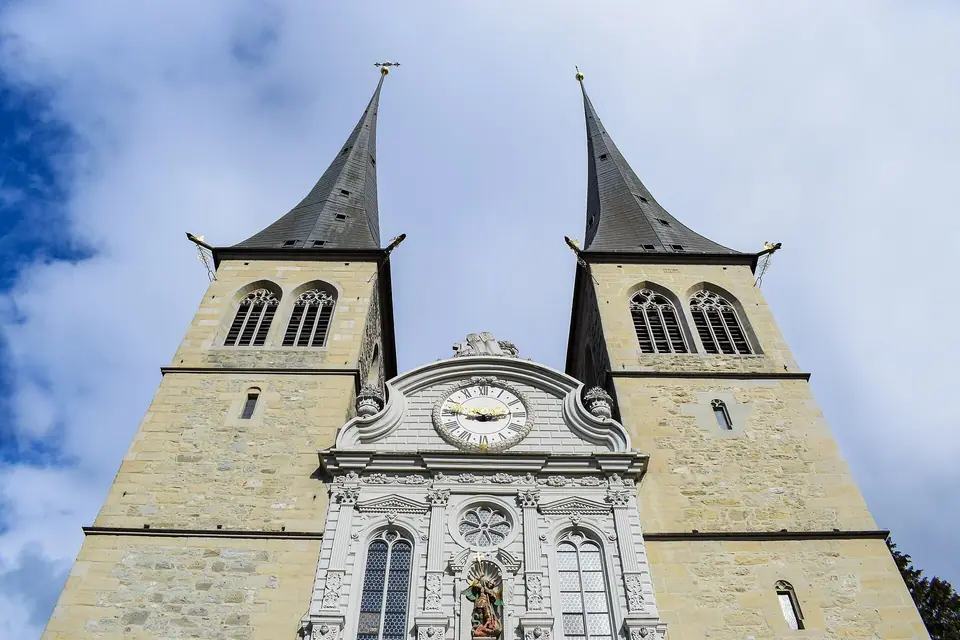
At the eastern end of Nationalquai, a broad monumental stone staircase rises above the chestnut trees to the Hofkirche St. Leodegar, the mother church of the city. Here Alemannic nobles founded a monastery dedicated to Saint Maurice around 735 to 736 (gifted serfs by Frankish King Pepin the Short in 760, placed under Benedictine rule by Abbot Wichard in 850, and made a provostry of Murbach Abbey in Alsace around 1135, which added Saint Leodegar as second patron in the twelfth century before converting the monastery into a secular collegiate chapter in 1455). On Easter Sunday evening, 27 March 1633, a roofer hired to shoot jackdaws nesting in the rafters ignited the dry timber roof with his gunshots, burning down the Romanesque basilica except for its two 69-metre twelfth-century square stone towers (measuring 9 metres per side with dragon-head gargoyles and pointed spires).
Late Renaissance Interior, Choir Stalls and Italianate Arcades
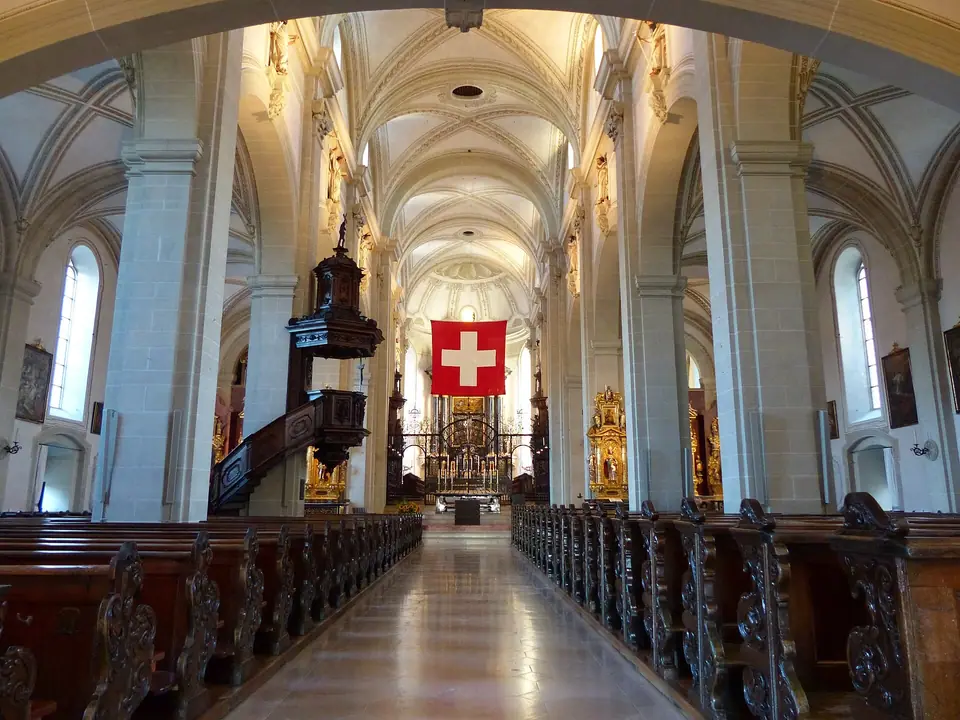
Rebuilt between 1633 and 1639 to plans by Ingolstadt Jesuit master builder Jakob Kurrer (with the first service celebrated at Easter 1638), the Hofkirche is the most important church built across the German-speaking world during the Thirty Years' War and the finest Late Renaissance church in Switzerland. Stepping through the carved western portal beneath a sandstone relief of the patron saints, you enter a bright, vaulted hall surrounded by Italianate burial arcades modeled on a Camposanto where historic patrician tombs line the cloister walk. Inside, look for the carved 1639 walnut choir stalls, the gilded wrought-iron rood screen, the historic Geisler great organ case in the gallery, the late-Gothic Seelenmuttergottes northern altar panel that survived the 1633 fire, and sculptor Kurt Sigrist's black basalt liturgical altar added during Damian Widmer's 2000 to 2001 renovation (rededicated on 8 April 2001). Regular organ concerts showcase the church's resonant acoustics across the nave.
Traveller tips
Real advice from people who have been to KKL Lucerne (Culture and Congress Centre) and the Twin-Towered Hofkirche. Every tip is read by our team before it goes live.
No tips yet. Been here? Yours could be the first.
Thank you! Your tip will appear here after a quick review.
More in Lucerne
Continue exploring Lucerne with related neighbourhood, food, and planning guides
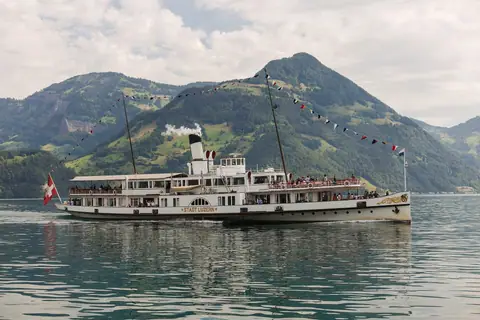
Lake Lucerne (Vierwaldstättersee): Paddle Steamers and Promenades
Lucerne, Switzerland
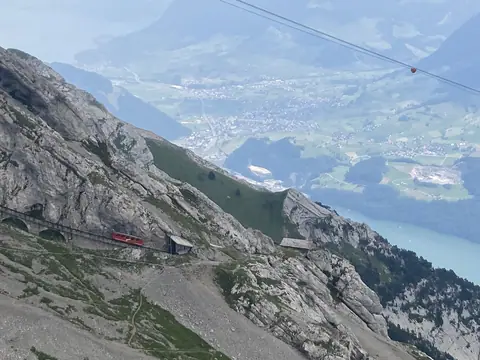
Mount Pilatus, Mount Rigi and Stanserhorn: Lucerne's Three Classic Peaks
Lucerne, Switzerland

What to Eat in Lucerne: Chügelipastete, Birnenweggen and Lake Fish
Lucerne, Switzerland
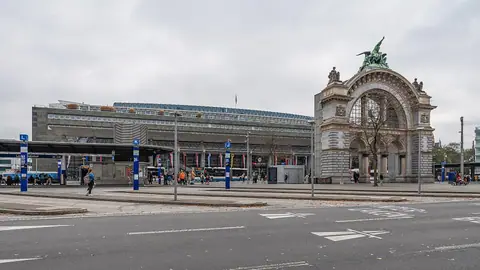
How to Get to Lucerne: Bahnhof Luzern, SBB Trains and Public Transport
Lucerne, Switzerland
