


























Lion Monument, Glacier Garden and Bourbaki Panorama at Löwenplatz
Visit Lucerne's Löwenplatz cultural quarter to see Bertel Thorvaldsen's dying lion relief, 20,000-year-old glacial potholes, and the 1881 Bourbaki circular painting.
A ten-minute walk north-east of the Altstadt along Löwengraben and Denkmalstrasse brings you to Löwenplatz, where three Category A national heritage landmarks sit within steps of one another: the cliff-carved Lion Monument (Löwendenkmal), the natural potholes and mirror labyrinth of the Glacier Garden (Gletschergarten), and the circular 1881 canvas of the Bourbaki Panorama. Because all three attractions cluster around a single square just north of the Hofkirche and Lake Lucerne, they form an essential half-day circuit in any 3-day Lucerne itinerary.
Visiting all three sites together creates a fascinating journey through nineteenth-century European memory and natural science: within a few steps, you move from an outdoor Romantic stone memorial to an Ice Age geological park and an immersive circular panorama rotunda.
The 1792 Tuileries History Behind the Lion Monument
Initiated by Guards officer Karl Pfyffer von Altishofen, who was on home leave in Lucerne during the French Revolution, the Lion Monument commemorates the regiment of Swiss Guards defending King Louis XVI when armed revolutionaries stormed the Tuileries Palace in Paris on 10 August 1792, as well as the captured soldiers killed during the September Massacres on 2 and 3 September 1792. After returning to a newly restored Bourbon France in 1818, Pfyffer launched a public subscription among European monarchs and Swiss families to fund a permanent memorial in Lucerne, where many of the fallen guardsmen had been recruited.
Designed in Rome in 1819 by Danish neoclassical sculptor Bertel Thorvaldsen, who chose the allegory of a dying lion rather than a human soldier to avoid political division, the plaster model was sent across the Alps to Lucerne. Between March 1820 and August 1821, mason Lukas Ahorn from Konstanz carved the colossal sculpture directly into the vertical face of a disused medieval sandstone quarry (whose stone had previously been extracted to build the town houses and Museggmauer), and the monument was formally dedicated on 10 August 1821.
Reading the Sculpture and Inscriptions
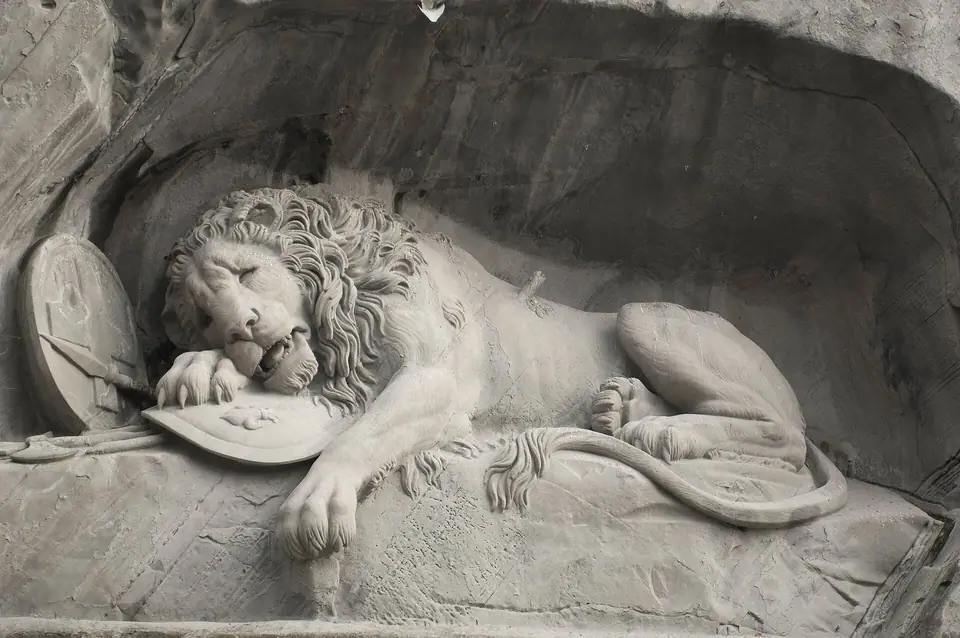
Measuring ten metres long and six metres high inside its recessed cliff grotto above a quiet spring-fed reflecting pool, the relief shows a mortally wounded lion impaled through the shoulder by a broken lance. Its head rests heavily on its front paw over a shield bearing the fleur-de-lis of the French monarchy, while a second shield bearing the Swiss coat of arms stands upright beside it. Above the niche is carved the Latin dedication Helvetiorum Fidei ac Virtuti ("To the loyalty and bravery of the Swiss"), while the Roman numerals DCCLX (760) and CCCL (350) below the sculpture record the estimated number of fallen and surviving guardsmen alongside the chiselled names of twenty-six fallen and sixteen surviving officers.
Notice the subtle outline of the cliff alcove surrounding the lion: local lore holds that the shape of the niche intentionally resembles the profile of a wild boar, though art historians view it as a natural recessed frame designed to shield the porous sandstone from rainwater. In his 1880 travelogue A Tramp Abroad, American author Mark Twain famously described the Lion of Lucerne as "the most mournful and moving piece of stone in the world", noting how the woodland setting and still pond heighten its quiet dignity compared with bronze memorials in busy city squares. Admission to the open-air park around the pond is unrestricted throughout the year.
Glacier Garden (Gletschergarten) and Pfyffer's Relief
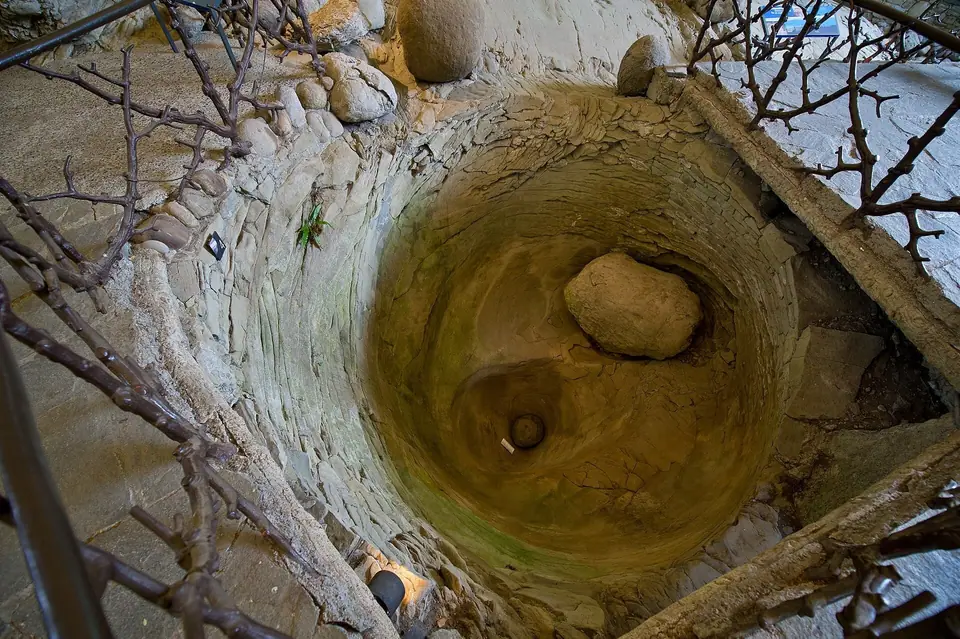
Immediately beside the Lion Monument cliff stands the entrance to the Glacier Garden (Gletschergarten). While excavating a wine cellar in the sandstone hillside on 2 November 1872, Josef Wilhelm Amrein-Troller uncovered deep, rounded potholes (Gletschertöpfe) scoured into the bedrock by swirling meltwater waterfalls beneath the Reuss Glacier during the last Ice Age around 20,000 years ago, directly above older subtropical sea-sandstone layers containing 20-million-year-old fossilised palm leaf impressions and seashells. Recognising the scientific importance of the find, Amrein-Troller opened the natural monument to visitors on 1 May 1873 and built the timber Schweizerhaus museum villa above the potholes in 1874 (expanded after his death in 1881 by his widow Marie Amrein-Troller with the 1884 Schwyzerhüsli and 1896 Swiss Alpine Club room).
Inside the historic villa sits the prized topographical relief of Central Switzerland created between 1762 and 1786 by Lucerne general and cartographer Franz Ludwig Pfyffer von Wyher, the oldest large landscape relief in the world. Measuring several square metres in wood, plaster, and wax, Pfyffer's model pioneered modern three-dimensional alpine cartography and covers Lake Lucerne and its surrounding cantons in painstaking detail. Above the potholes, a steep trail climbs through an Alpine park planted with 4,000 mountain plants to the 1875 wooden Sommerau lookout tower, which looks out over the Musegg towers toward Mount Pilatus.
The 1896 Alhambra Mirror Maze and 2022 Felsenwelt
Two additional architectural attractions make the Glacier Garden a favourite for both families and architecture enthusiasts. One is the ornate Moorish-style Alhambra mirror labyrinth, constructed with ninety mirrors for the 1896 Swiss National Exhibition in Geneva and relocated to Lucerne in 1899, where gilded arches create seemingly endless reflections. The second is the 2022 sandstone pavilion and subterranean Felsenwelt (Rock World) designed by Basel architects Miller & Maranta, which leads visitors through newly excavated caverns inside the Musegg sandstone ridge past an underground glacial lake up to the Sommerau tower.
The 1881 Bourbaki Panorama and 2024 Restoration
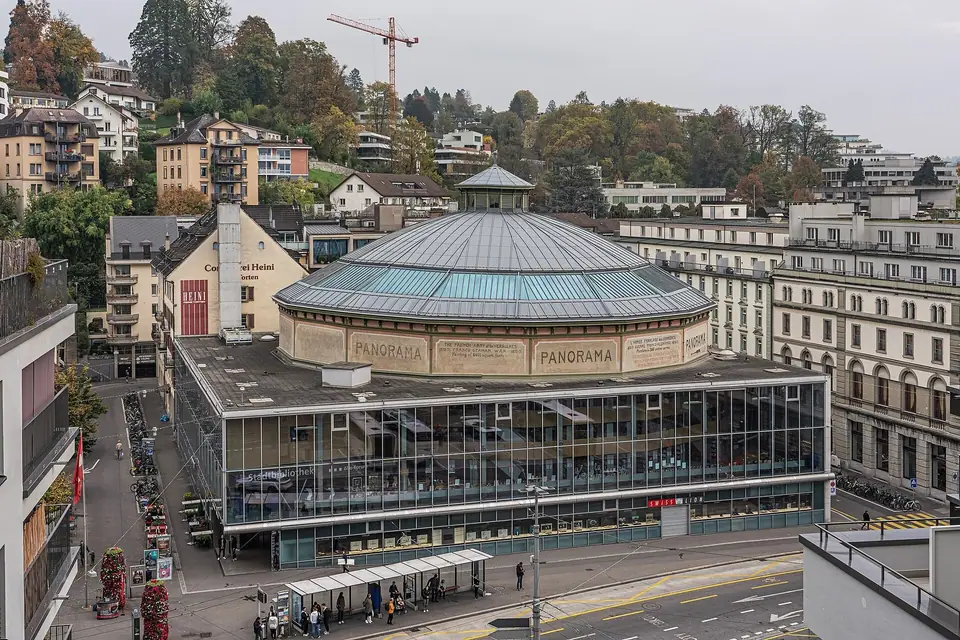
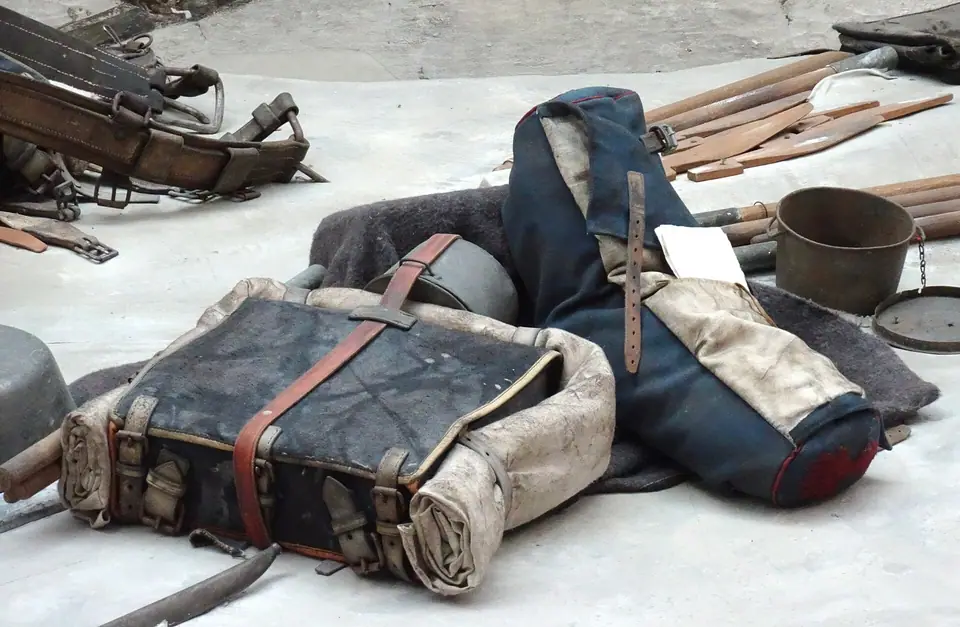
Across Löwenplatz stands the sixteen-sided 1889 timber-and-glass rotunda housing the Bourbaki Panorama (L'Entrée de l'armée française aux Verrières), painted in 1881 by Geneva artist Edouard Castres with a team of painters that included a young Ferdinand Hodler. Measuring 112 metres in circumference and 10 metres in height (reduced from an original 19.50 metres in 1926 and 1949 when the ground floor housed continental Europe's first mechanised Schindler turntable car park, later enclosed by a 1996 to 2000 glass facade along the municipal library), the circular canvas and three-dimensional faux-terrain foreground of real wagons, weapons, and snow depict General Charles Denis Sauter Bourbaki's exhausted 87,000-strong French Eastern Army laying down its arms and receiving humanitarian aid from the Red Cross and Swiss civilians upon crossing into neutral Switzerland at Les Verrières in February 1871. Between January and March 2024, the museum restored its historic 1889 viewing platform, installed new museum LED lighting, and hung a 1,600-square-metre, 200-kilogram overhead fabric canopy to recreate the unbroken nineteenth-century optical illusion.
Traveller tips
Real advice from people who have been to Lion Monument, Glacier Garden and Bourbaki Panorama at Löwenplatz. Every tip is read by our team before it goes live.
No tips yet. Been here? Yours could be the first.
Thank you! Your tip will appear here after a quick review.
More in Lucerne
Continue exploring Lucerne with related neighbourhood, food, and planning guides
Best Time to Visit Lucerne: MeteoSwiss Climate, Fasnacht and Festivals
Lucerne, Switzerland
3 Days in Lucerne: Covered Bridges, Löwenplatz, Lake Steamers and Alpine Peaks
Lucerne, Switzerland
Lucerne: Reuss Bridges, Lake Bay and Alpine Gateways
Lucerne, Switzerland
Things to Do in Lucerne: Medieval Bridges, Lake Steamers and Museums
Lucerne, Switzerland
