


























Photo: Chainwit · CC BY 4.0
Marble Mountains, Lady Buddha & Hai Van Pass Day Trip from Hoi An
Explore the coast north toward Da Nang, visiting the Marble Mountains caves, the Lady Buddha statue on Son Tra Peninsula, and the 21-kilometre Hai Van Pass.
The coastal corridor running north through Da Nang forms one of Southeast Asia's most dramatic landscapes. North of Hoi An Ancient Town, five marble and limestone hills rise from the coastal plain. Together they form the Marble Mountains (Ngũ Hành Sơn). Further north on the Son Tra Peninsula, a white statue of Bodhisattva Avalokiteshvara (the Lady Buddha) overlooks the East Sea. She looks directly across toward the 21-kilometre mountain switchbacks of the Hai Van Pass (Đèo Hải Vân, "Ocean Cloud Pass"). Visit these three sights as featured in our travel itinerary or during your transfer to Hue or Da Nang Airport.
| Coastal Landmark | Location Details | Features | Visitor Advice |
|---|---|---|---|
| Marble Mountains (Ngũ Hành Sơn) | North of Hoi An on coastal road | 5 limestone and marble hills, caves, and viewpoints | Take the stairs or lift through the sanctuaries |
| Dong Hai Village | Marble Mountains area | Around 600 families practicing stone engraving | Handicrafts listed on national intangible cultural heritage list |
| Lady Buddha (Linh Ung Pagoda) | North on Son Tra Peninsula | White statue facing the sea, home to rare douc langurs | Combine with scenic coastal viewpoints |
| Hai Van Pass (Ocean Cloud Pass) | Highway 1 on border of Da Nang and Thua Thien-Hue | 21 km coastal mountain road up to 500 m elevation | Visit on clear days for sweeping sea views |
The Five Elemental Peaks of the Marble Mountains (Ngũ Hành Sơn)
Champa carvings and altars sit inside these natural limestone grottoes. In the early nineteenth century, Nguyen Dynasty Emperor Minh Mang named the range after the five cosmic elements of Eastern philosophy (Ngũ Hành). The Marble Mountains comprise five karst peaks in Hoa Hai Ward. They are Kim Sơn (Metal), Mộc Sơn (Wood), Thủy Sơn (Water), Hỏa Sơn (Fire), and Thổ Sơn (Earth). Nearby in the mountains lies Dong Hai, where around 600 families work in stone engraving. Vietnam also exports stones extracted directly from the Marble Mountains.
All major cave shrines, pagodas, and viewpoints sit on the main peak, Thủy Sơn (Mount of Water). You can ascend Thuy Son via stone steps, including the 108 steps leading up to Linh Ung Pagoda. Alternatively, take the lift and follow shaded paths through the sanctuaries at an easy pace. The national intangible cultural heritage list includes marble handicrafts from this historic district.
Local workshops display finely polished statues, ornamental bowls, and decorative sculptures outside open-air showrooms. Craftsmen have maintained these stonecutting traditions across multiple generations. Walking along the base of the mountain allows you to observe stone artists at work. They carve intricate patterns from natural rock below the upper caves and viewpoints.
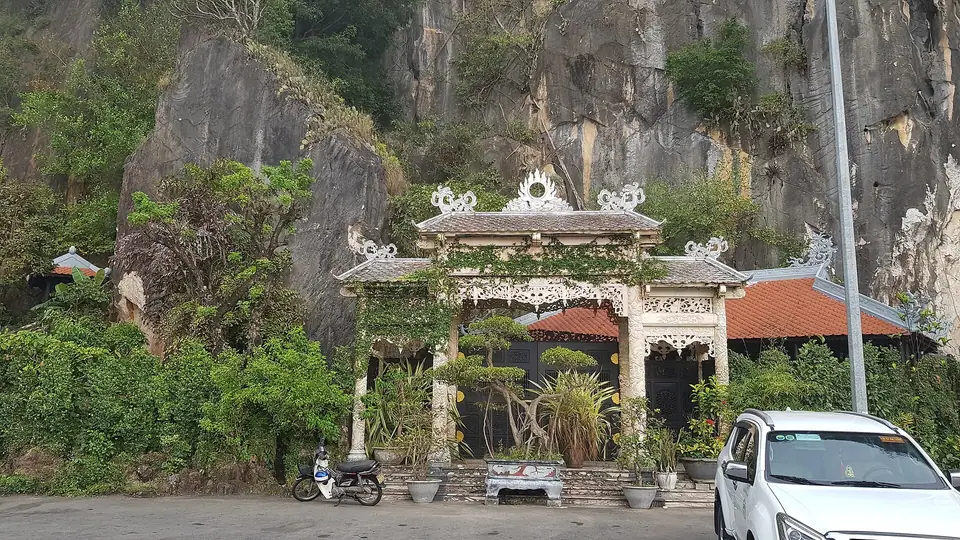
Inside Thuy Son: Huyen Khong Cave, Tam Thai Pagoda, and the River Viewpoint
Take time to walk the shaded upper paths of Thuy Son, linking several highlights:
- Huyen Khong Cave (Động Huyền Không, The Star Sanctuary). The spiritual highlight of the Marble Mountains is this vast, open-vaulted limestone cavern hidden inside the hill. Natural ceiling openings let shafts of sunlight illuminate the interior incense smoke and seated stone Buddha.
- Tam Thai Pagoda & Linh Ung Pagoda. Reached by stone steps near the stupa, these ridge temples sit under banyan trees.
- Vong Giang Dai & Vong Hai Dai Viewpoints. Short stone steps climb to natural rock balconies. Vong Giang tower looks over the river plain, while the seaward viewpoint faces the coast.
- Sanctuaries at the Base. At the foot of the mountain, cavern pathways reveal traditional Buddhist carvings as steep stone passages climb toward daylight.

The Lady Buddha at Linh Ung Pagoda on the Son Tra Peninsula
From the Marble Mountains, travel north along the coastal road past city beaches. The road climbs onto the forested headland of the Son Tra Peninsula. On a hillside above the bay stands Linh Ung Pagoda, set within a diverse marine and forest ecosystem.
The peninsula is celebrated for its natural attractions, the monumental white statue of Bodhisattva Quan The Am (Avalokiteshvara, the Lady Buddha), and rare red-shanked douc langurs. The Lady Buddha gazes out across the waters toward the open sea. Admission to the temple grounds is free, but check the official site before visiting. Cover shoulders and knees as noted in our packing guide, and keep snacks inside your bag away from monkeys.
The leafy temple grounds feature manicured bonsai trees and peaceful stone courtyards overlooking the sweeping waters of Da Nang Bay. Visiting in the early part of the day allows you to wander in cooler air before the midday heat arrives. The wide ocean horizon offers remarkable photography angles from the balustrades.

Driving the 21-Kilometre Hai Van Pass ("Ocean Cloud Pass")
Across the bay rises the misty ridge of the Hai Van Pass (Đèo Hải Vân). Hai Van means "Sea Clouds", since the peak rests in clouds while its foot lies close to the sea. At 500 metres above sea level, it is the highest mountain pass in Vietnam. It forms the final section of the Truong Son Range stretching to the sea. Historically, this pass formed the frontier between Thuan Hoa and Quang Nam. The pass also features old fortifications built by the French and later used by South Vietnamese and American forces.
The road stretching over the Hai Van mountain pass spans 21 kilometres. It lies on Highway 1 on the border between Thua Thien-Hue Province and Da Nang City. At the summit stands the historic gate, where the side facing Thua Thien-Hue Province is inscribed with the words "Hai Van Quan". The gate looking down on Quang Nam province is engraved "the most grandiose gateway in the world". On clear days, the pass offers wide views of Da Nang, Tien Sa seaport, Son Tra Peninsula, Cu Lao Cham Island, and long sandy beaches.
How to Combine All Three in a Half-Day Loop or One-Way Hue Transfer
You have two straightforward ways to visit this northern coastal trio from your hotel. If you are returning to sleep in Hoi An, hire a private car or Grab driver for a morning loop. Tour the Marble Mountains and the Lady Buddha, then return for lunch and An Bang Beach. If you are continuing north to Hue, book a sightseeing car transfer along the coastal route. Your driver stops at the Marble Mountains, Lady Buddha, the Hai Van Pass summit, and the northern lagoons. Because the carved stone staircases inside Thuy Son can feel damp from sea mist, step carefully on polished limestone treads inside the grottoes. Central Vietnam experiences its tropical storm season from May to November, so monitor local forecasts during autumn months as noted in our Hoi An weather guide. On clear mornings, the view from the coastal cliffs stretches across the curving bay of Da Nang to the ridgelines of the Truong Son mountains. At the summit of Hai Van Pass, cool mountain winds sweep across the old stone gate, making a light layer welcome. Packing a light windbreaker feels sensible even on warm days. Returning via the coastal road in late afternoon brings soft pastel light across the beaches. Carrying a bottle of water and a small hand towel makes climbing the shaded stone steps much more pleasant. Checking cloud cover over the mountain ridge before departing helps you time your coastal viewpoint stops for clear vistas.
Where it is
- 1Marble Mountains, Lady Buddha & Hai Van Pass Day Trip from Hoi An
- Da Nang International Airport (DAD) · about 8 km from here in a straight line
- Directions in Google Maps
Stations and taxi ranks: OpenStreetMap. Airports: OurAirports. Distances are in a straight line.
Traveller tips
Real advice from people who have been to Hoi An. Every tip is read by our team before it goes live.
No tips yet. Been here? Yours could be the first.
Thank you! Your tip will appear here after a quick review.
More in Hoi An
Continue exploring Hoi An with related neighbourhood, food, and planning guides
Best Things to Do in Hoi An: Bridges, Assembly Halls, Villages & Beaches
Hoi An, Vietnam
How to Get to Hoi An from Da Nang Airport, Train Station & Hue
Hoi An, Vietnam
Best Time to Visit Hoi An: Dry Season, Flood Months & Full Moon Dates
Hoi An, Vietnam
What to Wear in Hoi An: Temple Dress Codes, Slip-On Shoes & Linen Packing
Hoi An, Vietnam
