


























My Son Sanctuary Day Trip from Hoi An: Champa Hindu Temples at Sunrise
Visit UNESCO-listed My Son Sanctuary, 45 kilometres from Hoi An Ancient Town, to explore 4th-to-13th-century Champa Hindu brick temples built without mortar.
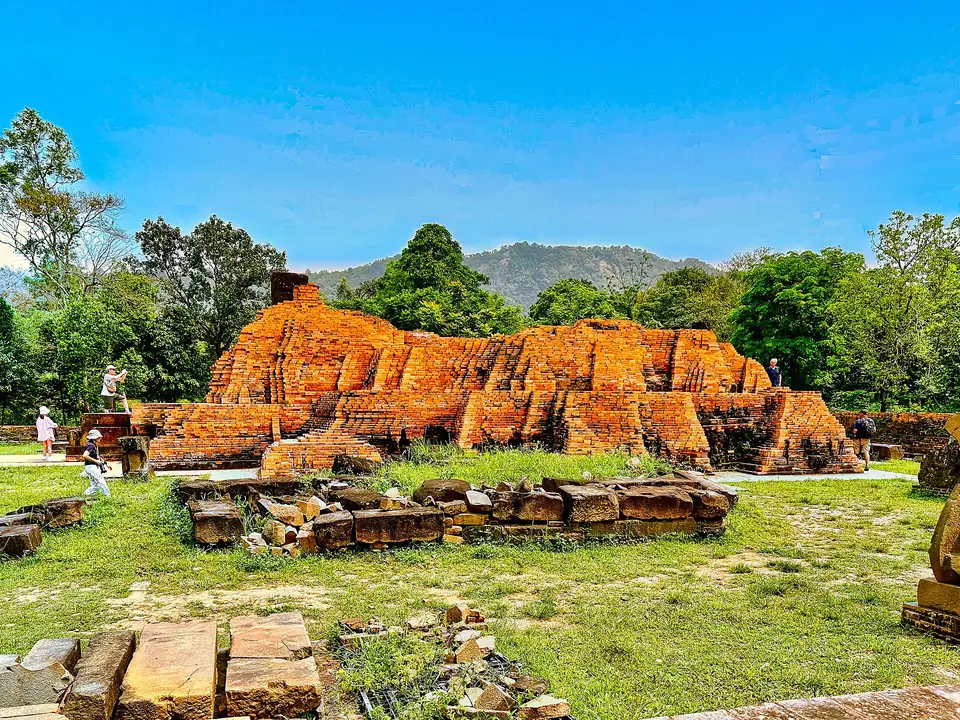
Forty-five kilometres from Hoi An Ancient Town in Duy Xuyen District, forested granite hills form a mountain amphitheatre. Watching over the basin is the sacred jagged peak of Cat's Tooth Mountain (Hòn Quắp or Mahaparvata). Inside this valley stands My Son Sanctuary (Thánh Địa Mỹ Sơn). It was inscribed on the UNESCO World Heritage list on 4 December 1999 together with the Ancient Town. Across nine centuries between the fourth and thirteenth centuries, My Son served as the royal religious centre of the Indianised Kingdom of Champa. That seafaring Austronesian empire controlled trade along the central coast of Vietnam while Faifo served as its maritime harbour. Pairing a dawn My Son visit with an afternoon at An Bang Beach anchors our 4-day itinerary.
| Monument Group | Historical Era & King | Architectural Role | Key Sculptures & Details |
|---|---|---|---|
| Groups B, C & D (The Core) | 4th to 13th centuries | Primary royal citadels, central Kalan sanctuaries & Mandapa halls | Sandstone Shiva Linga-Yoni, carved Apsara dancers, brick museums (D1/D2) |
| Group G (Hillslope Complex) | 4th to 13th centuries (Jaya Harivarman I) | Elevated brick sanctuary built on a natural laterite hillock | Terracotta lion reliefs, demon Kala masks, Italian conservation work |
| Group A (Eastern Ruin Site) | 4th to 13th centuries (My Son A1 masterpiece) | Formerly held a central tower sanctuary | Monumental sandstone pedestals & surviving Sanskrit-Cham stone stelae |
| Groups E, F & H | 4th to 13th centuries | Early medieval brick towers & vaulted roofs under Indian Gupta influence | E1 Pedestal backstory & early brick-bonding profiles |
The Kingdom of Champa and Worship of Shiva Bhadresvara (4th to 13th Centuries)
While northern Vietnam (Đại Việt) followed Confucian and Mahayana Buddhist traditions, the Cham people ruled the central coast from the second to fifteenth centuries. Through maritime trade with southern India, the Cham adopted Sanskrit epigraphy, Hindu Shaivite cosmology, and stone temple architecture. Around the late fourth century CE, Cham King Bhadravarman I erected a sanctuary in the My Son valley. He combined his royal name with Shiva to honour the deity Bhadresvara, represented inside each temple by a sandstone Linga-Yoni altar.
When a fire consumed that early temple, King Sambhuvarman rebuilt the sanctuary in permanent kilned red brick and carved sandstone. Over the centuries, each succeeding Cham monarch added new temple-towers to legitimise his reign. Together they created over 70 architectural works before the Champa capital shifted south toward Binh Dinh. Catalogued by Henri Parmentier from Group A to Group N, around 20 temples and towers remain preserved quite well today.
Anatomy of a Cham Temple Cluster and the Mystery of Mortarless Red Brick
As you walk into the main monumental court of Groups B, C, and D, notice how every Cham religious complex follows a strict east-facing cosmic layout:
- Gopura (Gate Tower): This single two-doorway brick portal faces the rising sun in the east, where priests entered the sacred enclosure.
- Mandapa (Long Meditation & Assembly Hall). Inside the gate stands a rectangular brick hall with carved sandstone window balusters where priests and dancers prepared offerings.
- Kalan (Main Sanctuary Tower). At the heart of the courtyard rises the tall pyramidal brick tower symbolising sacred Mount Meru. It houses the dark inner cella and the sandstone Linga-Yoni altar whose grooved drainage spout points north to channel lustral water offerings out through the wall.
- Kosagrha (Fire & Sacrificial Kitchen): This smaller two-room structure with a curved boat-shaped roof in the southeast corner stored sacred vessels and ritual meals.
Look closely at the walls of Tower C1 and Tower B5 to see the engineering riddle that puzzled modern conservators for decades. The kilned red bricks fit together so seamlessly that no mortar joint is visible, and virtually no white lichen grows on the original tenth-century bricks. Rather than laying thick lime mortar, Cham master builders rubbed two fired bricks together in water until their surfaces were flat. Masons bonded the bricks with native dầu rái (dipterocarp tree resin) and carved pilasters and floral reliefs directly into the walls.
Walking Loop Through Groups B, C, D, Group G, and the Site Museum
Your admission ticket to My Son includes internal amenities that save your energy before you reach the ruins. One highlight is the air-conditioned My Son Museum, built between June 2004 and March 2005 with grant aid from the government of Japan. Second is an electric shuttle buggy ride through the forested valley to the trailhead footbridge.
From the shuttle drop-off, a shaded stone footpath loops through the valley. Take unhurried time exploring inside Groups B, C, and D. Step inside longitudinal halls D1 and D2, which now function as open-air sculpture galleries. Inside you will see sandstone bas-reliefs of multi-armed Shiva dancing the Tandava, Vishnu reclining on the serpent Ananta, Ganesha, and graceful Apsara celestial nymphs. From there, climb the gentle path onto the laterite hillock of Group G (built by King Jaya Harivarman I). Grinning terracotta Kala faces guard the doorways above the path leading toward ruined Group A.
Why Arriving at Sunrise Beats Midday Heat and Tour Coaches
Because My Son sits inside a closed mountain bowl inland without coastal sea breezes, temperatures inside the red-brick courtyards climb steeply toward midday. That is also when large tour groups begin arriving from Da Nang and Hoi An Ancient Town. Book an early private car or sunrise shuttle so you enter the sanctuary right when ticket gates open.
During the early morning hours, relatively few visitors share the valley as sunlight burns the mist off Cat's Tooth Mountain. Later in the morning, stop at the open-air performance pavilion near Group G to catch a show of traditional Cham court music and Apsara fan dancing. The dancers perform to the reed melody of the Saranai oboe and Ginang drums.
Combining My Son with an Afternoon Town Visit and Practical Packing
Travelling the 45 kilometres from Hoi An out to My Son along provincial roads makes an easy morning journey. Many sunrise excursions drive out early and return by midday. That schedule leaves your afternoon free for tailor fittings in our custom tailoring guide or a stop at Thanh Ha Pottery or Kim Bong Carpentry villages. Wear shoulder- and knee-covering linen clothing and closed-toe walking shoes from our Hoi An packing guide. Carry water, and refuel back in town with turmeric noodles from our Hoi An food guide. Inside the sanctuary valley, stay strictly on the paved stone walkways and cleared forest trails linking the temple groups. Shaded wooden pavilions near the electric shuttle stop offer benches where you can rest and review site maps between tower clusters. Examine the carved sandstone lintels in the museum before walking the valley trail. Those displays help you recognise Hindu deities, makara sea creatures, and Sanskrit inscriptions outside. Listen for birdsong echoing off the surrounding hills and look for the steep silhouette of Cat's Tooth Mountain framing the eastern horizon. Notice how ancient Cham masons fitted each fired brick tightly without visible mortar beds, a technique that still fascinates architectural historians today. Returning to town before midday leaves your afternoon completely free for tailor fittings or a shaded courtyard nap. Pausing inside the site museum before walking the valley trails helps you understand the brickwork construction techniques. Walking quietly along the forested valley paths in the morning lets you hear birdcalls echoing around the ancient brick sanctuaries.
Where it is
- 1My Son Sanctuary Day Trip from Hoi An
- Da Nang International Airport (DAD) · about 32 km from here in a straight line
- Directions in Google Maps
Stations and taxi ranks: OpenStreetMap. Airports: OurAirports. Distances are in a straight line.
Traveller tips
Real advice from people who have been to Hoi An. Every tip is read by our team before it goes live.
No tips yet. Been here? Yours could be the first.
Thank you! Your tip will appear here after a quick review.
More in Hoi An
Continue exploring Hoi An with related neighbourhood, food, and planning guides
Hoi An Beaches Guide: An Bang Beach, Hidden Beach & Cua Dai Coastline
Hoi An, Vietnam
Cham Islands (Cu Lao Cham) Day Trip: Biosphere Reserve & Snorkelling
Hoi An, Vietnam
Thanh Ha Pottery Village, Kim Bong Carpentry & Hoi An Lantern Making
Hoi An, Vietnam
Hoi An Museums Guide: Trade Ceramics, Sa Huynh Culture, Folklore & Réhahn
Hoi An, Vietnam
