Brera District
A local-paced walk through Brera’s art and streets.
Brera is the quarter where Milan's artistic reputation feels closest to street level. Its cobbled lanes run between the Pinacoteca, the Academy of Fine Arts, a historic library and an eighteenth-century botanical garden, and in between are galleries, bookshops, ateliers and cafés with tables on the pavement. The district is compact and almost entirely walkable, so we treat it as a place to wander rather than a single museum stop.
Palazzo Brera at the centre
The great courtyard of Palazzo Brera, built as a Jesuit college in the seventeenth century, is free to walk into and sets the tone for the whole area. In the middle stands Canova's bronze Napoleon, posed as Mars the Peacemaker. Upstairs, the Pinacoteca di Brera holds one of Italy's great painting collections, which Napoleon expanded in 1809 with works taken from churches across northern Italy. The same building houses the Braidense National Library and the Academy, so students with portfolios cross the courtyard all day.
The lanes
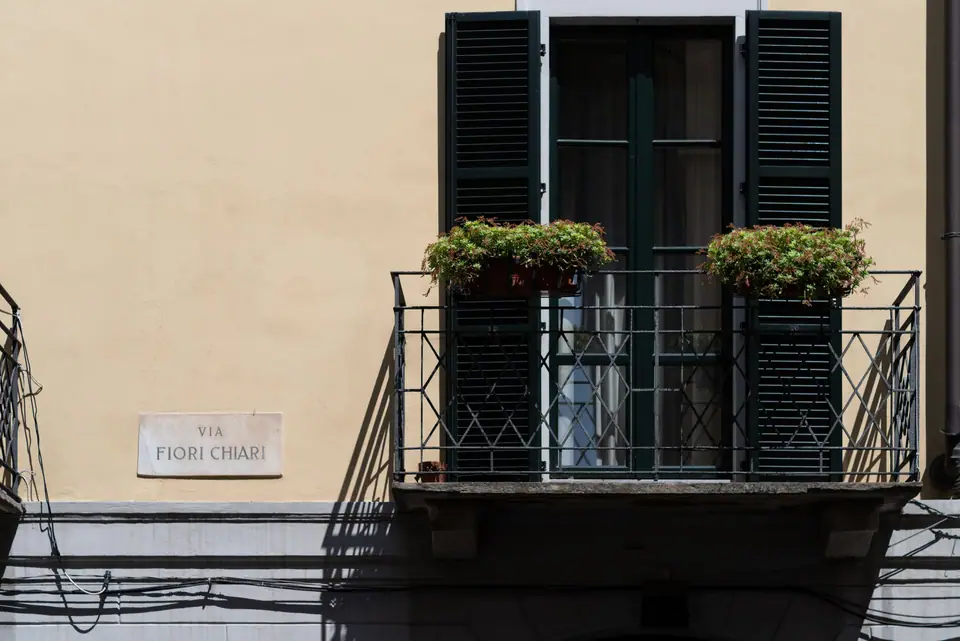
Via Brera, Via Fiori Chiari and Via Madonnina are the streets most visitors follow. Fiori Chiari, closed to traffic, fills with café tables and art shops. Look up at the iron balconies and painted shutters, and through open gates into courtyards. Corso Garibaldi on the northern edge has a more everyday feel, with bakeries, wine bars and neighbourhood shops. We like the area early in the day, when shopkeepers are setting up and the streets belong to residents.
Churches and squares
Two churches show how old Brera really is. San Simpliciano, on its own small square, dates back to the early Christian period and has a fine painted apse. Santa Maria del Carmine faces a piazza with a large contemporary sculpture and a quieter atmosphere than the main lanes. San Marco, on the street of the same name, is one of the largest churches in Milan, and the young Mozart stayed in the adjoining convent in 1770.
The botanical garden
Tucked behind the palazzo, the Orto Botanico di Brera was founded in 1774 under Maria Theresa of Austria as a teaching garden. It is small, with old trees, medicinal plant beds and two ponds, and it feels a world away from the busy streets around it. We use it as a pause between the gallery and lunch, especially in spring, when the beds are full.
Eating and drinking
Brera has many restaurants, and the busiest tables on Via Fiori Chiari tend to serve visitors more than locals. A street or two away the menus become more Milanese, with risotto and cotoletta alongside seasonal dishes; our Milanese food guide explains what to order. In the early evening, the district's bars fill for aperitivo, and a table on Corso Garibaldi or Via Solferino makes a relaxed end to a gallery afternoon.
Linking Brera with the centre
Brera sits a short walk north of La Scala, so it joins naturally with the Galleria and the Duomo on a central day. Castello Sforzesco and Parco Sempione are a few minutes west along Via Pontaccio and Via Mercato. Metro M2 stops at Lanza and Moscova on the edges of the quarter, and M3 at Montenapoleone is close to the eastern side.
Our view
Brera works because its culture is part of the street, not locked behind a ticket desk. The gallery gives the visit a focus, while the lanes make it personal. We give it a slow half-day: the Pinacoteca in the morning, a walk through the garden and churches, lunch away from the main strip and a return in the evening to see the district change. For a livelier night, continue south to the Navigli canals.
Traveller tips
Real advice from people who have been to Brera District. Every tip is read by our team before it goes live.
No tips yet. Been here? Yours could be the first.
Thank you! Your tip will appear here after a quick review.
More in Milano
Continue exploring Milano with related neighbourhood, food, and planning guides