Pinacoteca di Brera
How to approach Brera’s major painting collection and its setting.
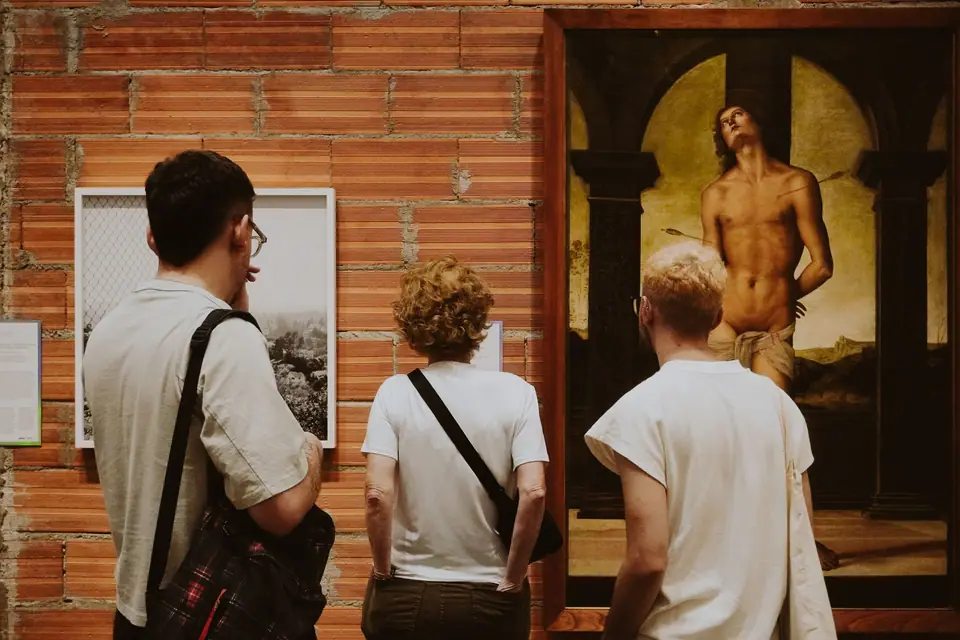
The Pinacoteca di Brera is one of Italy's great picture galleries, and for many visitors the finest art museum in Milan. It fills the upper floor of Palazzo Brera, a former Jesuit college that also houses the Academy of Fine Arts and a historic library. The gallery opened in 1809 under Napoleon, who filled it with altarpieces and paintings removed from churches and monasteries across northern Italy. The result is a collection unusually rich in Venetian and Lombard painting, shown in a sequence of nearly forty rooms.
Arriving through the courtyard
The entrance is through the grand arcaded courtyard of the palazzo, where Antonio Canova's bronze statue of Napoleon as Mars the Peacemaker stands on a tall plinth. A monumental staircase leads up to the gallery. The route is laid out in numbered rooms, broadly by school and period, and seats are placed in front of several key works. Timed entry is recommended on busy days, and we find the gallery calmer earlier in the day.
Mantegna's Dead Christ
Few paintings in Milan are as startling as Andrea Mantegna's Lamentation over the Dead Christ. The body lies on a marble slab, seen from the feet, with the perspective sharply foreshortened so that the wounds of the hands and feet are close to the viewer. It hangs low in a dim room, and the effect is intimate and unsettling. Nearby is Giovanni Bellini's tender Pietà, one of the masterpieces of Venetian painting.
Raphael and Piero della Francesca
In the central rooms, Raphael's Marriage of the Virgin, painted in 1504 when he was barely twenty-one, shows the young artist's mastery of space: the figures stand in the foreground of a piazza closed by a perfectly drawn round temple. Across from it hangs Piero della Francesca's Brera Altarpiece, with Federico da Montefeltro kneeling in armour before the Virgin and an ostrich egg hanging from the shell-shaped apse above. Together they are the heart of the collection.
Caravaggio and Hayez
Caravaggio's Supper at Emmaus, painted in 1606 after he fled Rome, is darker and quieter than his earlier version in London, with Christ revealed to the disciples in a few beams of light. Later rooms bring the nineteenth century, including Francesco Hayez's The Kiss of 1859, the most popular painting in the gallery, in which a couple embrace in a medieval stairwell. The work became a symbol of Italian Risorgimento romance.
Watching the conservators
One of the Pinacoteca's more unusual features is its glass-walled restoration laboratory, set within the route. Visitors can watch conservators at work on panels and canvases, with explanations of the techniques they use. It makes the care of the collection visible and explains why some works travel or leave the walls for a time.
Lombard painters and Leonardo's followers
The Lombard rooms are easy to pass quickly, and they deserve more time. Vincenzo Foppa, Bramantino and Bernardino Luini show how painting in Milan developed before and after Leonardo's arrival. The Leonardeschi, the artists who worked in his circle, such as Giovanni Antonio Boltraffio, adopted his soft modelling and smoky shadows. Seeing their work here helps explain the frescoes at San Maurizio and the wider influence Leonardo had on the city.
Our view
Brera rewards a focused visit of two or three hours. We follow the numbered route but slow down for Mantegna, Raphael, Piero, Caravaggio and Hayez, then rest in the café on the first floor. Afterwards, the lanes of the Brera district are right outside. For an art-filled day, pair the gallery with the Museo del Novecento or the Ambrosiana, and finish with an aperitivo in one of the bars on Corso Garibaldi.
Traveller tips
Real advice from people who have been to Pinacoteca di Brera. Every tip is read by our team before it goes live.
No tips yet. Been here? Yours could be the first.
Thank you! Your tip will appear here after a quick review.
More in Milano
Continue exploring Milano with related neighbourhood, food, and planning guides