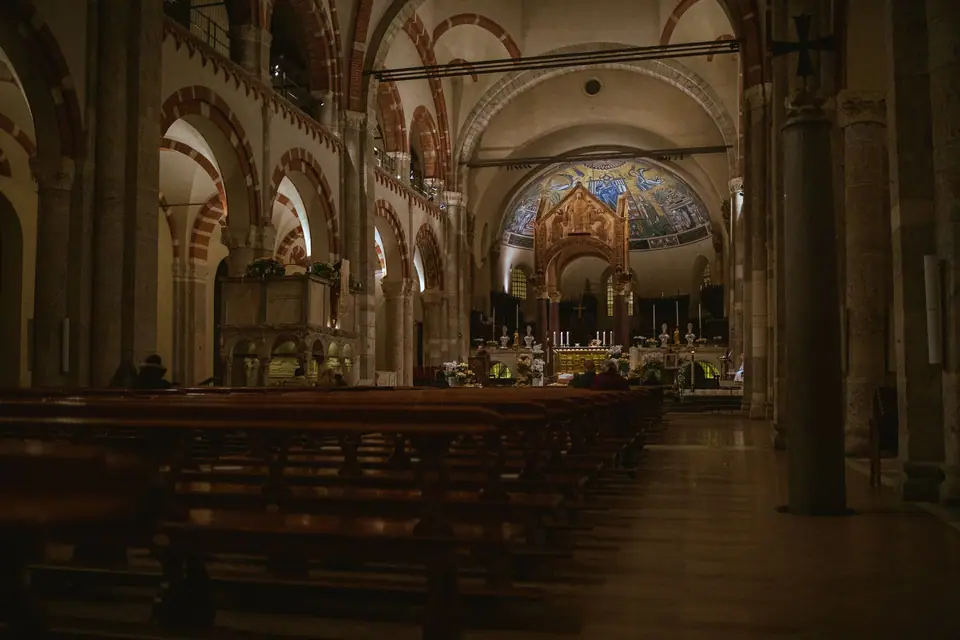
San Maurizio al Monastero Maggiore
A visitor’s introduction to the frescoed interior of San Maurizio.
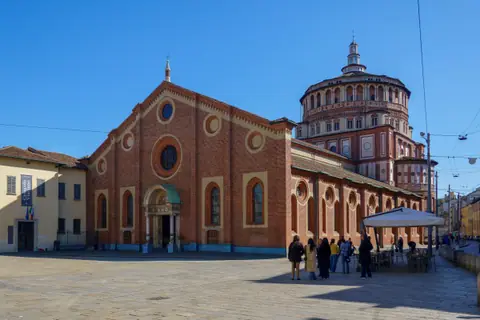
From the street, San Maurizio al Monastero Maggiore looks like a modest church on Corso Magenta. Step inside and every surface is painted: walls, arches, vaults and chapels covered with sixteenth-century frescoes in deep blues, reds and gold. The Milanese often call it the Sistine Chapel of Milan, and for once the comparison does not feel exaggerated. It is one of the city's most surprising interiors, and still relatively quiet compared with the major museums.
A church of two halves
The church belonged to the Monastero Maggiore, the largest Benedictine convent in Milan, and it was built in the early sixteenth century with a wall dividing it in two. The front half, the public hall, was used by the congregation. The rear half, the nuns' hall, was reserved for the enclosed community, who followed the Mass through a small opening in the dividing wall without being seen. Today a passage connects the two halves, and visitors can move freely between them.
Luini's frescoes
Much of the painting is by Bernardino Luini, the leading Lombard painter of his generation and a follower of Leonardo, together with his sons and workshop. In the public hall, scenes from the life of Saint Maurice and Saint Catherine of Alexandria fill the walls around the altar, alongside portraits of the Bentivoglio family who sponsored the decoration. Luini's figures have the soft faces and gentle expressions that show Leonardo's influence, while the narrative scenes are full of everyday detail.
The nuns' hall
The nuns' hall is even richer. Its walls carry a long series of scenes of the Passion, and one of its best-known panels shows Noah's Ark, with pairs of animals walking up the gangplank, including unicorns. Above the choir stalls, the galleries were reserved for the nuns, and the painted saints and angels seem to watch from every bay. The organ, built by Giovan Giacomo Antegnati in 1554, is one of the oldest in Milan and is still played at concerts.
The archaeological museum next door
The convent's former cloisters now house the Civic Archaeological Museum. In its garden stand two towers from Roman Milan, a many-sided tower from the late Roman city walls and a square tower that belonged to the circus, where chariot races were held. Inside, the collection covers Roman Mediolanum, which was briefly an imperial capital, as well as Etruscan, Greek and early medieval finds. It is a useful companion to the church and shows a side of Milan many visitors miss.
Restoration and light
The frescoes were restored over many years, and the work revealed colours that had been dulled by candle smoke and dust. Lighting is kept low to protect them, so the chapels can look dim at first. We let our eyes adjust before moving on, and we look at the side chapels as carefully as the main walls, since several hold scenes painted with particular delicacy, including the story of Saint Catherine's martyrdom.
Our view
San Maurizio is one of our favourite small visits in Milan. We give it at least half an hour, since the eyes need time to adjust and the details keep revealing themselves on a second circuit. Concerts held here, especially on the historic organ, are a memorable way to experience the space. The church lies on the same street as the Last Supper, so the two belong together, and the castle and Sant'Ambrogio are both a short walk away.
Metro M1 and M2 at Cadorna, or M1 at Cairoli, are the nearest stations. Combined with the central Milan walking route, San Maurizio turns a busy morning into a day of contrasts, from Roman stones to Renaissance colour.
Traveller tips
Real advice from people who have been to San Maurizio al Monastero Maggiore. Every tip is read by our team before it goes live.
No tips yet. Been here? Yours could be the first.
Thank you! Your tip will appear here after a quick review.
More in Milano
Continue exploring Milano with related neighbourhood, food, and planning guides