Sforza Castle
How to experience the castle and its collections at a comfortable pace.
Castello Sforzesco is the great brick fortress at the western edge of Milan's historic centre. Francesco Sforza began rebuilding an older Visconti castle here in the 1450s, and under his son Ludovico it became one of the most splendid courts of Renaissance Europe, with Leonardo da Vinci and Bramante among the artists working for the duke. Later centuries turned it into a barracks, and the castle was saved from demolition at the end of the nineteenth century and restored as a home for the city's civic museums.
The approach and the towers
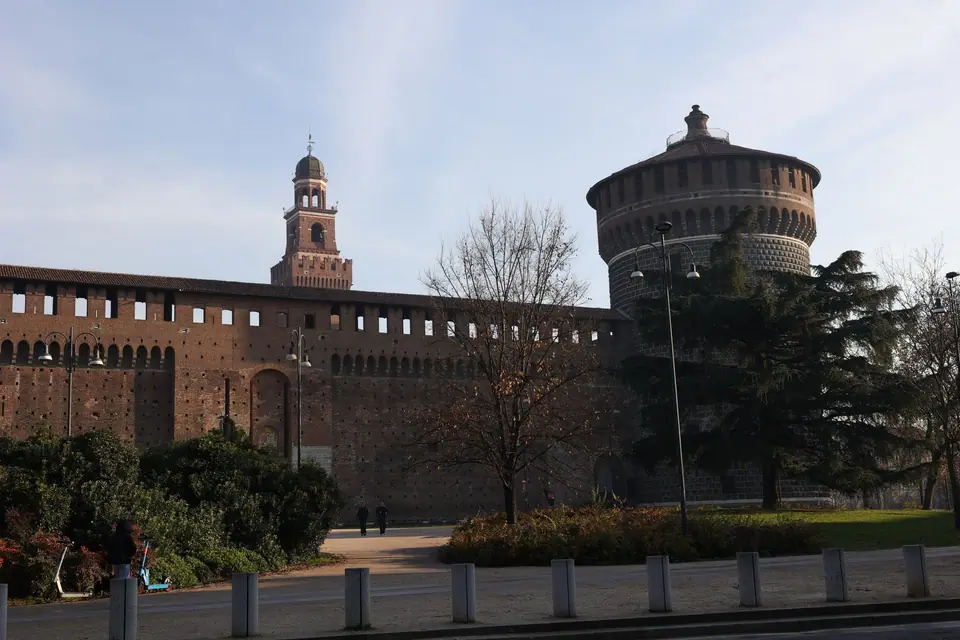
Coming from the centre along Via Dante, the castle fills the end of the street. The tall central gate tower, the Torre del Filarete, is a twentieth-century reconstruction of the original, which was destroyed by an explosion in 1521. Flanking it are two round corner towers faced with stone. In front, the fountain in Piazza Castello is a popular meeting point, and we like to see the façade from here before walking in.
Courtyards
The first courtyard, the vast Piazza d'Armi, is free to enter and gives a sense of the castle's military scale. Beyond it, the Rocchetta was the fortified heart of the complex, and the elegant Corte Ducale, with its Renaissance portico, was the residence of the dukes. Even if you do not visit a museum, walking through the courtyards and out the far gate into Parco Sempione is one of our favourite short walks in Milan.
Michelangelo's last sculpture
The castle's most moving work is the Rondanini Pietà, the marble group Michelangelo was carving in the days before his death in 1564. It stands alone in a dedicated space in the former Spanish hospital within the complex. The figures of Mary and Christ are unfinished and strangely elongated, and traces of earlier versions remain in the stone. We find it one of the most personal works in Milan.
Leonardo's painted room
In the Sala delle Asse, Leonardo painted the vaulted ceiling as an arbour of intertwined mulberry trees, a compliment to Ludovico Sforza, who was nicknamed il Moro after the mulberry. Restoration has revealed sketches beneath the later repainting, including roots breaking through rocks. Access depends on restoration work, which has continued for several years.
A court of artists
Under Ludovico il Moro, the castle was the centre of a brilliant court. Leonardo organised festivals and stage machinery here, designed a giant bronze horse for the duke's father that was never cast, and filled notebooks with plans for the city's defences. The French invasion of 1499 ended that golden age, and the castle passed through French, Spanish and Austrian hands. Its thick walls and star-shaped outer bastions, now mostly gone, tell of those centuries as a garrison.
The civic collections
Several museums share the castle. The Museum of Ancient Art includes Lombard sculpture and the funeral monument of Bernabò Visconti. The Pinacoteca holds paintings by Mantegna, Giovanni Bellini, Correggio and Lombard masters. There are also collections of musical instruments, furniture, applied arts and Egyptian antiquities. One ticket covers most of them, but we suggest choosing two or three rather than attempting them all.
Our view
Give the castle a morning, then let it lead into the park. It connects easily with the Last Supper, a short walk away along Corso Magenta, and with the galleries of Brera to the east. Metro M1 stops at Cairoli and M2 at Lanza, both a few steps from the gates. In the afternoon, the Triennale design museum on the far side of the park makes a modern contrast to the Renaissance courts.
Families will find the castle approachable: children enjoy the towers, the moat and the armour in the Museum of Ancient Art, and the open courtyards give room to run between rooms full of fragile objects.
Traveller tips
Real advice from people who have been to Sforza Castle. Every tip is read by our team before it goes live.
No tips yet. Been here? Yours could be the first.
Thank you! Your tip will appear here after a quick review.
More in Milano
Continue exploring Milano with related neighbourhood, food, and planning guides