Milan Cathedral and Rooftops
How to explore the cathedral, its rooftop and the heart of Milan.
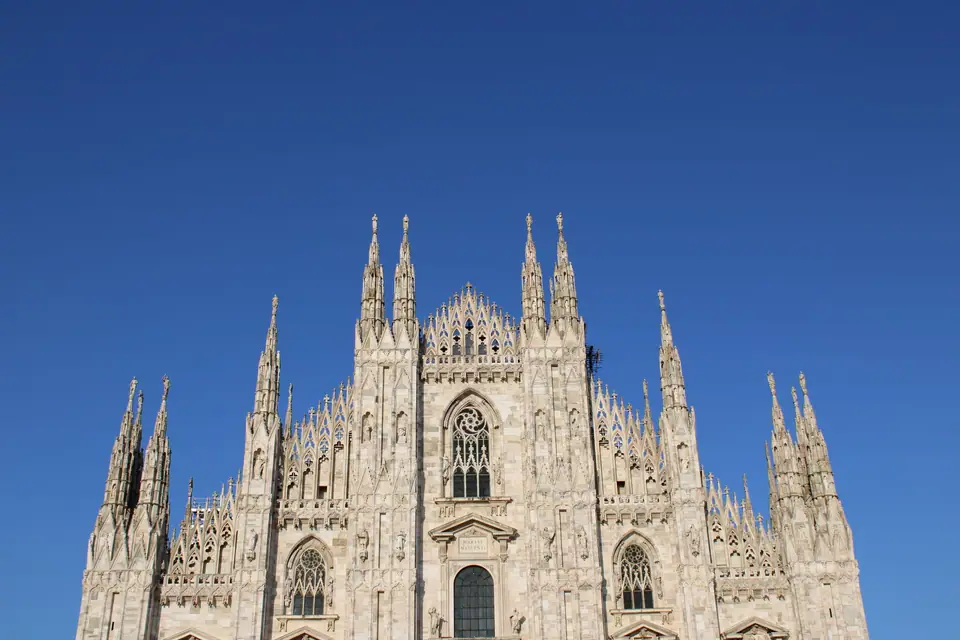
The Duomo is where we start every first visit to Milan, and not only because it sits at the geographic heart of the city. Work began in 1386, and the cathedral was still being finished in the nineteenth century, when Napoleon pushed the façade to completion. That long building history shows in the stone: Gothic pinnacles, Baroque portals and later statues sit side by side on a surface of pale pink and white Candoglia marble, quarried near Lake Maggiore and carried to Milan by water.
Read the façade from the piazza
Stand back near the equestrian statue of Vittorio Emanuele II and let the front settle into view before walking closer. At ground level the bronze doors carry detailed reliefs from the Bible and the city's history; higher up, the spires multiply until the outline dissolves into carved stone. On the tallest spire stands the Madonnina, the gilded statue of the Virgin placed there in 1774. For generations a local rule kept new buildings below her height, and Milanese still treat her as the guardian of the city.
Inside the cathedral
The interior feels vast and dim after the bright square. Fifty-two massive pillars divide five aisles, and the stained glass along the apse ranges from the fifteenth century to the twentieth. We always look for the statue of Saint Bartholomew, carved by Marco d'Agrate in 1562, which shows the flayed saint carrying his own skin like a cloak. Beneath the floor, the archaeological area reveals the foundations of the baptistery where Saint Ambrose is said to have baptised Augustine in 387. Shoulders and knees should be covered, and the security queue moves faster with a small bag.
Up among the spires
The terraces are the part of the visit our readers remember longest. Stairs or a lift bring you onto the roof, where you walk between flying buttresses and statues that are invisible from the ground, each one carved with the same care as those at eye level. The sloping marble roof above the nave makes a strange, open plaza in the sky. On clear days the Alps appear to the north, and the modern towers of Porta Nuova and CityLife frame the horizon. Roof tickets are sold separately from cathedral entry, so choose the combination that suits your interest when you book.
Around the square
The cathedral faces the triumphal entrance of the Galleria Vittorio Emanuele II, so the two link naturally. To the right, Palazzo Reale hosts major exhibitions, and the Arengario beside it holds the Museo del Novecento, whose top floor looks straight at the spires. Behind the apse, the Duomo Museum displays original statues and stained glass removed from the building over the centuries, a useful stop for anyone curious about how the cathedral was made and maintained.
Our view
We see the Duomo best from three distances: across the piazza, among the columns inside and close to the carved stone on the roof. Each one changes the building. Early in the day the square is calmer and the marble takes on a warm tone; late afternoon light catches the spires from the west. Give the visit a morning, then let the rest of the day follow on foot along our central Milan walking route towards La Scala and Brera.
The Duomo also sits at the meeting point of the M1 and M3 metro lines, which makes it a practical base for the whole city. Leonardo's Last Supper lies a short ride west and needs its own reservation, so we plan it for a separate morning. For lunch, step a few streets away from the square, where trattorias serving the dishes in our Milanese food guide feel more local than the cafés facing the cathedral.
Traveller tips
Real advice from people who have been to Milan Cathedral and Rooftops. Every tip is read by our team before it goes live.
No tips yet. Been here? Yours could be the first.
Thank you! Your tip will appear here after a quick review.
More in Milano
Continue exploring Milano with related neighbourhood, food, and planning guides