Leonardo’s Last Supper
How to plan the limited visit to Leonardo’s mural.
Leonardo da Vinci painted the Last Supper between about 1495 and 1498 for Ludovico Sforza, Duke of Milan, on the end wall of the Dominican refectory at Santa Maria delle Grazie. It is not a gallery painting that can travel or be moved to a larger room, and that is exactly why seeing it feels different. Visitors enter in small groups for a short, timed slot, and the room is kept quiet and climate controlled to protect a surface that has been fragile almost from the start.
Book before anything else
Every visitor needs a named reservation through the official Cenacolo Vinciano channels, including children. Places are released in blocks and often sell out weeks ahead, especially in spring and autumn. We treat the booking as the fixed point of the trip and build the other days around it. Avoid resellers that cannot show an official link; authorised guided tours exist, but they work because they hold real reservations. Arrive early for your slot, since latecomers can lose their place. Bags larger than a small handbag go into lockers, and photography rules are set by the museum, so we simply follow the guidance given at the entrance on the day.
Why the painting is so fragile
Leonardo did not use true fresco, which must be painted quickly on wet plaster. He wanted time to refine faces and gestures, so he worked with tempera and oil on a dry wall. The method let him paint slowly, but the paint began flaking within decades. Later centuries brought clumsy repainting, Napoleonic troops used the refectory as a stable, and in 1943 an Allied bomb destroyed much of the hall while the mural survived behind sandbags. A careful restoration that ended in 1999 removed layers of overpainting and revealed what remains of Leonardo's own work.
What to look for in the room
The scene captures the moment Christ says that one of the apostles will betray him. Leonardo arranges the twelve in four groups of three, and the shock passes through them like a wave, from raised hands to leaning bodies. Judas sits in shadow, clutching a small bag. The painted ceiling and walls continue the real architecture of the refectory, so the table seems to stand at the end of the room you are in. Turn around before you leave: the opposite wall holds Montorfano's Crucifixion of 1495, which most visitors barely notice.
The church and the neighbourhood
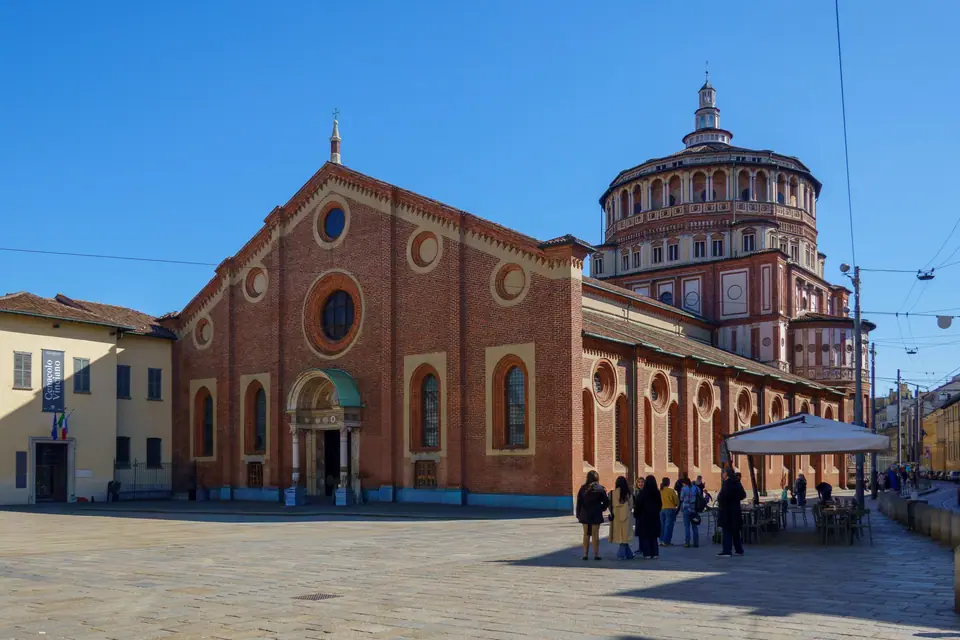
Santa Maria delle Grazie is part of the UNESCO listing, and its brick and terracotta exterior is a calm contrast to the marble of the centre. Bramante designed the domed tribune at the east end, and the small cloister beside it is a peaceful place to wait. Corso Magenta, the street outside, is lined with handsome palazzi and leads towards San Maurizio, whose frescoed interior makes an ideal second stop. The Basilica of Sant'Ambrogio is also a short walk south.
If tickets have gone
Do not let a sold-out date spoil the area. Visit the church itself, then continue to the Pinacoteca Ambrosiana, which displays pages from Leonardo's Codex Atlanticus and his Portrait of a Musician. The science museum nearby has galleries of models built from his engineering drawings. Neither replaces the mural, but together they show a wider Leonardo than the single famous wall.
Our view
The short visit is what makes the Last Supper powerful. There is no long route of rooms to wear you down, and the hush of the refectory focuses attention on one wall. We read a little about the composition beforehand, arrive calmly and spend the whole slot looking rather than photographing. Afterwards, the walk east along Corso Magenta to Castello Sforzesco turns the morning into one of the most rewarding half-days in Milan.
Traveller tips
Real advice from people who have been to Leonardo’s Last Supper. Every tip is read by our team before it goes live.
No tips yet. Been here? Yours could be the first.
Thank you! Your tip will appear here after a quick review.
More in Milano
Continue exploring Milano with related neighbourhood, food, and planning guides