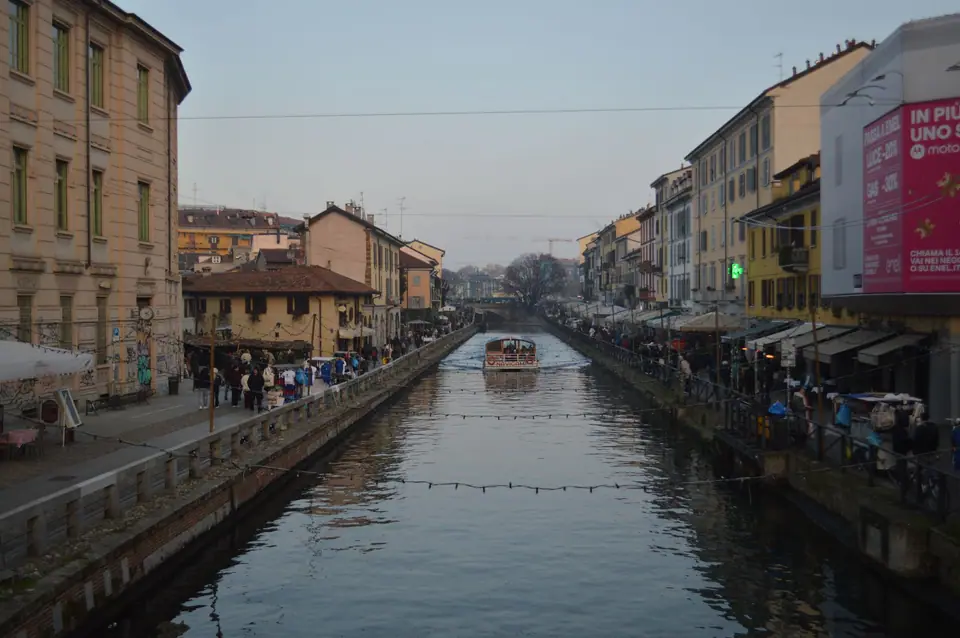
Navigli and Darsena
A relaxed route beside Milan’s historic canals.
The Navigli are what remains of the canal network that once tied Milan to the rivers and lakes of Lombardy. The Naviglio Grande, begun in the twelfth century, brought water from the Ticino; later canals linked the city with Lake Como and Pavia. Barges carried salt, timber, grain and the marble used to build the Duomo. Most of the city's canals were covered over in the twentieth century, but the Naviglio Grande and Naviglio Pavese still meet at the Darsena, the old harbour on the southwest edge of the centre.
Start at the Darsena
The former port basin was redesigned for Expo 2015 and now has broad stone edges, steps down to the water and a covered market building. It is the natural place to get your bearings. Metro M2 stops at Porta Genova, a short walk away, and several tram lines pass along the edge of the basin. From here, the Naviglio Grande heads southwest and the Naviglio Pavese heads south, each lined with bars and restaurants on both banks.
Along the Naviglio Grande
The Grande is the older and more picturesque of the two. Walk slowly and watch for the details: iron footbridges, old ringhiera houses with shared balconies, small workshops and courtyards opening off the towpath. Vicolo dei Lavandai, a narrow lane beside the canal, keeps its covered stone washing troughs, where women scrubbed laundry in the canal water until the mid twentieth century. Further along, the church of San Cristoforo, with its two joined buildings, marks the point where the city begins to thin out.
Morning and evening
The district has two personalities. In the morning it is quiet, ideal for photographs of reflections and façades, and the side streets of Porta Genova and Tortona reward a wander. From early evening the canals fill with people heading for aperitivo, and the waterside tables become crowded. We often choose a bar one street back from the canal, where the atmosphere is the same and the space is easier to find.
Markets and neighbours
Once a month the Naviglio Grande hosts a large antiques market, the Mercatone dell'Antiquariato, with hundreds of stalls stretching along both banks. The Fiera di Senigallia, a weekly flea market, sets up near the Darsena; our markets and vintage guide covers both. North of the basin, Corso di Porta Ticinese leads past the Basilica of Sant'Eustorgio and the Roman columns of San Lorenzo, where young Milanese gather in the evening.
Leonardo and the locks
The canals needed locks to manage changes in level, and Leonardo da Vinci, who spent nearly two decades in Milan, studied and improved their design while working for Ludovico Sforza. A restored lock gate, the Conca dell'Incoronata, survives on Via San Marco in Brera, a reminder that the waterways once reached deep into the city. Along the Naviglio Pavese you can still see the old lock chambers that allowed barges to travel on to Pavia and the river Ticino.
Practical notes
Pavements beside the water are narrow, and some stretches have no barrier, so keep children close. Pickpockets work the crowded evening stretches, as in any busy area of Milan. The last metro trains run late, but trams and night buses also serve the area; our public transport guide explains the options for getting back.
Our view
We enjoy the Navigli most as an evening that begins in daylight. Arrive in late afternoon, walk the length of the Naviglio Grande while the light is soft, then settle into a table for a drink and dinner as the canal lights come on. If you prefer a calm visit, come in the morning instead and pair it with lunch nearby. Either way, it shows a softer, more social Milan than the monumental centre.
Traveller tips
Real advice from people who have been to Navigli and Darsena. Every tip is read by our team before it goes live.
No tips yet. Been here? Yours could be the first.
Thank you! Your tip will appear here after a quick review.
More in Milano
Continue exploring Milano with related neighbourhood, food, and planning guides