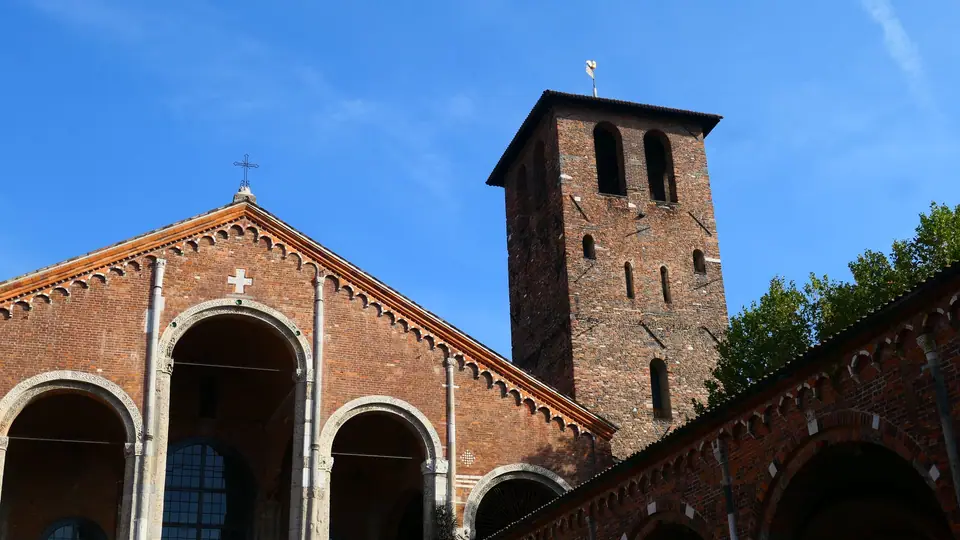
Basilica of Sant’Ambrogio
A thoughtful visit to one of Milan’s oldest churches.
The Basilica of Sant'Ambrogio is the church the Milanese hold closest. It was founded by Saint Ambrose, bishop of Milan and the city's patron, in the late fourth century, and it still contains his remains. The building visitors see today is mostly the Romanesque church of the eleventh and twelfth centuries, one of the most important of its kind in Italy and a model for many churches across Lombardy. It feels calm and ancient after the marble grandeur of the Duomo.
The atrium
Before entering the church, you pass through a large rectangular atrium surrounded by arcades of brick and stone. It was a place where those not yet baptised could gather, and today it works as a quiet threshold from the street. Look closely at the carved capitals of the columns, decorated with animals, monsters and interlaced patterns. The church façade at the far end is a broad, low gable with two tiers of arches, framed by two bell towers of different heights.
Two towers, two communities
The shorter tower on the right, the Campanile dei Monaci, dates from the ninth century and belonged to the Benedictine monks who served the church. The taller one on the left, the Campanile dei Canonici, was built in the twelfth century for the canons, a separate community of clergy. The two groups were famously rivals, and their towers stand as a reminder of that long dispute over the basilica.
Inside the basilica
The interior is dim, with heavy brick vaults and wide arches. Near the front, the pulpit rests on a late Roman sarcophagus traditionally linked to the general Stilicho. Beneath the canopy of the high altar stands the Golden Altar, a ninth-century masterpiece of goldsmith's work by Vuolvinio, covered with gold and silver panels showing the lives of Christ and Saint Ambrose. In the crypt, the remains of Ambrose lie between the martyrs Gervasius and Protasius. The chapel of San Vittore in Ciel d'Oro keeps fifth-century mosaics with one of the earliest portraits of Ambrose.
The square and its legends
In the piazza beside the church stands a Roman column known as the Colonna del Diavolo, marked by two holes. Legend says they were made by the devil's horns when he charged at Saint Ambrose and missed. Bramante's elegant portico, the Canonica, is on the north side of the church, and the cloisters he designed now form part of the Università Cattolica next door.
Planning a visit
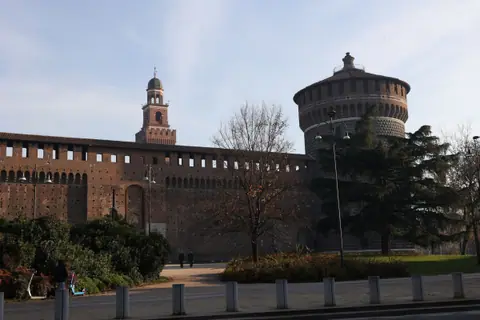
Sant'Ambrogio is an active parish church, so visits pause during Mass and weddings. Modest dress is expected, and visitors are asked to keep voices low. Metro M2 stops at Sant'Ambrogio station right beside the square. Around 7 December, the saint's feast day, the area fills with the Oh Bej Oh Bej fair, a traditional Christmas market that has spread from the church to the streets around the castle.
Ambrose and the city
Ambrose was a Roman governor who was acclaimed bishop by the people of Milan in 374, before he had even been baptised. He became one of the most influential figures of the early Church, standing up to emperors and baptising Augustine of Hippo, who later wrote about him with admiration. The Ambrosian rite, a distinct form of the liturgy, is still used in most churches of the diocese, and the Milanese call themselves Ambrosiani. His feast day remains a city holiday.
Our view
We find Sant'Ambrogio the most moving church in Milan, because it carries the city's early history so plainly. It sits in a cluster of rewarding sights: the science museum is round the corner, San Maurizio and the Last Supper are a short walk north, and the shops of Corso Magenta make an easy link between them.
Traveller tips
Real advice from people who have been to Basilica of Sant’Ambrogio. Every tip is read by our team before it goes live.
No tips yet. Been here? Yours could be the first.
Thank you! Your tip will appear here after a quick review.
More in Milano
Continue exploring Milano with related neighbourhood, food, and planning guides