Parco Sempione
A green route between the castle and Milan’s western centre.
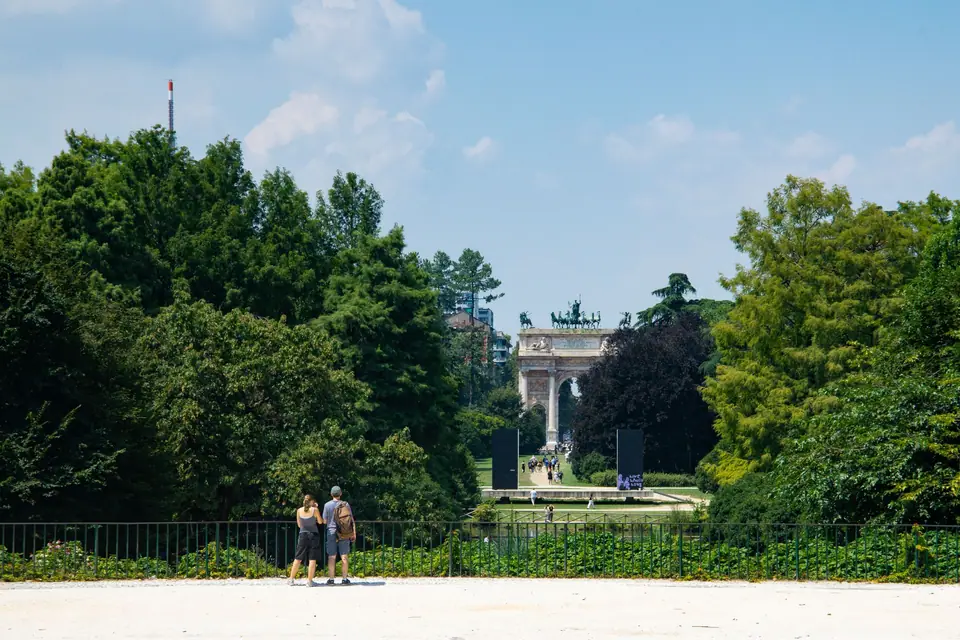
Parco Sempione is central Milan's largest park, a green space of nearly forty hectares stretching from the back of Castello Sforzesco to the Arco della Pace. It was laid out in the 1890s by the architect Emilio Alemagna on the former parade ground of the castle, in the informal English style, with winding paths, a small lake, open lawns and groups of mature trees. On fine days it fills with joggers, families, students and office workers on their lunch break, and it shows the relaxed side of a city better known for its pace.
From the castle gate
We enter the park through the rear gate of Castello Sforzesco, which frames the long central view towards the arch. Immediately to the left, the small lake with its curved bridge is the most photographed corner of the park. The paths here are shaded by plane trees, chestnuts and cedars, and benches face the water.
The Arco della Pace
At the far end stands the Arco della Pace, a triumphal arch begun in 1807 to celebrate Napoleon's victories. After his fall, the Austrian rulers of Milan finished it in 1838 and dedicated it to the peace agreed at the Congress of Vienna. The bronze chariot of Peace on top was famously turned to face the city rather than France. The arch marks the start of Corso Sempione, the road Napoleon built towards the Simplon Pass, and the surrounding streets are full of bars that come alive at aperitivo time.
Torre Branca and the Arena
Beside the park's western side rises the Torre Branca, a slender steel tower designed by Gio Ponti in 1933. A lift climbs to a viewing platform with wide views over the city and, on clear days, to the Alps. To the north, the Arena Civica, opened in 1807, is a Napoleonic stadium still used for athletics and events. The Acquario Civico, in a handsome Liberty-style building of 1906, sits on the eastern edge of the park.
Art among the trees
The park contains several works of art. The most loved is Giorgio de Chirico's Bagni Misteriosi, a fountain of 1973 with a swan and a diving board set in a pool shaped like a floor of wavy tiles. It stands beside the Palazzo dell'Arte, home of the Triennale design museum, whose garden and café open onto the park. Other sculptures appear along the paths, and the small Biblioteca del Parco is a reading room among the trees.
Families and sport
The park has playgrounds near the lake and on the northern side, and plenty of open lawn for ball games. Runners follow the long loop around the edge, and cyclists use the shared paths that connect with the city's bike network. In summer, open-air cinema and concerts sometimes take place in the park and at the Triennale, adding an evening life to the green space.
Our view
We use Parco Sempione as the hinge of a western Milan day: the castle in the morning, a picnic or a slow lunch on the grass, the Triennale in the afternoon and an aperitivo near the arch as the light fades. Metro M1 and M2 at Cadorna, Cairoli and Lanza serve the edges, and the walk from the Duomo takes little time along Via Dante. For other green spaces in the city, see our Milan parks and gardens guide.
In spring the lawns turn bright and blossom appears around the lake; in autumn the chestnuts and maples colour the paths, and the park feels quieter. Summer brings strong sun, so we choose the shaded walks near the castle in the middle of the day. The park closes at night, and the lighting is limited, so we enjoy it in daylight and continue the evening in the streets around the arch.
Traveller tips
Real advice from people who have been to Parco Sempione. Every tip is read by our team before it goes live.
No tips yet. Been here? Yours could be the first.
Thank you! Your tip will appear here after a quick review.
More in Milano
Continue exploring Milano with related neighbourhood, food, and planning guides