Museo del Novecento
A considered visit to Milan’s modern art museum beside the Duomo.
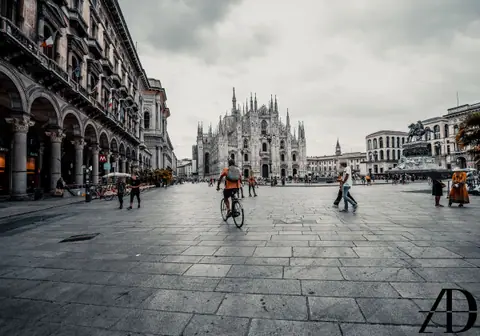
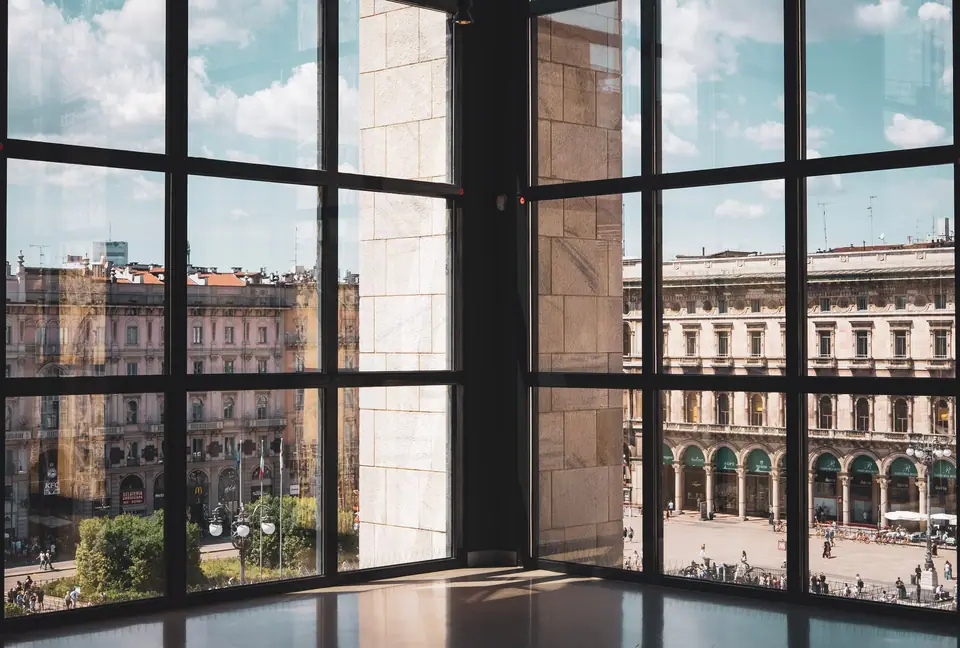
The Museo del Novecento tells the story of Italian art in the twentieth century, and it does so from one of the most striking positions in Milan. The museum occupies the Palazzo dell'Arengario, a pair of buildings designed in the 1930s on the edge of Piazza del Duomo, and a modern extension that opened in 2010. Its upper galleries look straight across at the cathedral spires, so the city's Gothic past and its modern art meet through the windows.
The spiral and the Fourth Estate
The visit begins with a spiral ramp that climbs inside a glass tower. At its top hangs Giuseppe Pellizza da Volpedo's The Fourth Estate, finished in 1901, a huge canvas of workers advancing towards the viewer in sunlight. It was painted at the turn of the century and has become a symbol of Italian labour movements, and its placement at the start of the route frames everything that follows as a century of change.
Futurism
Milan was the birthplace of Futurism, the movement launched by Filippo Tommaso Marinetti's manifesto of 1909, which celebrated speed, machines and the modern city. The museum has one of the most important Futurist collections anywhere, with paintings and sculpture by Umberto Boccioni, Giacomo Balla, Carlo Carrà and Gino Severini. Boccioni's bronze Unique Forms of Continuity in Space, the striding figure that appears on the Italian twenty-cent coin, is one of the highlights, alongside his paintings of Milan's growing suburbs.
Metaphysics and the interwar years
The following rooms move through Giorgio de Chirico's metaphysical squares, Giorgio Morandi's quiet still lifes of bottles and jars, and the artists of the Novecento group who looked back to classical forms in the 1920s. Mario Sironi's dark urban landscapes show the industrial outskirts of Milan with a mood very different from the optimism of the Futurists. The sequence is clear, and the labels place each movement in the city's history.
Fontana's neon and the Duomo view
Lucio Fontana, who lived and worked in Milan, has a room of his own at the top of the building. His Struttura al neon, a looping line of white neon made for the Triennale in 1951, hangs from the ceiling in front of a vast window onto the piazza. Beneath it, his slashed and punctured canvases show his search for a new kind of space in painting. We think this room, with the neon glowing against the marble spires outside, is one of the most memorable views in Milan.
Arte Povera and later works
The later galleries include Piero Manzoni, whose provocative works of the late 1950s and early 1960s questioned what art could be, and artists of Arte Povera such as Michelangelo Pistoletto and Jannis Kounellis, who used everyday and natural materials. A walkway connects the Arengario with the upper floor of Palazzo Reale next door, extending the route.
The building itself
The Arengario was designed in the 1930s by a team of architects including Piero Portaluppi and Giovanni Muzio, as part of a plan to reshape Piazza del Duomo. Its stern arcades and relief panels carry the style of the period, and after the war the building housed offices and the tourist information centre. The conversion into a museum, led by Italo Rota, added the glass spiral and opened the upper floors to the light, turning a heavy civic building into one of the most open spaces on the square.
Our view
The Novecento is compact, central and rarely overwhelming, which makes it an easy addition to a day at the Duomo. We like to see it after the cathedral roof, when the view from Fontana's room makes the connection between the two. Art lovers can pair it with the older collections of the Pinacoteca di Brera or the Ambrosiana for a sweep across six centuries of Italian painting, and design lovers can continue to the Triennale. Allow time to rest at the windows, since the museum's best moments come when you look out as well as in.
Traveller tips
Real advice from people who have been to Museo del Novecento. Every tip is read by our team before it goes live.
No tips yet. Been here? Yours could be the first.
Thank you! Your tip will appear here after a quick review.
More in Milano
Continue exploring Milano with related neighbourhood, food, and planning guides