Teatro alla Scala
A practical introduction to Milan’s opera theatre and museum.
Teatro alla Scala is one of the most famous opera houses in the world, and for the Milanese it is as much a civic symbol as the cathedral. It opened in 1778 with Salieri's L'Europa riconosciuta, built by the architect Giuseppe Piermarini on the site of a church called Santa Maria alla Scala, which gave the theatre its name. Verdi's Nabucco and Otello, Puccini's Madama Butterfly and Turandot all had their first nights here, and the season still opens each year on 7 December, the feast of Saint Ambrose, Milan's patron saint.
The square and the façade
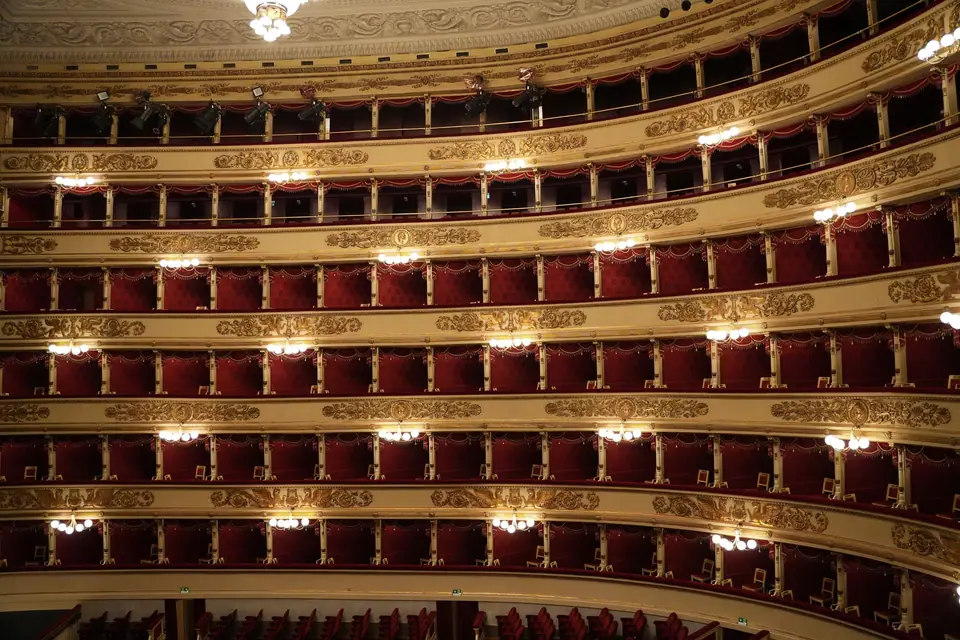
Piazza della Scala sits at the northern end of the Galleria. In the centre stands a marble monument to Leonardo da Vinci, surrounded by four of his pupils, and opposite the theatre is Palazzo Marino, Milan's city hall. La Scala's neoclassical front is surprisingly plain, with a portico for carriages to stop beneath. Piermarini kept the drama for the interior, and we enjoy that contrast between restraint outside and gold and red velvet inside.
The museum
The Museo Teatrale, entered from the left side of the building, tells the theatre's story through portraits of composers and singers, costumes, set designs, early instruments and theatrical memorabilia. There are rooms dedicated to Verdi, who is closely linked with La Scala, and to Maria Callas, whose performances here in the 1950s became legendary. For anyone new to opera, the museum makes later performances easier to follow, since it introduces the composers and the theatre's working traditions.
A glimpse of the auditorium
From some of the museum's boxes, visitors can look out over the horseshoe-shaped auditorium with its six levels of boxes and galleries. Whether the view is open depends on rehearsals and stage work, so we treat it as a bonus rather than a promise. The theatre was badly damaged by bombing in 1943 and rebuilt to reopen in 1946 with a concert conducted by Arturo Toscanini; a major restoration in the early 2000s renewed the stage machinery behind the historic hall.
Seeing a performance
The season includes opera, ballet and symphonic concerts, and the official calendar is published well in advance. Seats range from the stalls and boxes to the upper galleries, the loggione, where devoted regulars listen intently and are famous for showing their opinion. Popular productions sell out quickly, though returns appear. Smart dress is expected in the stalls and boxes. Reading the synopsis before the performance helps, since surtitles are provided but the stage deserves your full attention.
The Prima della Scala
The opening night on 7 December, known as the Prima, is the social event of the Milanese year. Politicians, designers and celebrities arrive in evening dress, the performance is broadcast live on Italian television and shown on screens around the city, and protesters sometimes gather outside the theatre. Tickets for the Prima itself are scarce and go almost at once, but later performances of the same production in December and January are far easier to reach and offer the same staging.
Our view
Even without a ticket for the evening, La Scala rewards an hour. The museum explains why the house matters, and a glimpse into the auditorium brings that history to life. We pair it with the Galleria and the Duomo on a central day, then walk north into Brera for a quieter lunch.
For families with older children, the costumes and stage objects make the subject concrete, and the square in front is a lively meeting point at any time of day. If an evening performance is part of your trip, we suggest an early dinner nearby, using our Milanese food guide, so there is no need to hurry across the city before the curtain rises.
Traveller tips
Real advice from people who have been to Teatro alla Scala. Every tip is read by our team before it goes live.
No tips yet. Been here? Yours could be the first.
Thank you! Your tip will appear here after a quick review.
More in Milano
Continue exploring Milano with related neighbourhood, food, and planning guides