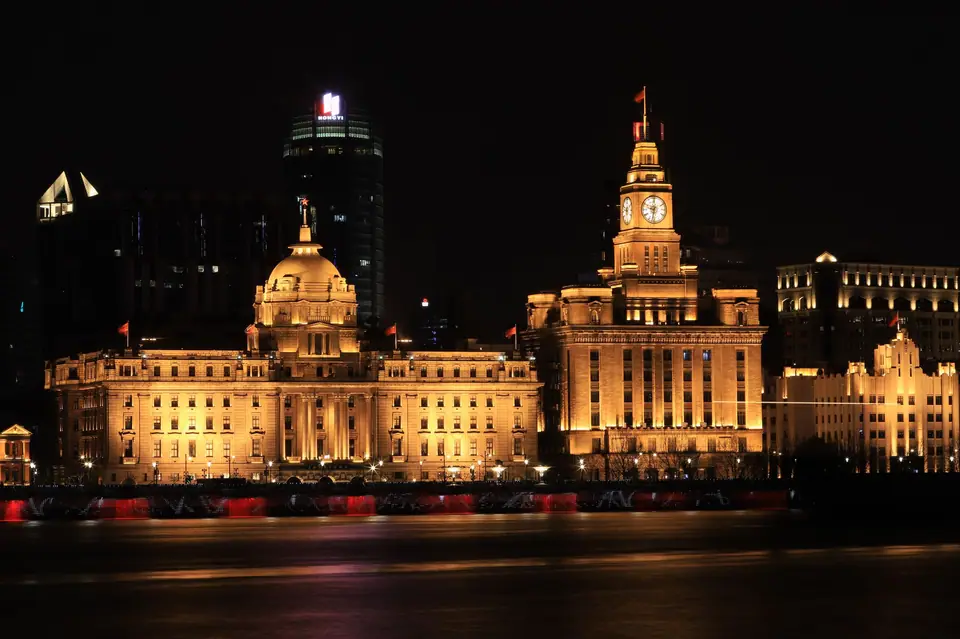
The Bund Guide
The Bund is a waterfront strip along the Huangpu River featuring historic architecture and views of the modern Pudong skyline.
Every first trip to Shanghai seems to start here. The Bund, or Waitan, is a waterfront strip of about 1.5 kilometres along the western bank of the Huangpu River, lined with grand banks, trading houses and clubs built mostly between the 1900s and the 1930s. Across the water is the glass skyline of Pudong, which was open fields not much more than thirty years ago. Few places show so clearly how old Shanghai and new Shanghai were stacked against each other, and the walk is free.
Architecture and historical buildings
The buildings are a catalogue of styles, including neoclassical columns, Gothic touches, Art Deco towers and a few that mix Chinese and European ideas. The old HSBC building, finished in 1923, is the one to study, with a domed hall whose ceiling mosaic deserves a look if the lobby is open. The Customs House next door carries a clock tower that chimes a famous melody on the hour. The Peace Hotel, with its green pyramid roof, opened as the Cathay Hotel in 1929, and the Bank of China building tops a modern tower with a Chinese-style roof. Read the Art Deco guide if you want to know who designed what.
Riverside promenade levels
There are really two walks. The street side, along Zhongshan East 1st Road, is where you see the facades and the details. The raised riverside promenade, rebuilt in the years before the 2010 Expo, is where you look across the water at the towers, and it has the clear views for photographs. Walk one way on each level and you will see both. A small park at the southern end has a memorial and a fine angle on the bend of the river. Benches are scarce on the busiest stretch, so plan short stops rather than a long sit, and keep a hand on your phone in the thickest crowds.
Morning and evening visits
Go twice if you can. Early morning is calm, with locals practising tai chi, flying kites and exercising, and the light on the old facades is soft. After dark is the famous version, when both banks light up and the Pudong towers glow. Evenings, weekends and public holidays can be packed, and at peak times the promenade may use queues and one-way flow. On hazy days the skyline fades quickly, so choose a clear evening when you can.
Nearby attractions and connections
The Bund sits at the end of Nanjing Road, so a walk from the shops to the river makes a natural loop. To the south, a short ride or walk reaches Yu Garden and the old city. To the north, the Suzhou Creek mouth and Waibaidu Bridge make a quiet end to the stroll. A river cruise shows the same buildings from the water, and Lujiazui is a short ride or ferry away on the other side.
Transport and access
The nearest metro stop is East Nanjing Road, on lines 2 and 10, and from there it is a short walk down to the river. Taxis can be hard to find near the promenade at night, so plan the ride home before you go, or walk back to a metro station.
Avoid these tourist traps
You do not need a paid tour of the Bund, and many visitors skip the tourist tunnel that runs under the river with its light show, because it is pricey for a short ride. Ignore anyone who offers to take you for tea or to an art show, because that is the most common scam on this stretch.
Editor opinion
This is the single best free thing to do in Shanghai. Make it a morning and an evening, and you will understand the city before you have finished your first coffee. If you only have one slot, choose the hour after sunset, when the old banks and the new towers are lit side by side.
Traveller tips
Real advice from people who have been to The Bund. Every tip is read by our team before it goes live.
No tips yet. Been here? Yours could be the first.
Thank you! Your tip will appear here after a quick review.
More in Shanghai
Continue exploring Shanghai with related neighbourhood, food, and planning guides