


























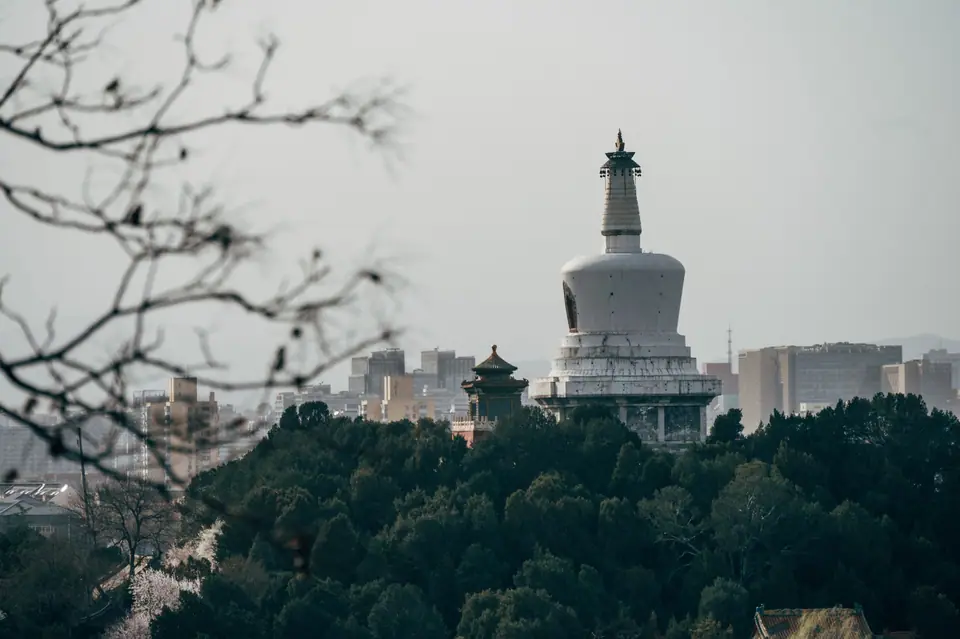
Beihai Park: The White Dagoba, Nine-Dragon Screen and Royal Lake
Walking the royal lake gardens of Beihai Park, from the Round City and White Dagoba to the glazed Nine-Dragon Screen.
Lying immediately northwest of the Forbidden City and west of Jingshan Park, Beihai Park (North Sea Park) is the oldest and best-preserved imperial garden in China, with more than eight hundred years of continuous landscaping stretching back to the Liao, Jin and Yuan courts. When Kublai Khan laid out his Yuan capital of Dadu in the thirteenth century, he centred his royal palaces right around Jade Flower Island and the waters of Beihai, long before the Ming dynasty shifted the main palace walls slightly east. Covering nearly seventy hectares, more than half of which is open water, Beihai feels far airier and more relaxed than the formal courtyards next door.
The Round City (Tuancheng) and Jade Flower Island
If you arrive at the South Gate (near the northwest turret of the Forbidden City) or walk across from Jingshan's West Gate to Beihai's East Gate, begin at the Round City (Tuancheng), a circular brick fortress terrace that was once an island of its own. Inside Chengguang Hall sits a serene 1.5-metre white jade Buddha inset with rubies and gems brought from Burma in the late Qing era, while outside in the courtyard stands a massive carved black-jade wine basin (the Dushan Great Jade Sea) commissioned by Kublai Khan in 1265.
From the Round City, cross the arched white stone Yong'an Bridge onto Jade Flower Island (Qionghuadao). Crowning the summit is Beihai's unmistakable landmark: the 35.9-metre White Dagoba (Baita), a bell-shaped Tibetan Buddhist stupa built in 1651 by the Qing Shunzhi Emperor to commemorate the visit of the Fifth Dalai Lama. Climb the steep stone paths through covered galleries and hillside rockeries to the stupa terrace for sweeping views across the lotus beds and over the crimson walls of the Zhongnanhai lake compound to the south.
Ferry across to the North Shore and Nine-Dragon Screen
From the northern dock of Jade Flower Island (near the historic Fangshan Restaurant), walk along the western embankment or hop on a short passenger ferry across the lake to the North Shore (served directly by Beihai North Station on Subway Line 6). Here you will find three tranquil highlights that many visitors miss: the Five-Dragon Pavilions (Wulongting) jutting out over the water on linked stone piers; the classical garden within a garden known as Jingxinzhai (Quiet Heart Studio) with its miniature rockery bridges; and the 1756 Nine-Dragon Screen (Jiulongbi), a twenty-seven-metre freestanding spirit wall faced on BOTH sides with 424 seven-colour glazed ceramic tiles depicting nine coiling dragons playing with flaming pearls. From Beihai North Gate, you can walk directly across Di'anmen West Avenue into Qianhai and Shichahai.
Traveller tips
Real advice from people who have been to Beihai Park: The White Dagoba, Nine-Dragon Screen and Royal Lake. Every tip is read by our team before it goes live.
No tips yet. Been here? Yours could be the first.
Thank you! Your tip will appear here after a quick review.
More in Beijing
Continue exploring Beijing with related neighbourhood, food, and planning guides
Nanluoguxiang and the Central Hutongs: Side Lanes and Courtyards
Beijing, China
Wudaoying Hutong: Independent Cafes, Studios and Quiet Courtyards
Beijing, China
Dashilar and Yangmeizhu Byway: Guild Facades and Bookshops
Beijing, China
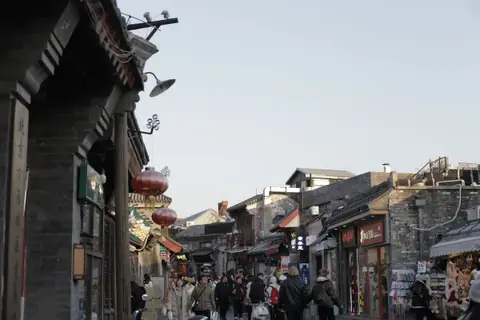
Qianmen Street and Zhengyangmen: Arrow Tower and Time-Honoured Shops
Beijing, China
