


























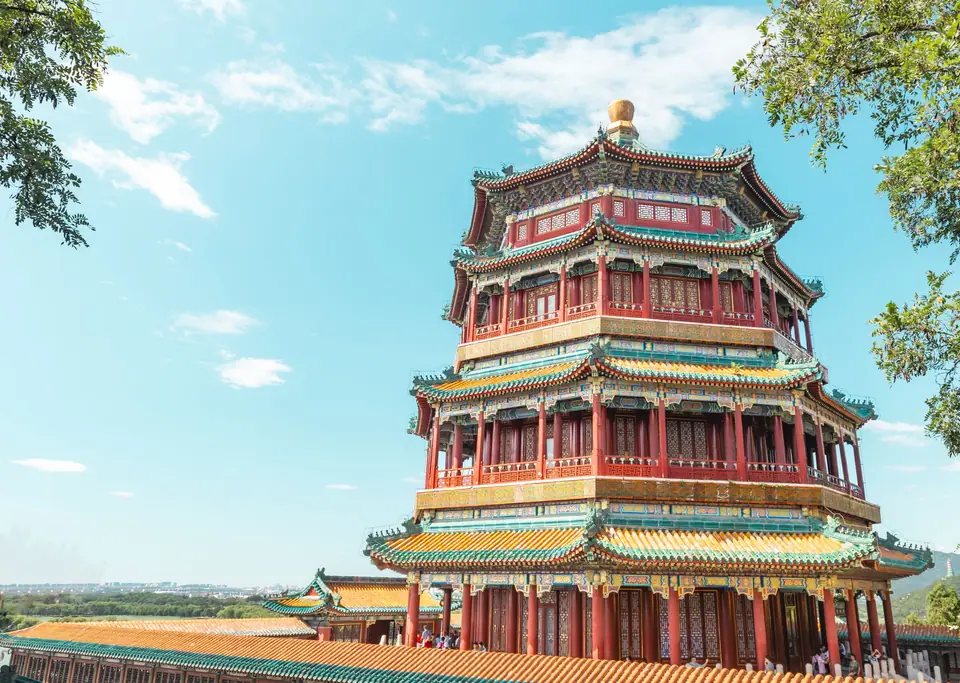
Lama Temple (Yonghegong): Tibetan Halls and Sandalwood Buddha
Exploring the five incense-filled courtyards and the eighteen-metre sandalwood Maitreya Buddha at Beijing's Yonghegong Lama Temple.
Right inside the northeast corner of the Second Ring Road at the junction of Subway Lines 2 and 5 (Yonghegong Station), the Lama Temple (Yonghegong, the Palace of Peace and Harmony) is the most active working Tibetan Buddhist monastery in Beijing. Unlike pure museum precincts, Yonghegong hums with daily devotion: locals bow three times with handfuls of eco-friendly incense sticks offered free at the courtyard entrance, prayer wheels spin beneath red lacquer colonnades, and yellow-glazed imperial roof tiles gleam through fragrant cedar smoke.
From royal residence to Gelugpa monastery
The complex owes its imperial scale to a unique double history. Built in 1694 by the Kangxi Emperor as the princely mansion for his fourth son, Prince Yinzhen, the estate was elevated to imperial status when Yinzhen ascended the throne as the Yongzheng Emperor in 1722 (and it was also the birthplace of the Qianlong Emperor). Under court custom, a former residence of a living emperor could no longer be used by ordinary nobles, so half the grounds were converted into an imperial lodge with yellow tiles, and in 1744 the Qianlong Emperor formally transformed the entire palace into a lamasery for Gelugpa (Yellow Hat) monks from Tibet and Mongolia, making it the spiritual liaison hub between Beijing and the Himalayan borderlands.
Walking the five main halls
Enter from the south through three painted wooden archways (pailou) and follow the central courtyard axis north, where the architecture gradually blends Han palace symmetry with Tibetan stupas and gilded roof emblems:
- Hall of the Heavenly Kings (Tianwangdian): greeted by a jovial Maitreya Buddha and flanked by the Four Heavenly Kings holding a lute, sword, umbrella and pagoda.
- Hall of Harmony and Peace (Yonghedian): houses three bronze Buddhas of the Past, Present and Future (Dipankara, Gautama and Maitreya) flanked by eighteen dynamic cloth-lacquer Arhats.
- Hall of Everlasting Protection (Yongyoudian) and Hall of the Wheel of the Law (Falundian): the former living and Audience halls of Prince Yong; Falundian serves as the monastic assembly hall where monks chant scriptures beneath a bronze statue of Je Tsongkhapa, founder of the Gelug school, and the exquisite five-hundred-Arhat mountain carved from red sandalwood.
- Pavilion of Ten Thousand Happinesses (Wanfuge): the soaring triple-eaved northern climax of the monastery, linked to its side pavilions by elevated flying bridges. Inside stands the eighteen-metre Maitreya Buddha (with an additional eight metres buried underground for structural stability), carved from a single massive trunk of white sandalwood gifted by the Seventh Dalai Lama and transported from southern Yunnan over three years.
After exiting Yonghegong, cross the street directly into Guozijian Street and the Temple of Confucius or pause for coffee along Wudaoying Hutong.
Traveller tips
Real advice from people who have been to Lama Temple (Yonghegong): Tibetan Halls and Sandalwood Buddha. Every tip is read by our team before it goes live.
No tips yet. Been here? Yours could be the first.
Thank you! Your tip will appear here after a quick review.
More in Beijing
Continue exploring Beijing with related neighbourhood, food, and planning guides
Guomao and the Beijing CBD: China Zun and the CCTV Loop
Beijing, China
Panjiayuan Antique Market: Weekend Collectibles and Browsing Tips
Beijing, China
Hongqiao Pearl Market: Freshwater Pearls, Silk and Bargaining
Beijing, China
Fragrant Hills (Xiangshan Park): Autumn Red Leaves and Cableway
Beijing, China
