China National Botanical Garden: Conservatories and Sleeping Buddha
Exploring the North and South Gardens, the Tang-founded Sleeping Buddha Temple and glasshouse conservatories in the Western Hills.
Set at the foot of the Western Hills between Summer Palace and Fragrant Hills, and reached directly at National Botanical Garden Station on the scenic Xijiao Tram Line, the China National Botanical Garden (Guojia Zhiwuyuan) is one of the greenest, most relaxing half-day escapes in Beijing. Officially elevated to China's flagship national botanical garden in 2022, the institution spans both sides of Xiangshan Road: the larger North Garden climbing gently into the mountain valleys, and the research-focused South Garden managed by the Chinese Academy of Sciences across the avenue.
Wofosi (Temple of the Sleeping Buddha) and the Metasequoia Boardwalk
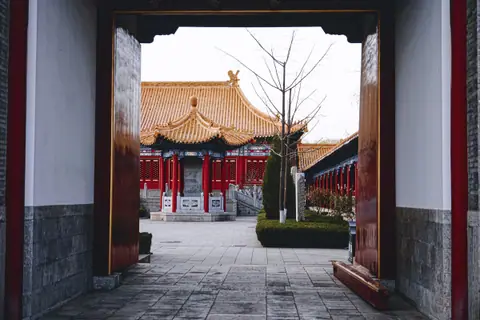
Entering the North Garden leads you up a gentle central axis framed by mountain peaks toward the ancient Temple of the Sleeping Buddha (Wofosi, formally Shifang Pujue Temple). Founded during the Tang dynasty in the seventh century, the monastery takes its name from a monumental 1321 Yuan-dynasty casting inside the rear hall: a 5.3-metre hollow copper statue of Sakyamuni entering parinirvana, reclining peacefully on his right side with his head resting on his palm and surrounded by twelve grieving terracotta disciples. Notice the stacks of handmade cloth shoes left by grateful visitors outside the hall; because the Beijing pronunciation of Wofosi sounds like the English word offers, university students across the capital visit the temple each spring to pray for postgraduate and overseas admission offers.
Behind and west of the temple, follow the wooden boardwalk into Cherry Valley (Yingtaogou), a deep shaded ravine where a natural spring stream flows beneath towering dawn redwood (metasequoia) trees, a "living fossil" conifer once thought extinct since the dinosaur era until botanists rediscovered wild trees in Hubei in the 1940s. Fine mist sprayers run along the boardwalk in warm months, turning the redwood gorge into an emerald cloud forest that leads up to the boulders of the Source of the Water (Shuiyuan, Shuiyuantou).
The Exhibition Conservatory and seasonal flower collections
Before crossing the street to the quieter lotus ponds and medicinal herb gardens of the South Garden, visit the huge glass Exhibition Conservatory (Zhanlan Wenshi) in the North Garden, divided into tropical rainforest, desert succulent, orchid and carnivorous plant biomes. In late March and April, the outdoor hillside collections burst into bloom with more than four hundred varieties of peach blossoms, lilacs and tree peonies, while autumn brings golden ginkgo groves and far lighter crowds than neighbouring Xiangshan.
Traveller tips
Real advice from people who have been to China National Botanical Garden: Conservatories and Sleeping Buddha. Every tip is read by our team before it goes live.
No tips yet. Been here? Yours could be the first.
Thank you! Your tip will appear here after a quick review.
More in Beijing
Continue exploring Beijing with related neighbourhood, food, and planning guides