


























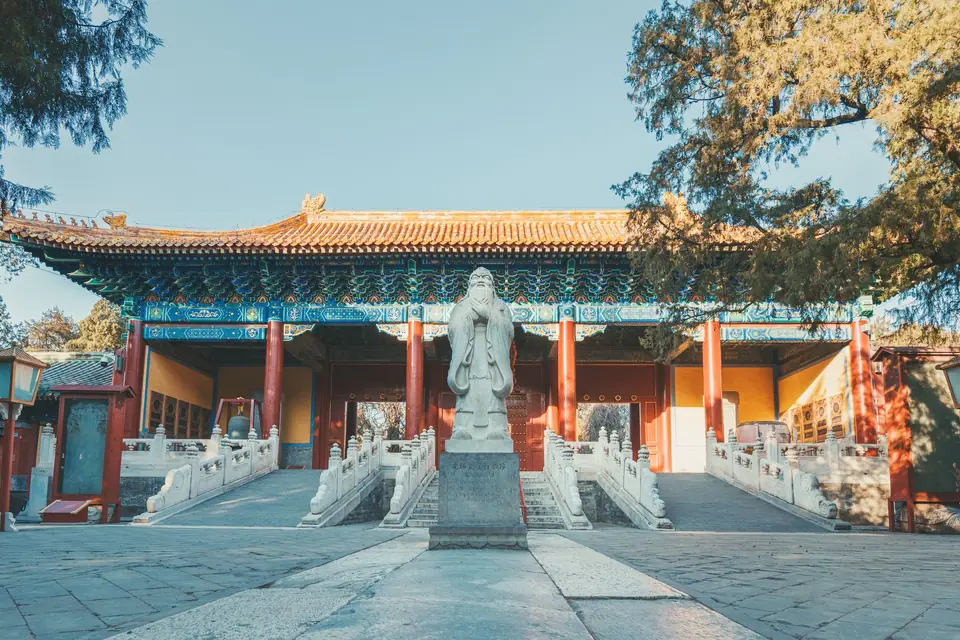
Temple of Confucius and Guozijian: Imperial Academy Courtyards
Exploring the quiet cypress courtyards, imperial examination rosters and the Biyong water pavilion opposite the Lama Temple.
Step across the avenue from the incense crowds of the Lama Temple (Yonghegong) onto tree-shaded Guozijian Street and the pace of Beijing drops immediately. Marked by four painted wooden commemorative archways (pailou) spanning the road, this historic Dongcheng lane holds the dual complex of the Temple of Confucius (Kongmiao) and the Imperial Academy (Guozijian). Founded in 1302 under the Yuan dynasty and expanded across the Ming and Qing eras, the twin compounds follow the classical rule of Temple on the Left, Academy on the Right, serving for six centuries as the highest institution of learning and state Confucian ritual in the empire.
The Temple of Confucius and Jinshi Stone Steles
Entering through the Xianshi Gate on the eastern side brings you into a serene courtyard shaded by seven-hundred-year-old cypress trees, including the gnarled Touch-Evil Cypress, named after a Ming legend that its branches brushed the hat of a corrupt court grandee. Aligned on either side of the path stand 198 massive stone steles (Jinshi Timing Beilin) inscribed with the names, birthplaces and ranks of all 51,624 scholars who passed the final triennial palace examination (dianshi) across the Yuan, Ming and Qing dynasties.
At the heart of the temple rises the double-eaved Dacheng Hall (Hall of Great Accomplishment), where emperors performed sacrificial rites to Confucius before wooden spirit tablets of the Sage and his four principal disciples, accompanied by bronze bell sets and stone chimes. Along the rear corridors, a forest of 189 Qianlong Stone Steles preserves the complete text of the Thirteen Confucian Classics, more than 630,000 characters chiselled by a single impoverished scholar, Jiang Heng, over twelve years so students could take ink rubbings without errors.
Guozijian and the circular Biyong Hall
Passing through a side doorway connects you directly into the Imperial Academy (Guozijian), where scholars from across China and neighbouring kingdoms studied the classics. Its centrepiece is one of the finest architectural gems in Beijing: the Biyong Pavilion, constructed in 1784 under the Qianlong Emperor. Built as a square yellow-tiled hall sitting on a circular island surrounded by a marble-ringed moat crossed by four bridges, Biyong was designed exclusively for the emperor to deliver state lectures on Confucian texts. Immediately in front of the moat stands the dazzling Glazed Archway (Liuli Paifang), the only decorative archway in Beijing faced in yellow and green glazed ceramic bricks dedicated to education rather than a temple deity. Finish your visit with a quiet walk one lane north into Wudaoying Hutong.
Traveller tips
Real advice from people who have been to Temple of Confucius and Guozijian: Imperial Academy Courtyards. Every tip is read by our team before it goes live.
No tips yet. Been here? Yours could be the first.
Thank you! Your tip will appear here after a quick review.
More in Beijing
Continue exploring Beijing with related neighbourhood, food, and planning guides

High-Speed Bullet Trains from Beijing: Stations and 12306 Tickets
Beijing, China
Universal Beijing Resort: Kung Fu Panda, Transformers and Metro Access
Beijing, China
Chengde Mountain Resort Day Trip: Qing Lakes and Eight Outer Temples
Beijing, China
Tianjin Day Trip from Beijing: Five Great Avenues and Hai River
Beijing, China
