Jingshan Park: Climbing Coal Hill for the Palace Panorama
Climbing the five summit pavilions of Jingshan Hill for the classic view over the Forbidden City and the Drum and Bell Towers.
Directly across the street from the northern exit gate of the Forbidden City rises Jingshan Park, a forty-five-metre artificial hill piled up during the Ming Yongle reign from the earth excavated to dig the palace moat and nearby canals. In traditional Chinese geomancy (fengshui), an imperial palace requires a protective mountain to the north to shield the court from winter winds and negative spiritual influences, and Jingshan (literally Prospect Hill, also nicknamed Coal Hill) served as that royal screen.
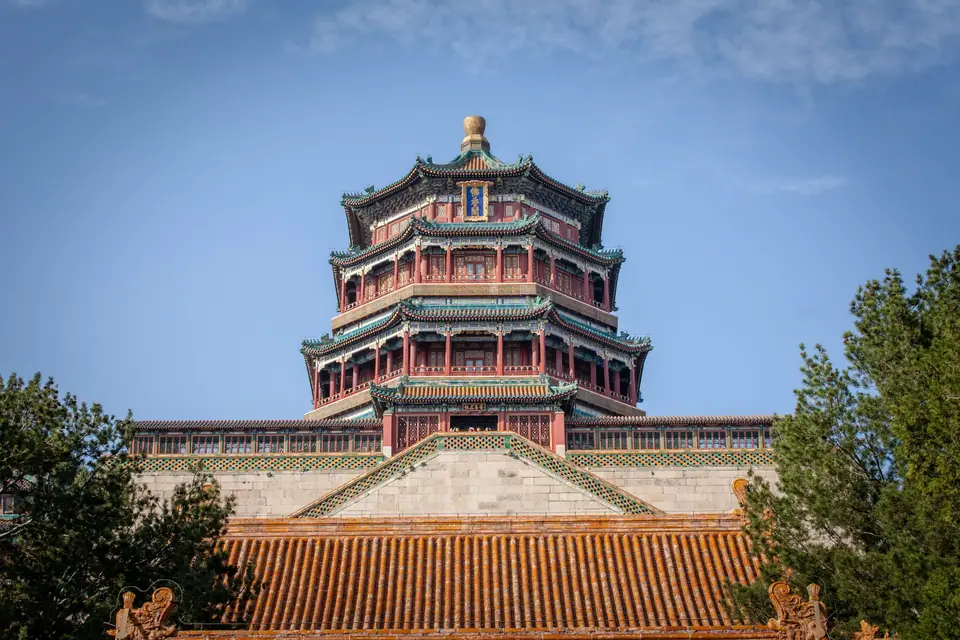
Today, a ten-minute climb up stone steps through groves of centuries-old juniper and cypress trees brings you to the triple-eaved Wanchun Pavilion (Pavilion of Everlasting Spring) on the central peak. Because building height inside the Second Ring Road was historically capped below the palace roofs, the terrace around Wanchun Pavilion offers the single clearest elevated panorama in central Beijing:
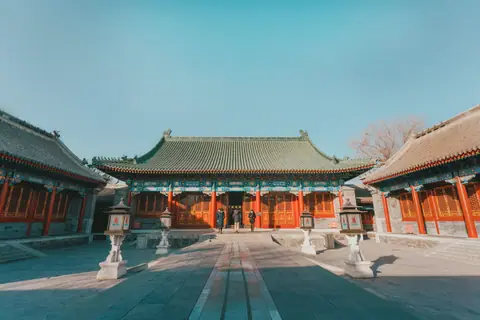
- Looking south: the entire symmetrical hierarchy of the Forbidden City unfolds directly below you, with yellow glazed-tile roofs glowing above vermilion courtyard walls and the distant halls of Tiananmen beyond.
- Looking north: the dead-straight line of the Beijing Central Axis runs through Di'anmen directly to the dark red timber silhouette of the Drum and Bell Towers.
- Looking west: the white Tibetan stupa of the White Dagoba rises on Jade Flower Island across the water of Beihai Park.
- Looking east: across the grey-tile roofs of Dongcheng's hutongs stands the modern glass profile of China Zun and the Guomao CBD.
Four smaller pavilions flank Wanchun Pavilion along the ridge, each built under the Qing Qianlong Emperor to house a bronze Buddha statue. Down on the flat eastern path at the foot of the hill, a stone tablet marks the spot where the last Ming ruler, the Chongzhen Emperor, ended his life in the spring of 1644 as rebel forces breached the city walls. In April and May, Jingshan also hosts one of the capital's finest peony displays, with hundreds of tree peonies blooming in waist-high beds near the front gates. Exit through the park's West Gate to walk straight to the East Gate of Beihai Park or catch Trolleybus 103 or Subway Line 8 at Jingshan Back Street.
Traveller tips
Real advice from people who have been to Jingshan Park: Climbing Coal Hill for the Palace Panorama. Every tip is read by our team before it goes live.
No tips yet. Been here? Yours could be the first.
Thank you! Your tip will appear here after a quick review.
More in Beijing
Continue exploring Beijing with related neighbourhood, food, and planning guides